How B2B Buyers Use AI to Make Purchase Decisions: Mind-blowing Statistics You Need to Know
Every key 2026 statistic on how B2B buyers use AI: adoption, ChatGPT use, vendor research, shortlists, trust, AI agents, and buying groups.
How B2B buyers use AI now decides who gets the deal before your sales team even knows there is one.
Picture your next buyer. They open ChatGPT, describe their problem, and get a shortlist in minutes. Then they compare three vendors and check the reviews.
Then they fill out a demo form. Maybe yours. Maybe not.
I work on SEO, AEO, and GEO for B2B brands, and I see this shift in every account. So I pulled every credible 2026 study on AI in B2B buying.
Six research teams, nearly 26,000 buyers, one clear story. (Spoiler: your website is no longer the first impression.)
Key statistics on how B2B buyers use AI
- 94% of business buyers use AI during their buying process, per Forrester’s State of Business Buying 2026.
- More than 80% of B2B software buyers sourced software recommendations from an AI chatbot in the past two years.
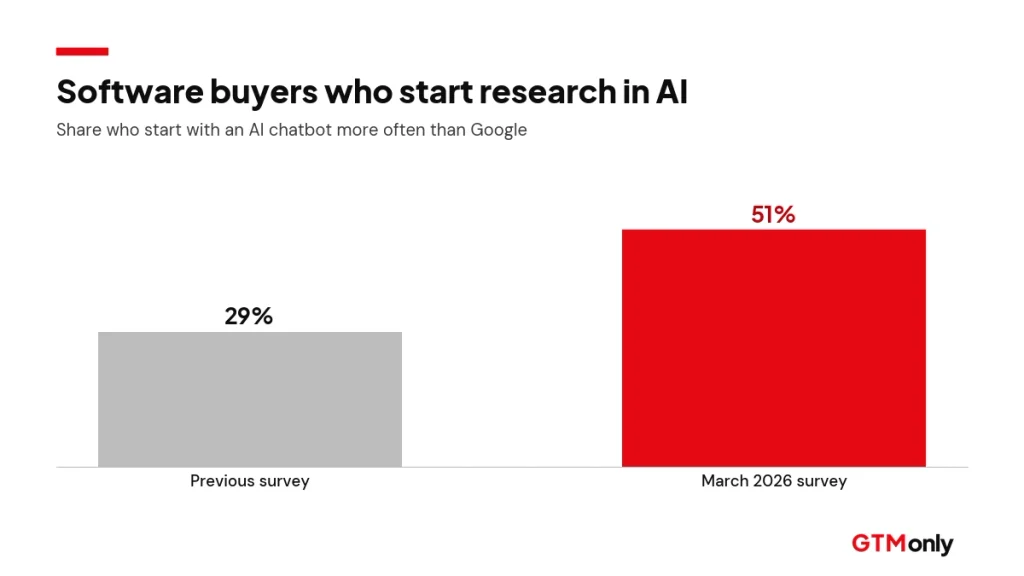
- 51% of B2B software buyers start research in AI chatbots more often than Google, up from 29% in G2’s prior survey.
- 66% of AI-using B2B professionals regularly use AI to research vendors and solutions.
- ChatGPT is the main AI chatbot for 62% of B2B software buyers, up from 47% a year earlier.
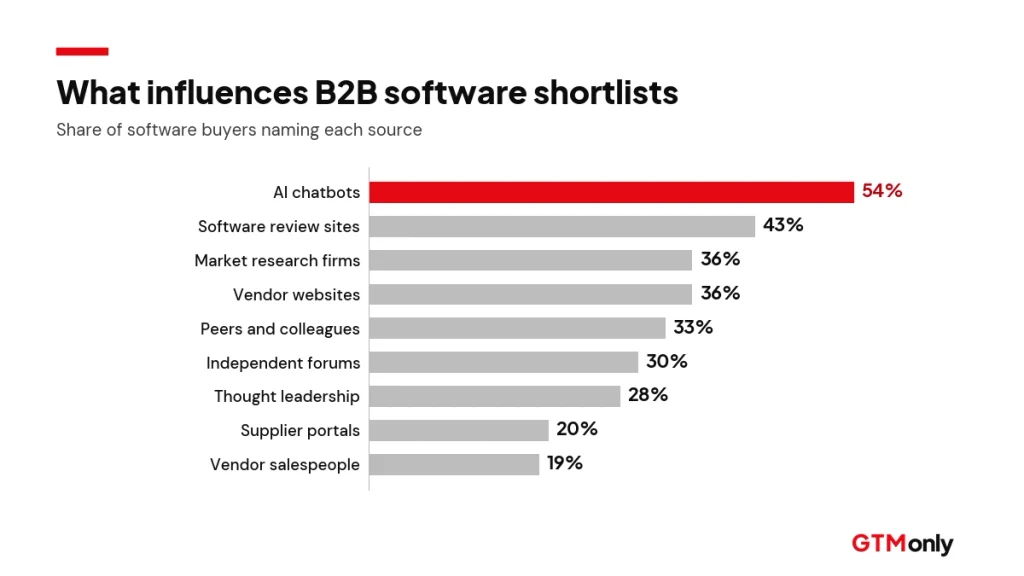
- AI chatbots are the #1 source shaping B2B software shortlists, named by 54% of buyers. Vendor salespeople sit at 19%.
- 69% of software buyers chose a different vendor than planned because of AI. 33% picked one they hadn’t considered.
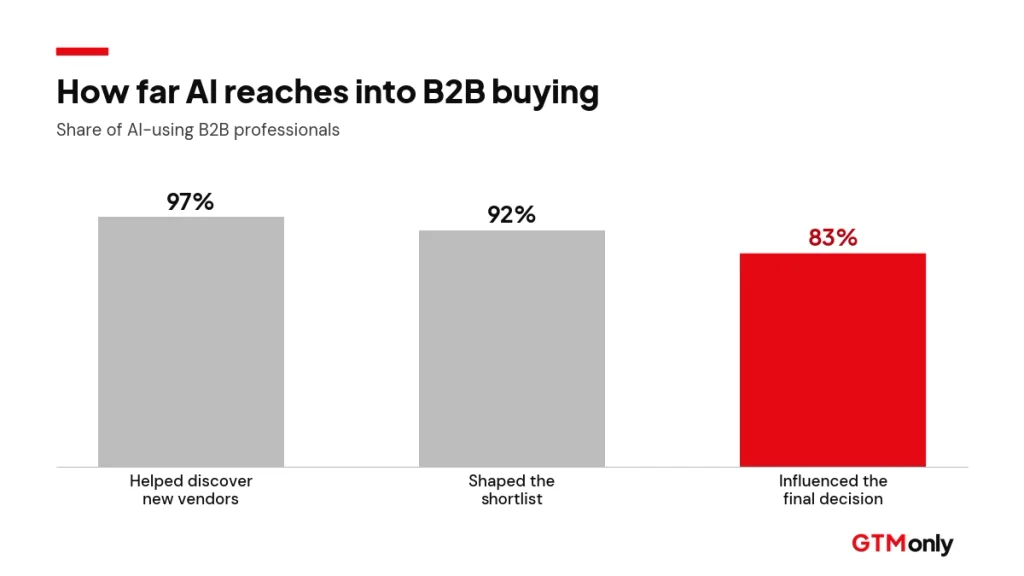
- 83% of AI-using B2B professionals say AI influenced their final vendor decision.
- 75% fully or mostly trust AI vendor recommendations, yet 71% visit the vendor’s website to check before going further.
- More than 60% of B2B software buyers use or plan to use AI agents in the buying process.
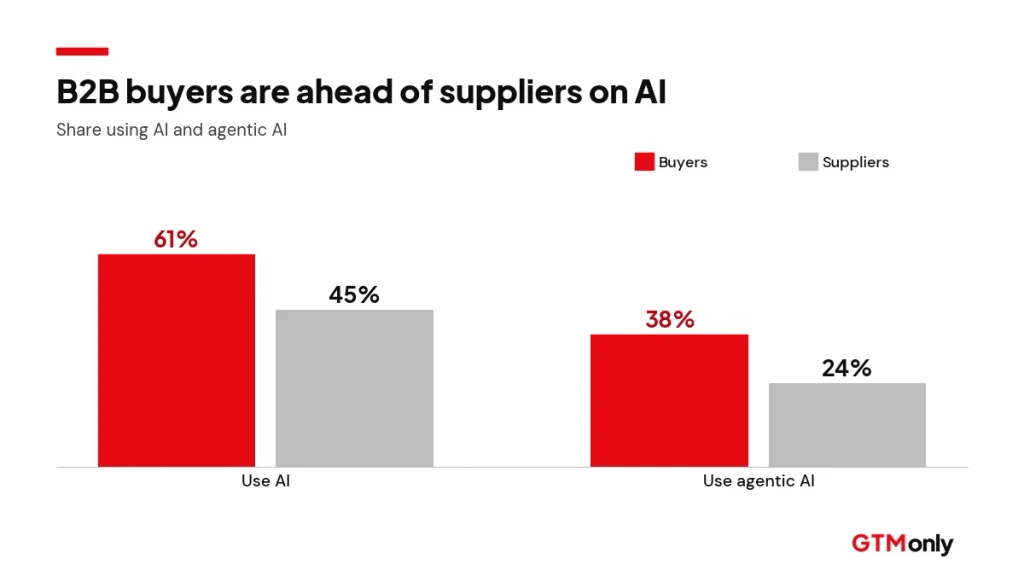
- 38% of US B2B buyers already use agentic AI in purchasing, compared with 24% of B2B suppliers.
- Buying groups for purchases with genAI features average 14 members, double the 7 for other purchases.
AI adoption among B2B buyers
94% of business buyers use AI during their buying process, according to Forrester’s survey of nearly 18,000 global business buyers.
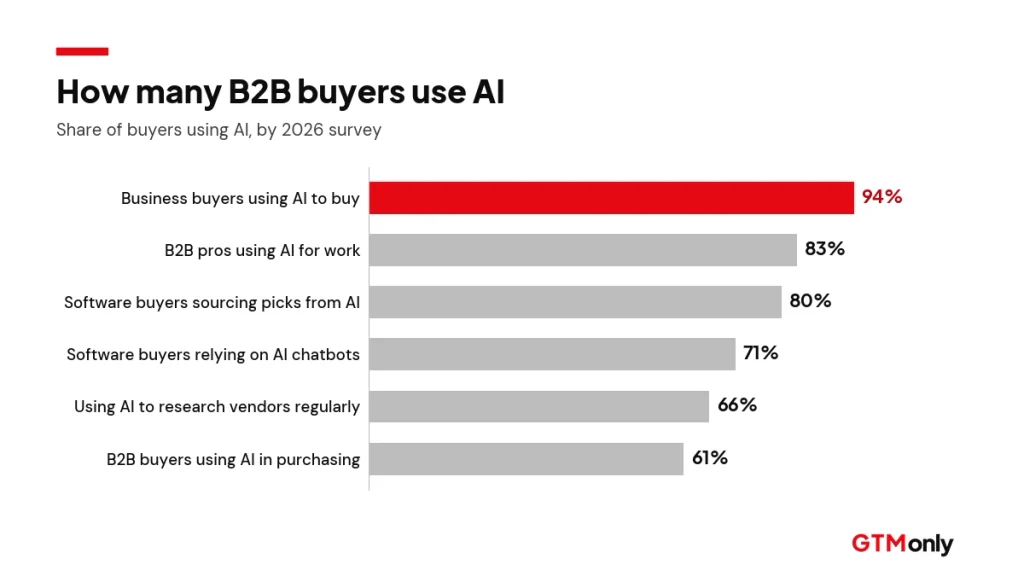
Other 2026 surveys measure AI adoption among B2B buyers more narrowly:
| Statistic | Who was surveyed | Source |
|---|---|---|
| 94% use AI during their buying process | Nearly 18,000 global business buyers | Forrester |
| 80%+ sourced software recommendations from an AI chatbot in the past two years | 1,038 B2B software buyers | G2 Buyer Behavior Report |
| 83% use AI tools for work | 622 US B2B professionals | Semrush |
| 71% rely on AI chatbots for software research | 1,076 B2B software buyers | G2 Answer Economy Report |
| 66% regularly use AI to research vendors and solutions | 519 AI-using US B2B professionals | Semrush |
| 61% use AI in purchasing | 530 US B2B buyers | Deloitte Digital |
McKinsey’s 2026 Global B2B Pulse Survey adds the channel view. Generative AI now ranks among the top five channels buyers use to discover and evaluate suppliers. The other four are supplier websites, in-person meetings, web search, and video calls.
Buyers now use an average of 10 channels across the buying journey, McKinsey found.
Sources: Forrester, G2, Semrush, Deloitte Digital, McKinsey
How often B2B buyers use AI
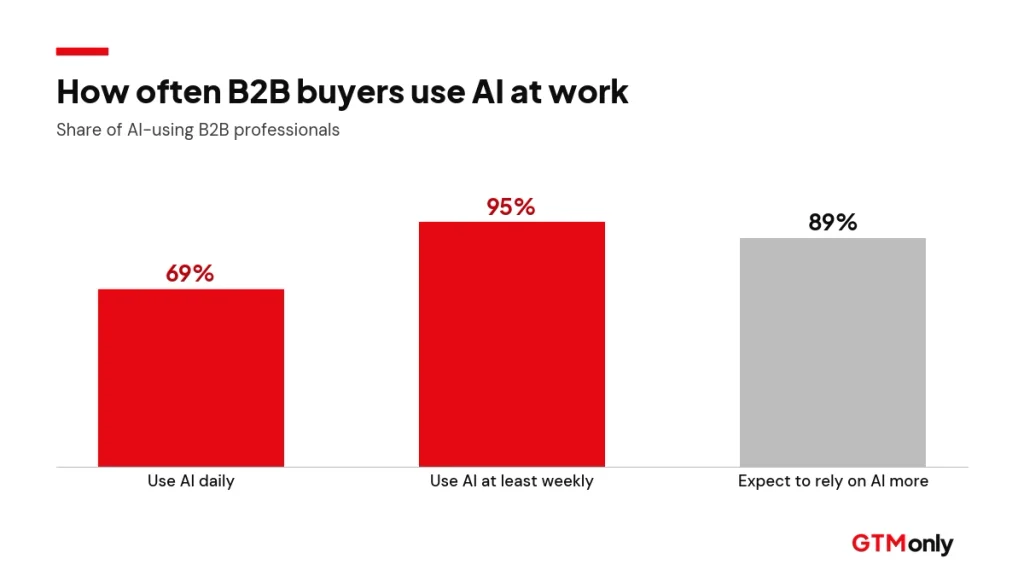
69% of AI-using B2B professionals use AI tools every day, per Semrush’s survey of US B2B professionals. 95% use them at least weekly.
Nearly two-thirds of B2B software buyers use AI chatbots 6+ hours a week at work. That’s from G2’s AI Search Insight Report. More than 40% call themselves daily power users.
| Usage statistic | Share of buyers | Source |
|---|---|---|
| Use AI tools for work daily | 69% | Semrush |
| Use AI tools for work at least weekly | 95% | Semrush |
| Spend 6+ hours a week in AI chatbots for work | Nearly two-thirds | G2 |
| Call themselves daily AI power users | 40%+ | G2 |
| Increased AI chatbot use for software research in the past year | 86% | G2 |
| Say AI chatbots have fundamentally changed how they research | 93% | G2 |
| Expect to rely on AI more for work decisions | 89% | Semrush |
| Expect to rely on AI less | Under 1% | Semrush |
41% of software buyers use Deep Research tools regularly for software evaluations, and another 37% use them occasionally. 44% default to “Thinking” or “Reasoning” models when they research software.
A Deep Research report returns 10 to 20 pages, according to G2. Your brand has to hold up across the whole report, not one answer.
Sources: Semrush, G2
How B2B buyers use ChatGPT and other AI tools
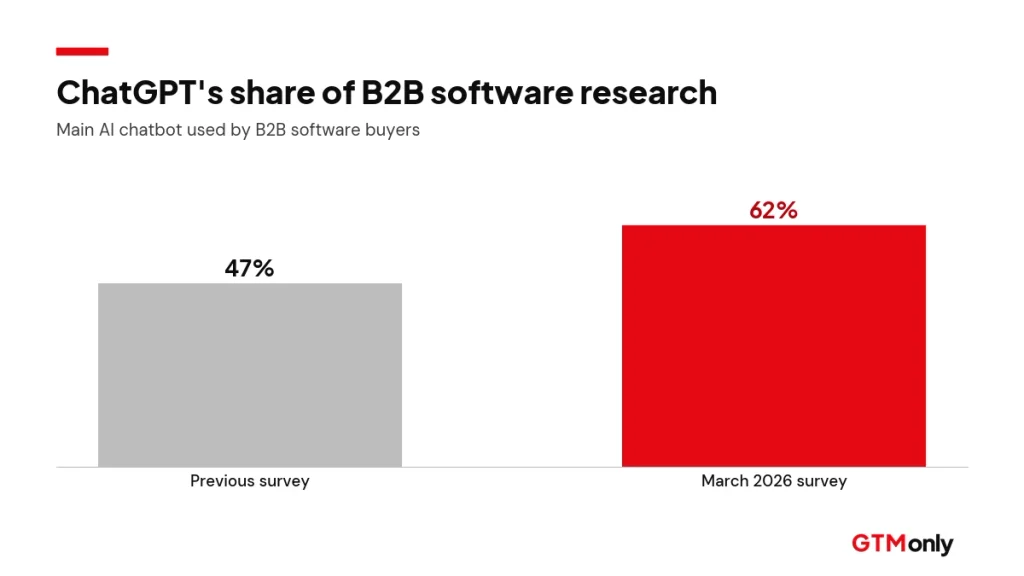
ChatGPT is the main AI chatbot for 62% of B2B software buyers, up from 47% a year earlier, according to G2. Among US B2B professionals, 71% use ChatGPT for product research, per Semrush.
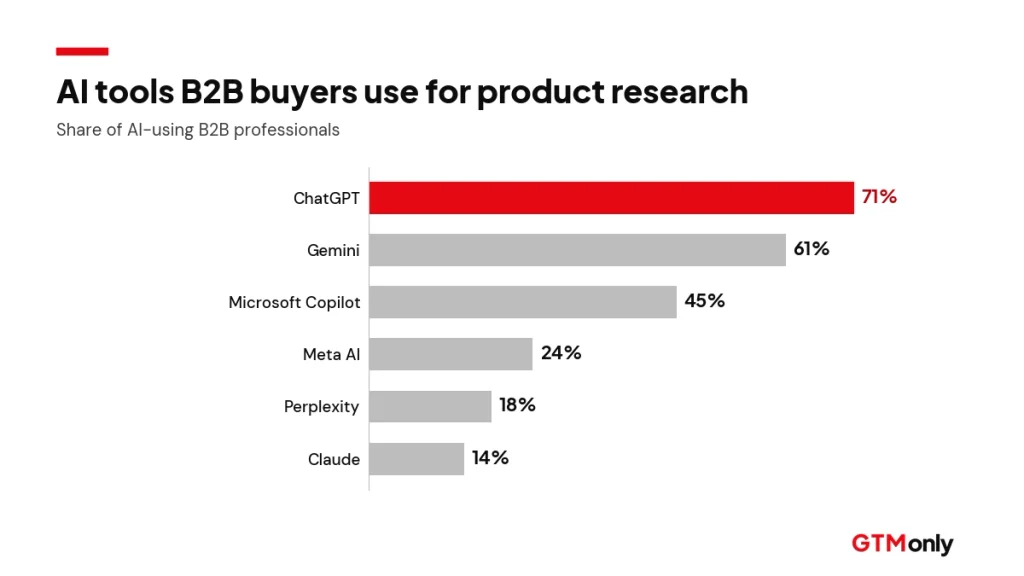
Most buyers also use other AI tools alongside it:
| AI tool | Used for work | Used for product research |
|---|---|---|
| ChatGPT | 76% | 71% |
| Google Gemini | 62% | 61% |
| Microsoft Copilot | 53% | 45% |
| Meta AI | 31% | 24% |
| Perplexity | 22% | 18% |
| Claude | 20% | 14% |
| Grok | 13% | Not reported |
Source: Semrush, 519 AI-using US B2B professionals.
ChatGPT’s lead shrinks as buyers move deeper into the purchase. G2 found it’s the main chatbot for 73% of buyers at discovery, but only 53% at consideration and 56% at decision. Other tools pick up the slack, and Claude more than doubled its share in seven months.
Tool choice also shifts by who’s buying:
| Buyer segment | ChatGPT as main chatbot | Notable runner-up |
|---|---|---|
| C-suite | 66% | Gemini 23% |
| Manager, director, or VP | 61% | Gemini 18% |
| Individual contributor | 58% | Gemini 18% |
| Purchasing and procurement | 56% | Gemini 16% |
| Engineering and R&D | 51% | Claude 12% |
| Enterprise (1,000 to 5,000 employees) | 70% | Copilot 10% |
| Large enterprise (5,000+ employees) | 57% | Copilot 13% |
| Manufacturing | 53% | Gemini 23% |
| Retail | 57% | Gemini 28% |
Source: G2 AI Search Insight Report, 1,076 B2B software buyers.
There’s no single AI answer about your brand. The CFO may see you in ChatGPT while the engineer reads a Claude report.
Sources: G2, Semrush
AI vs Google for B2B research
51% of B2B software buyers now start their research with an AI chatbot more often than Google, according to G2. In G2’s previous buyer report, that share was 29%.
Most buyers still use Google, but often as a second step:
| AI vs search statistic | Share of buyers | Source |
|---|---|---|
| Start research with AI more often than Google | 51% | G2 |
| Still use Google somewhere in the buying journey | 80% | G2 |
| Use AI search alongside Google during discovery | 61% | G2 |
| Say AI research is more productive than search | 53%, up from 36% in August 2025 | G2 |
| Still use search engines in vendor research | 75% | Semrush |
| Start with AI, then validate with search | 41% | Semrush |
| Start with search, then use AI to compare | 35% | Semrush |
| Switch between both throughout | 20% | Semrush |
Sources: G2, Semrush
How B2B buyers use AI at each stage of the purchase
72% of AI-using B2B professionals use AI during early research, according to Semrush. 45% still use it for the final decision.
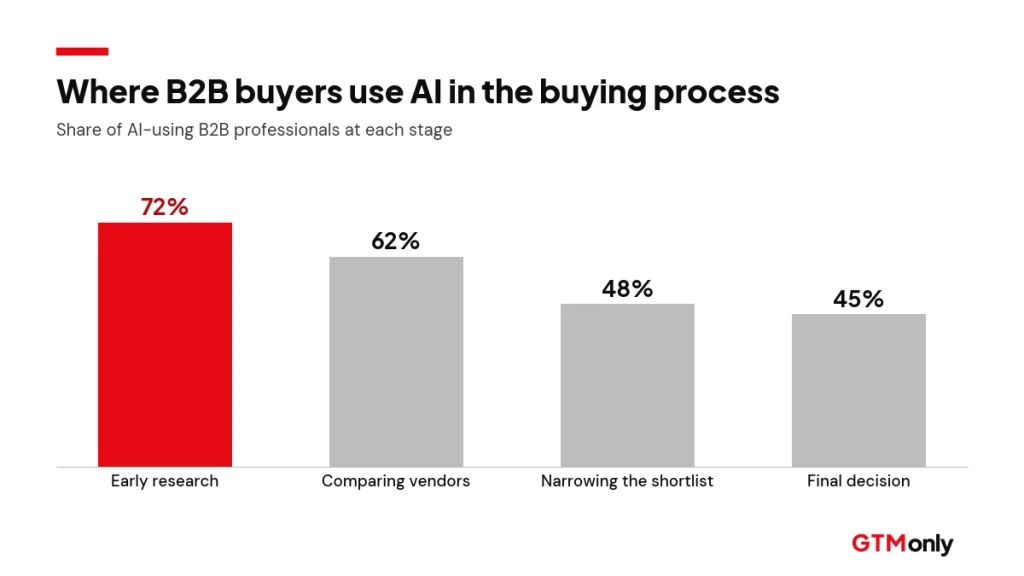
AI use stays high at every buying stage:
| Buying stage | Share using AI |
|---|---|
| Early research, scoping the category, or defining needs | 72% |
| Comparing vendors | 62% |
| Narrowing the shortlist | 48% |
| Supporting the final decision | 45% |
Source: Semrush.
The top vendor research tasks buyers hand to AI:
| Vendor research task | Share of buyers |
|---|---|
| Explore possible solutions | 66% |
| Compare vendors directly | 61% |
| Understand a problem or category | 59% |
| Summarize options | 55% |
| Ask for recommendations | 53% |
Source: Semrush.
G2 asked software buyers to rank their main reasons for using AI chatbots. Comparing vendor strengths and weaknesses came first, ahead of learning category basics.
Next came identifying vendors, validating use cases, and checking a recommendation. Narrowing the shortlist, drafting RFP questions, and pricing research rounded out the top eight.
Buyers use AI for sizable purchases:
| Typical purchase size researched with AI | Share of buyers |
|---|---|
| $1,000 to $10,000 | 43% |
| $10,000 to $100,000 | 42% |
| More than $100,000 | 14% |
Source: Semrush.
Agencies and service providers (51%) and SaaS tools (46%) are the most researched categories. Marketing tools (45%), infrastructure tools (44%), and enterprise platforms (43%) follow.
One side effect worth knowing: most of this research happens off your website. That leaves fewer visible buying signals for your team to spot early.
Sources: Semrush, G2
What B2B buyers ask AI
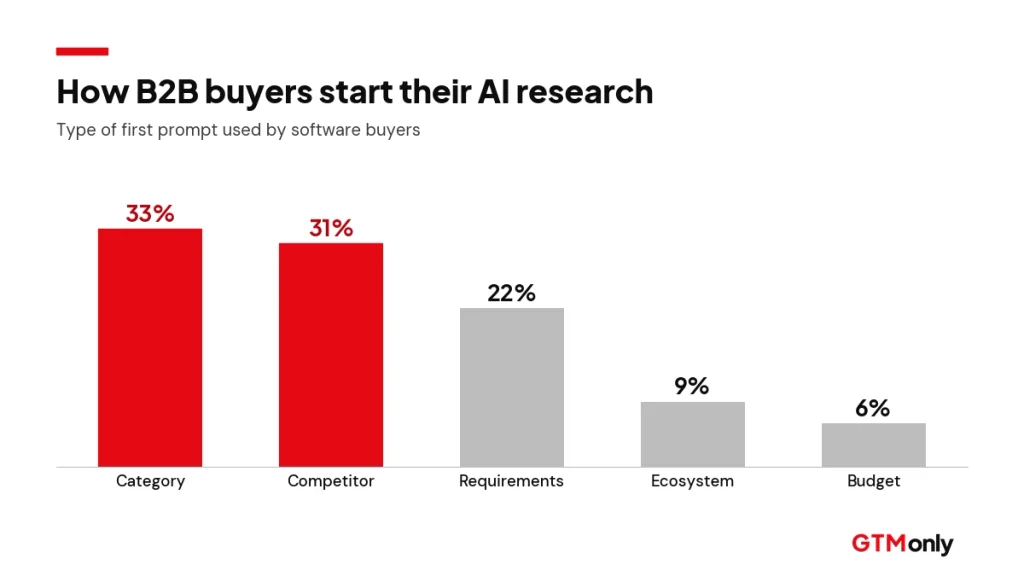
Two-thirds of B2B software buyers open their AI research with a category or competitor prompt, according to G2.
| Type of first AI prompt | Share of buyers |
|---|---|
| Category-based (for example, “best CRM for enterprise”) | 33% |
| Competitor-based (naming specific vendors) | 31% |
| Requirements or process-based | 22% |
| Ecosystem-based | 9% |
| Budget-based | 6% |
Source: G2.
Most buyers add detail to their prompts:
| How B2B buyers prompt AI during vendor research | Share of buyers |
|---|---|
| Describe their specific use case or problem | 61% |
| Ask for direct vendor comparisons | 56% |
| Add constraints like budget, features, or compatibility | 45% |
| Refine with follow-up questions | 43% |
Source: Semrush.
Buyers describe their exact situation, so use-case pages give AI something specific to match.
Sources: G2, Semrush
How AI builds the B2B shortlist
AI chatbots are the #1 source influencing B2B software shortlists, according to G2’s AI Search Insight Report. 54% of software buyers named them. Vendor salespeople came in last at 19%.
| Source influencing the shortlist | Share of buyers |
|---|---|
| Generative AI chatbots | 54% |
| Software review sites | 43% |
| Market research firms | 36% |
| Vendor websites | 36% |
| Peers and colleagues | 33% |
| Independent forums | 30% |
| Thought leadership | 28% |
| Internal supplier portals | 20% |
| Vendor salespeople | 19% |
Source: G2 AI Search Insight Report.
Your sales team now ranks below a forum thread. (I’d leave that slide out of the next kickoff.)
G2’s later 2026 Buyer Behavior Report shows how sticky an AI-built shortlist is:
- More than 80% of software buyers sourced recommendations from an AI chatbot in the past two years.
- Nearly half of those buyers say AI had its biggest influence during shortlisting and evaluation.
- 80% of buyers who sourced picks from AI bought from their first shortlist in three of their last five purchases. Among buyers who didn’t use AI, that figure was 65%.
- Asked about their top shortlist influences in this survey, buyers named review sites (38%) and AI chatbots (37%) almost equally.
Once a buyer trusts their shortlist, they rarely leave it. If AI didn’t put you on it, you’re fighting for a spot that’s already taken.
AI also changes which vendor wins:
| AI’s effect on vendor choice | Share of buyers | Source |
|---|---|---|
| Chose a different vendor than planned because of AI | 69% | G2 |
| Chose a vendor they hadn’t considered before | 33% | G2 |
| Think more highly of a vendor when AI mentions it | 85% | G2 |
| Say AI helped them discover new vendors | 97% | Semrush |
| Say AI shaped their vendor shortlist | 92% (45% significantly) | Semrush |
That’s the whole business case for answer engine optimization in B2B. If AI doesn’t name you, the buyer may never know you exist.
Sources: G2, Semrush
How AI influences the final B2B purchase decision
83% of AI-using B2B professionals say AI influenced their final vendor decision, according to Semrush. 32% call that influence major.
G2 asked software buyers the same question about their most recent purchase:
| Did an AI chatbot influence the vendor you chose? | Share of buyers |
|---|---|
| Yes, chose a vendor I hadn’t considered | 33% |
| Yes, chose a vendor I was already familiar with | 36% |
| Yes, it reinforced the vendor I expected | 22% |
| No, it didn’t influence my decision | 7% |
Source: G2.
AI also makes buyers faster and more confident. 83% of software buyers say AI chatbots sped up their decision. The same share felt more confident in their final choice.
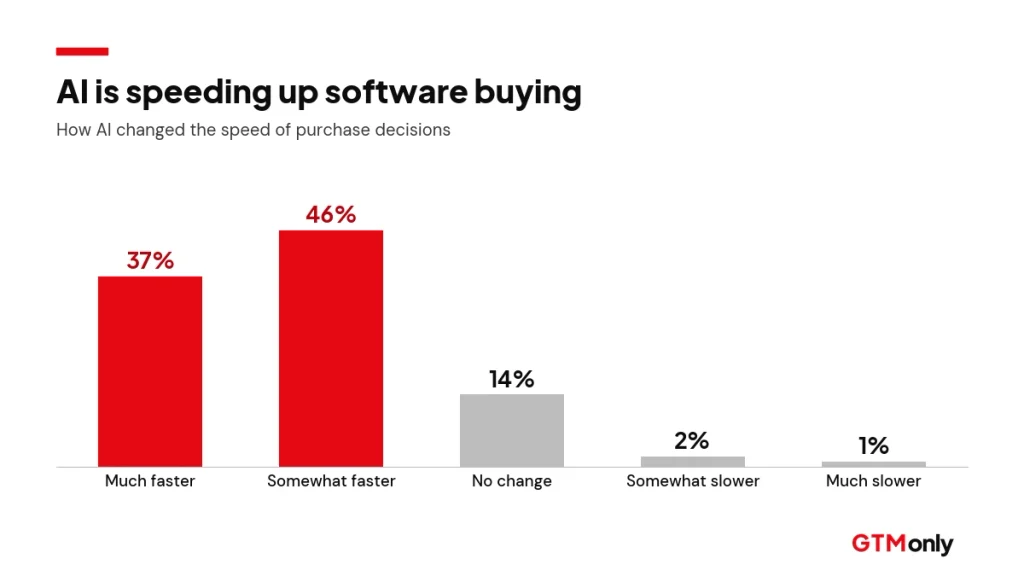
| How AI changed decision speed | Share of buyers |
|---|---|
| Much faster | 37% |
| Somewhat faster | 46% |
| No change | 14% |
| Somewhat slower | 2% |
| Much slower | 1% |
Source: G2.
AI compressed discovery, but evaluation got harder. Evaluation is now the longest buying stage for 40% of buyers, per G2’s Buyer Behavior Report. A year earlier, it was 36%.
| Longest stage of the buying journey | Share of buyers |
|---|---|
| Evaluation | 40% |
| Research | 36% |
| Decision | 22% |
Source: G2 Buyer Behavior Report.
The biggest delays after picking a vendor are IT security review (39%), budget approval (32%), and implementation planning (25%). For enterprise buyers, security review is the top delay for 50%.
So AI gets you on the list faster. It doesn’t get you through procurement.
Sources: Semrush, G2
Do B2B buyers trust AI?
75% of AI-using B2B professionals fully or mostly trust AI vendor recommendations, according to Semrush. Only 3% report low trust.
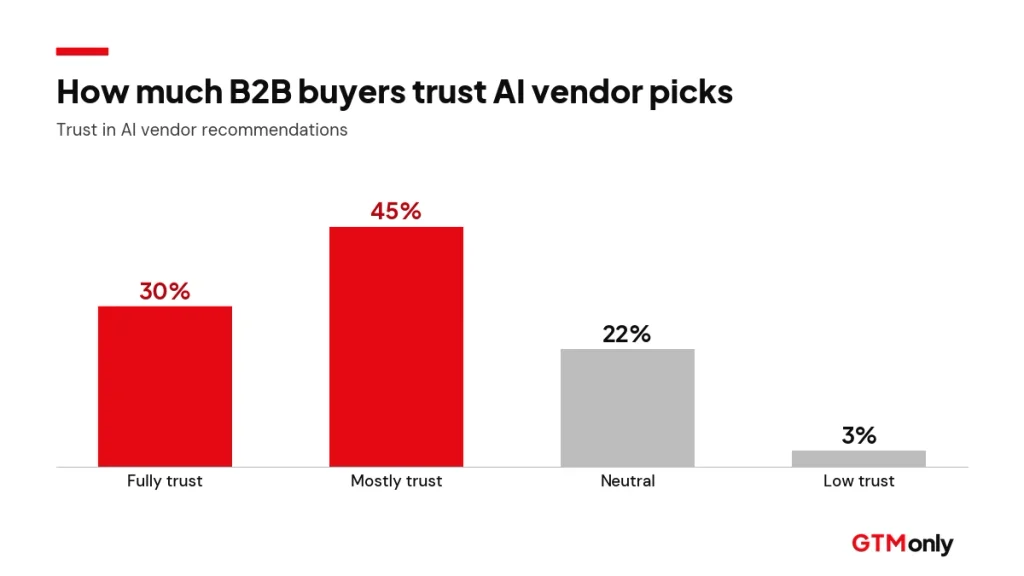
| Trust in AI vendor recommendations | Share of buyers |
|---|---|
| Fully trust | 30% |
| Mostly trust | 45% |
| Neutral | 22% |
| Low trust | 3% |
Source: Semrush.
64% of software buyers run into AI inaccuracies at least a few times a month, according to G2. Forrester found buyers balance AI’s speed by checking its output with peers, product experts, and analysts.
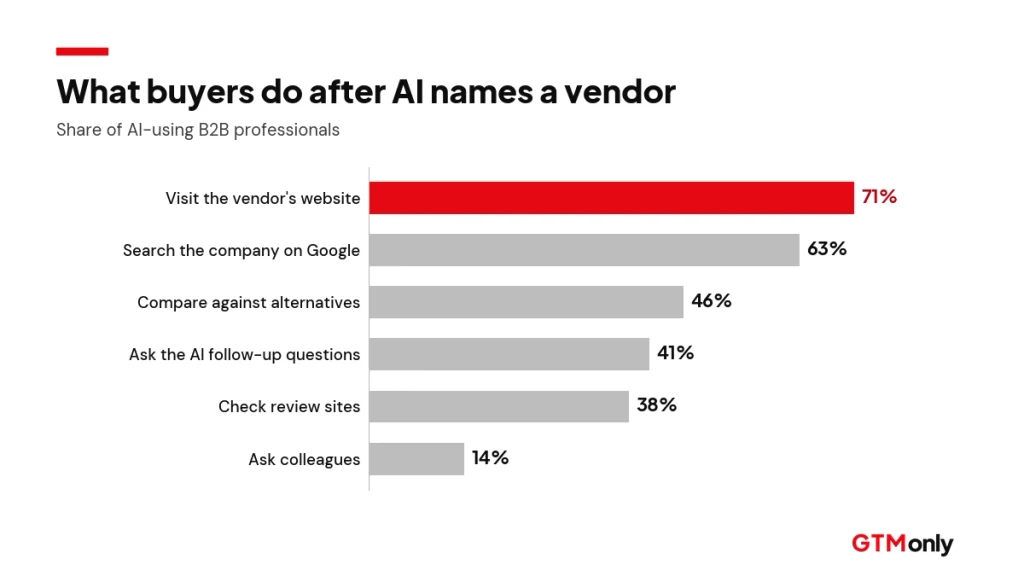
After AI names a vendor, most buyers check it:
| Action after AI recommends a vendor | Share of buyers |
|---|---|
| Visit the vendor’s website | 71% |
| Search for the company on Google | 63% |
| Compare it against alternatives | 46% |
| Ask the AI follow-up questions | 41% |
| Check review sites | 38% |
| Ask colleagues | 14% |
Source: Semrush.
45% of software buyers say a review-site citation is the most confidence-inspiring signal in an AI answer. Among daily AI power users, that rises to 50%.
When AI gets a brand wrong or leaves one out, buyers react in different ways:
| Buyer response to an AI mistake | Share of buyers |
|---|---|
| Look for peer feedback to vet the recommendation | 24% |
| Ask the AI why a brand was left out | 22% |
| Go with the AI-recommended option anyway | 21% |
| Try another AI tool or prompt | 19% |
| Default to a brand they already know | 14% |
Source: G2.
Buyers also told Semrush what bugs them about AI vendor recommendations:
| Top frustration with AI vendor recommendations | Share of buyers |
|---|---|
| Too generic for their use case | 33% |
| Lacks depth or accuracy | 28% |
| Doesn’t reflect real pricing or contracts | 27% |
| Credibility concerns | 27% |
| Missed relevant vendors | 25% |
| No major issues | 30% |
Source: Semrush.
66% of AI-using B2B professionals have spotted relevant vendors missing from AI results, and 26% say it happens often.
Sources: Semrush, G2, Forrester
What makes a vendor stand out in AI answers
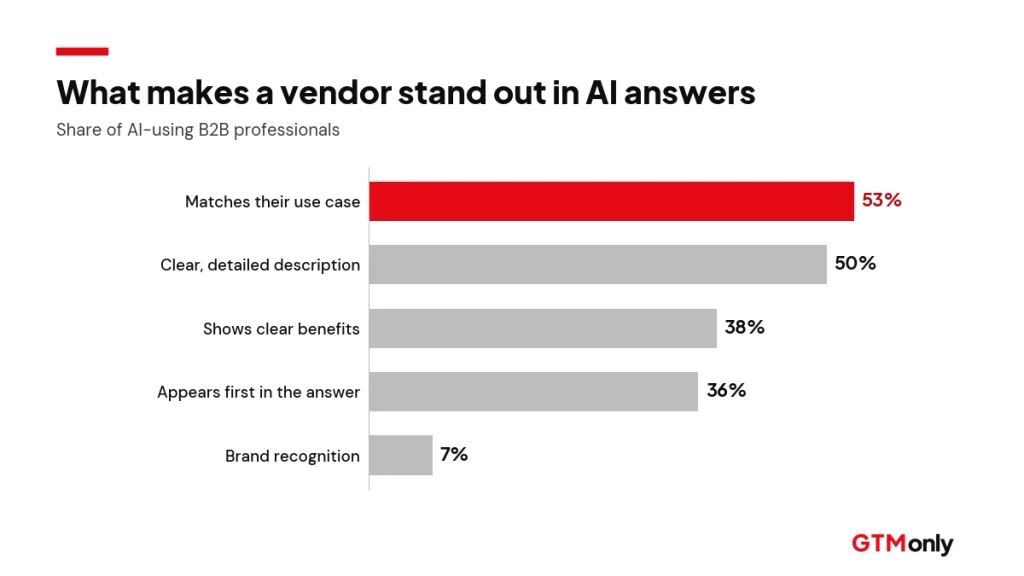
Only 7% of B2B buyers notice a vendor in an AI answer because they know the brand, per Semrush. 53% notice the vendor that closely matches their use case.
| What makes buyers notice a vendor in an AI answer | Share of buyers |
|---|---|
| Closely matches their specific use case | 53% |
| Clear, detailed description | 50% |
| Highlights clear benefits or outcomes | 38% |
| Appears early or first in the answer | 36% |
| Brand recognition | 7% |
Source: Semrush.
This is good news for smaller vendors. Specific, well-documented B2B content marketing can beat a famous logo inside an AI answer.
Source: Semrush
AI agents in B2B buying
More than 60% of B2B software buyers use or plan to use AI agents in buying, per G2’s Buyer Behavior Report. Another 19% would use them for select tasks.
Buyers are putting agents to work on evaluation, not purchasing:
| Task buyers use AI agents for | Share of buyers |
|---|---|
| Comparing total cost of ownership | 51% |
| Building shortlists of top vendors | 51% |
| Researching solutions | 49% |
| Evaluating shortlisted vendors | 46% |
Source: G2 Buyer Behavior Report.
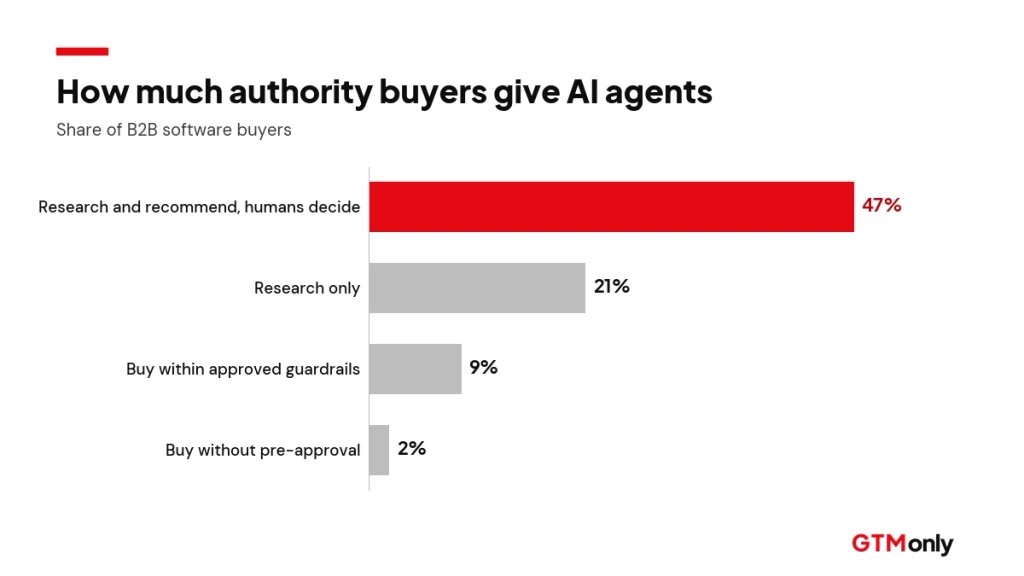
Nearly two-thirds limit agents to research or recommendations:
| How much authority buyers give AI agents | Share of buyers |
|---|---|
| Research and recommend, humans make all final decisions | 47% |
| Research only | 21% |
| Execute purchases within approved guardrails | 9% |
| Make purchases without pre-approval | 2% |
Source: G2 Buyer Behavior Report.
When buyers do let agents act alone, they stick to low-risk jobs:
| Tasks buyers would let an AI agent handle alone | Share of buyers |
|---|---|
| Early research and shortlist building | 31% |
| Purchases from approved vendors | 31% |
| Add-ons and usage top-ups | 29% |
| Routine renewals | 28% |
| Additional seats or licenses | 27% |
Source: G2 Buyer Behavior Report.
Agentic AI is already in the buyer’s toolkit beyond software, too. Deloitte Digital research found 38% of US B2B buyers use agentic AI in purchasing.
Your next buyer may be an AI agent comparing your pricing page with three competitors. Keep your TCO, integrations, and security details easy for a machine to read.
Sources: G2, Deloitte Digital
AI and the B2B buying group
The typical B2B buying decision involves 13 internal stakeholders and 9 external influencers, according to Forrester’s 2026 buyer research.
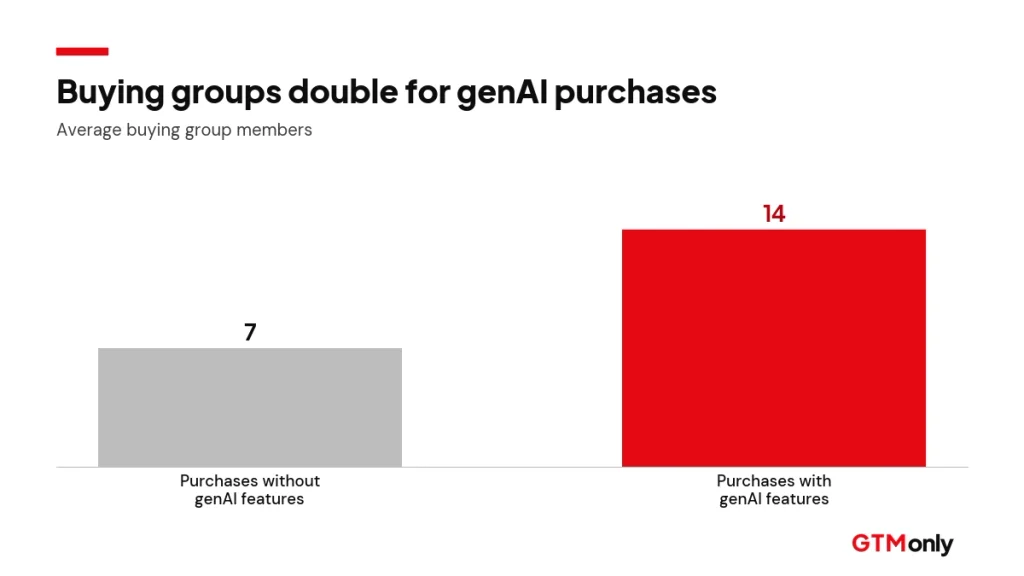
For purchases with genAI features, the buying group doubles.
| Buying group statistic | Figure | Source |
|---|---|---|
| Internal stakeholders in a typical buying decision | 13 | Forrester |
| External influencers in a typical buying decision | 9 | Forrester |
| Buying group size for purchases with genAI features | 14 members | Forrester |
| Buying group size for purchases without genAI features | 7 members | Forrester |
| Buying cycles where procurement acts as a decision-maker | 53% | Forrester |
| Buyers with groups of six or more who report clear benefits | 94% | Forrester |
| Buyers who purchase some form of trial | More than 60% | Forrester |
| Buyers making $10M+ purchases who trial first | 78% | Forrester |
| Say most stakeholders in their company use AI for vendor research | 39% | Semrush |
| Say AI use across their buying team is mixed | 52% | Semrush |
The last two rows matter. The person who found you through AI may not sign the contract. Their colleagues may have seen a different answer.
McKinsey’s buyer archetypes show the same split.
Adapters (53%) lean on trusted relationships. Seekers (29%) want smooth buying across channels. Innovators (18%) adopt new tools like gen AI early.
It’s one more reason account-based marketing keeps getting more relevant. You’re selling to a committee, and each member may be asking a different AI.
Sources: Forrester, Semrush, McKinsey
AI in B2B sales: are sellers keeping up?
B2B buyers are ahead of the companies selling to them. 61% of US B2B buyers use AI in purchasing, according to Deloitte Digital. Only 45% of B2B suppliers use AI in sales.
| AI adoption statistic | B2B buyers | B2B suppliers |
|---|---|---|
| Use AI (buyers in purchasing, suppliers in sales) | 61% | 45% |
| Use agentic AI | 38% | 24% |
| Say sales processes are mostly or highly automated | 47% | 72% |
Source: Deloitte Digital, 530 US B2B buyers and 530 US B2B suppliers.
More from the same research:
- About two-thirds of suppliers not using agentic AI plan to adopt it, and 9% have no plans.
- Suppliers lose an estimated 13% of sales bids because of negative buying experiences.
- Positive buying experiences are linked to a 36% increase in buyer spending.
- Digitally mature suppliers grew 110% more than low-maturity competitors.
McKinsey’s sell-side data fills in the rest. 22% of B2B organizations have fully implemented gen AI, up from 19% a year earlier. Another 31% are actively adopting it. Market leaders are twice as likely as laggards to have adopted gen AI (44% vs 22%).
| AI in B2B sales statistic | Figure | Source |
|---|---|---|
| Organizations that fully implemented gen AI | 22% (up from 19%) | McKinsey |
| Organizations actively adopting gen AI | 31% | McKinsey |
| Market leaders that adopted gen AI | 44% | McKinsey |
| Laggards that adopted gen AI | 22% | McKinsey |
| Leaders that grew AI investment by double digits | 71% | McKinsey |
| Laggards that grew AI investment by double digits | 25% | McKinsey |
If you’re building AI in GTM, plan for this gap. Your buyers are already automating their side of the deal.
Sources: Deloitte Digital, McKinsey
FAQs about how B2B buyers use AI
How many B2B buyers use AI to make purchase decisions?
Nearly all of them. Forrester found 94% of business buyers use AI during their buying process, based on almost 18,000 buyers. Semrush found 83% of AI-using B2B professionals say AI influenced their final vendor decision, and 32% call that influence major.
Do B2B buyers use ChatGPT to research vendors?
Yes. ChatGPT is the main AI chatbot for 62% of B2B software buyers, up from 47% a year earlier, according to G2. Semrush found 71% of AI-using US B2B professionals use ChatGPT for product research, ahead of Gemini at 61%.
How does AI influence B2B vendor shortlists?
AI chatbots are the top source shaping B2B software shortlists, named by 54% of buyers in G2’s survey. G2 also found 69% of buyers chose a different vendor than planned because of AI. Buyers who source recommendations from AI usually buy from their first shortlist.
Do B2B buyers trust AI vendor recommendations?
Mostly, but they verify. Semrush found 75% of AI-using B2B professionals fully or mostly trust AI vendor recommendations.
Still, 71% visit the vendor’s website afterward. And 64% of software buyers hit AI inaccuracies at least a few times a month, per G2.
How do B2B buyers use AI agents in purchasing?
Most use AI agents for research and evaluation, not buying. G2 found more than 60% of software buyers use or plan to use AI agents. Their top tasks are comparing total cost of ownership and building shortlists, and only 9% let agents execute purchases.
Are B2B buyers or sellers further ahead on AI adoption?
Buyers are ahead. Deloitte Digital found 61% of US B2B buyers use AI in purchasing, while 45% of B2B suppliers use AI in sales. The gap holds for agentic AI too, with 38% of buyers using it versus 24% of suppliers.
Conclusion
Buyers start in AI, build shortlists in AI, and increasingly hand the legwork to AI agents. Then they verify everything, from reviews to security docs, with a buying group that may have asked three different chatbots.
The vendors who win this shift won’t be the loudest ones. They’ll be the ones AI can describe accurately, and the ones a skeptical buying committee can verify in five minutes.