
What Is Search Intent? How to Identify It and Optimize for It
TL;DR
- Search intent is the real goal behind a search query — what the person actually wants, not just the words they typed.
- There are four types: informational, navigational, commercial, and transactional. Each one demands a different content approach.
- Google’s ranking systems evaluate intent before anything else. A technically perfect page loses to a simpler page that gets intent right.
- Search intent is often layered. One query can carry multiple intent signals at once.
- The fastest way to identify intent is free: search Google and read the SERP. It tells you everything.
You can write a well-researched, cleanly structured, keyword-optimised article and still land on page three.
The most common reason is simple: the content does not match what the person was actually looking for. That gap between what you wrote and what they wanted is called a search intent mismatch.
This guide covers search intent from the ground up — what it is, why it matters more than keywords, the four types every B2B marketer needs to know, and how to identify and optimise for it on every piece you publish.
What Is Search Intent?
Search intent (also called user intent or keyword intent) is the primary goal a person has when they type a query into a search engine. It is not just about the words used — it is about what the person wants to accomplish. Google’s entire ranking system is built around identifying and serving that intent.
Here is a straightforward example. Two people type different queries into Google:
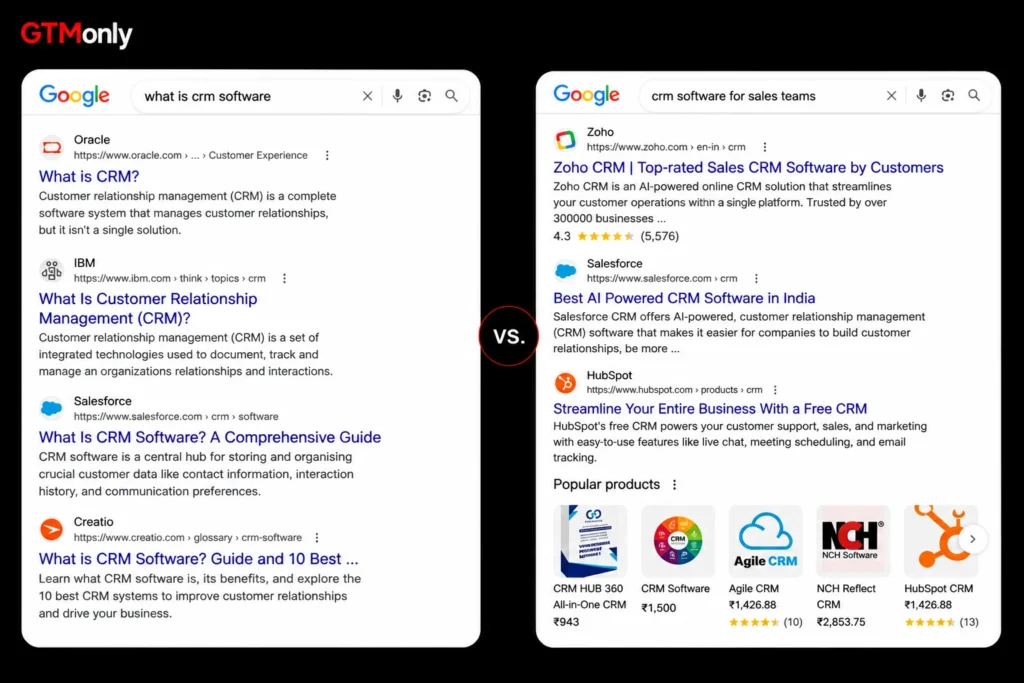
- “What is CRM software” — this person wants an explanation. They are learning.
- “Buy CRM software for sales team” — this person is ready to act. They want options or a place to purchase.
Same broad topic. Two completely different goals. Google knows the difference and serves different results for each. If you publish an educational guide targeting the second query, you will not rank. The content type does not fit what the searcher wants.
That is the core of search intent. It is not about keywords. It is about the question behind the query.
Understanding what search intent is gets you halfway there. Understanding why Google treats it as a first-order ranking signal is what makes it actionable.
Why Search Intent Matters More Than Keywords
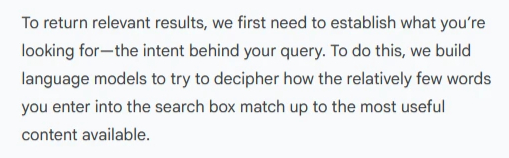
Google’s own documentation makes this explicit. Their page on how search ranking works states: “To return relevant results, we first need to establish what you’re looking for — the intent behind your query.” Intent comes before keywords in Google’s process, not after.
This shift happened gradually. Before RankBrain in 2016, Google matched pages to keywords mechanically. The page with the most relevant keyword usage tended to rank. BERT in 2019 changed the game by processing full query context — understanding how words relate to each other in a sentence, not just individually.
By 2026, Google evaluates three signals for every query to determine intent fit. SEOs call this framework the 3 Cs.
| Signal | What Google Evaluates | What It Means for Your Content |
| Content Type | What kind of page ranks? Blog post, product page, landing page, tool? | Match the dominant page type in the SERP |
| Content Format | How is the content structured? Guide, listicle, comparison, definition? | Match the format that top results use |
| Content Angle | What perspective does the content take? Beginner, expert, use-case specific? | Match the angle that satisfies the searcher’s level of need |
Miss any one of these three and you are fighting an uphill battle. A well-written listicle targeting a keyword where guides dominate will struggle. A beginner guide targeting a query where expert-level content ranks will not satisfy the searcher.
The practical consequence: search intent, high-quality content, and backlinks are the three top ranking factors in 2026 according to AIOSEO. Intent is not a supporting signal. It is a first-pass filter.
With that context in place, here are the four types of search intent your B2B content strategy needs to cover.
The 4 Types of Search Intent
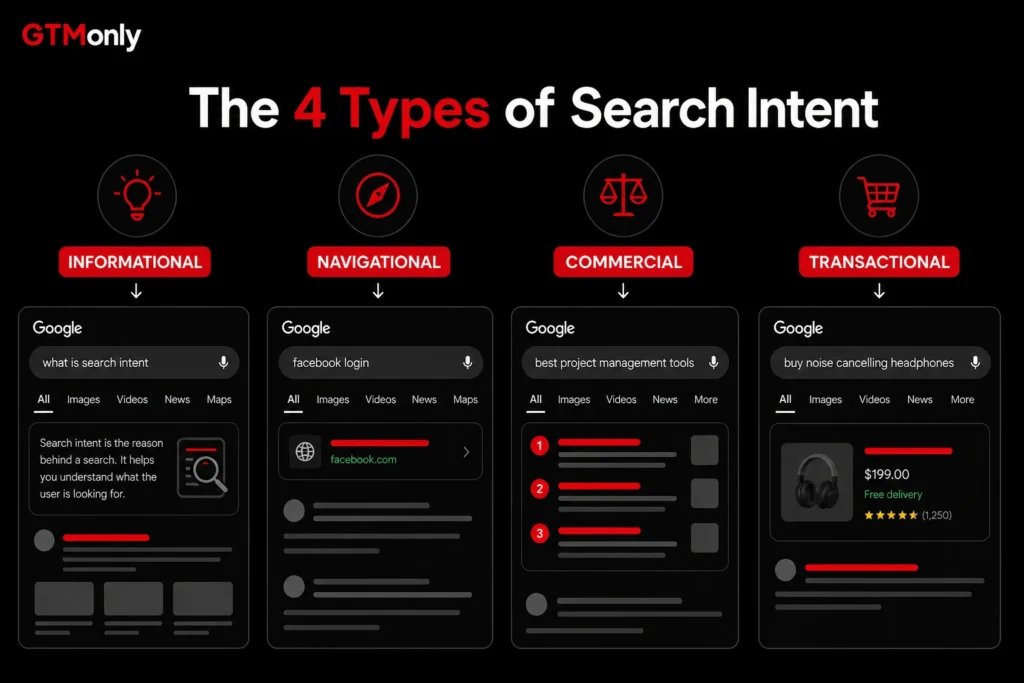
Informational Intent
Informational intent is the most common type of search query. The person wants to learn something. They are not comparing tools. They are not ready to buy. They just want a straight answer.
Queries like “what is SEO,” “how does Google rank pages,” or “what is a keyword” all fall here. These searches often start with “what,” “how,” “why,” or “best way to.”
Most top-of-funnel content lives in this category. The reader who gets a clear answer here becomes the repeat visitor and eventually the buyer.
One thing kills informational content fast: burying the answer. Google’s Featured Snippet and AI Overview both pull from pages that lead with the answer. Put your definition or core response in the first 60 words of the section. Not the third paragraph. The first.
So let’s move to the second type, and it is the one most content sites ignore until it is too late.
Navigational Intent
Navigational searches happen when someone already knows where they want to go. They are using Google as a shortcut instead of typing the full URL.
“Semrush login,” “Ahrefs blog,” “Google Search Console” are all navigational queries. The user has made their decision. They just want to get there fast.
Here is the hard truth: you cannot rank for another brand’s navigational terms. Trying to is a waste of time. But you must own your own brand name in search. If someone types your name and a competitor shows up above you, that is a credibility problem and it compounds over time.
For a new content site, navigational intent is not about creating new content. It is about making sure your homepage, about page, and category pages are indexed, clean, and showing up correctly for your own brand terms. Sort that first.
Commercial intent is where things get interesting, and where most content either earns its place or wastes everyone’s time.
Commercial Intent
Commercial intent means the searcher is evaluating options. The budget conversation is already happening. They want help deciding, not a sales pitch dressed up as a guide.
Queries like “best SEO tools for small business,” “Semrush vs Ahrefs,” or “top keyword research tools” sit here. These searches often include words like “best,” “top,” “review,” “compare,” or “alternatives.”
These are the warmest readers you will get outside of a direct sales conversation. They respond to honest trade-off analysis, real specifics, and content that treats them like adults. What they do not respond to is a listicle that gives every tool a 9.5 out of 10 and calls it a comparison.
This is also where affiliate revenue is built on most content sites. A reader comparing two tools has already done the hard thinking. Your job is to be the most useful voice at that moment, not the most promotional one.
With commercial intent covered, the last type is the shortest distance between content and conversion.
Transactional Intent
Transactional intent means the decision is made. The person wants to act right now.
“Buy Semrush subscription,” “Ahrefs free trial,” “Mangools pricing” are all transactional queries. These people are searching for the front door. They already know what they want and they expect to land on the right page and complete the action without friction.
For a content-first site, transactional intent matters less in the early stages. But as the site grows and builds tool-specific pages, bottom-of-funnel content targeting these queries becomes a real revenue source.
These four types give you a clean framework. But real search intent rarely fits a perfect box.
When Intent Does Not Fit One Box (Mixed Intent)
Some keywords carry more than one intent at once. This is common and it trips up a lot of content teams.
“Best laptops for students under $1000,” “running shoes for beginners,” “coffee maker reviews” — these searches blend informational and commercial intent. The user wants to learn and compare at the same time. Google reflects this by mixing buying guides, review articles, and product pages on the same SERP.
When you spot mixed intent in your keyword research, build content that serves both needs. Answer the core informational question. Include honest comparisons. Guide the reader toward a decision without forcing one. Use clear headings so they can scan and find what they need fast.
Mixed intent is not a problem to solve. It is a signal that your reader is actively working through a decision. Meet them where they are and let them move at their own pace.
Why Search Intent Is More Nuanced Than It Looks
Intent is rarely pure. A single query can carry multiple signals at once. Treating intent as a strict category is the shortcut that leads to content that technically fits the type but still misses what the searcher actually needs.
Overlapping Intent
Take the query ‘best CRM software for B2B startups.’ On the surface this is commercial intent. But the person also wants to understand what makes a CRM good for startups specifically — that’s an informational layer sitting underneath the commercial one.
If you write a pure comparison table with no context, you miss the informational layer. If you write a long educational guide with no clear recommendation, you miss the commercial layer. The content that ranks covers both.
Intent Subtypes
Within informational intent alone, there are at least three distinct subtypes that demand different content structures:
- Definition queries: ‘what is revenue operations’ — the person wants a clean, direct explanation. Short, structured, built around the definition.
- Process queries: ‘how to build a GTM strategy’ — the person wants steps. Numbered lists, clear sequencing, actionable specifics.
- Comparison within informational: ‘difference between demand gen and lead gen’ — the person wants a contrast. Tables, side-by-side breakdowns, a clear conclusion.
Each subtype has a different structure that performs best. A definition guide formatted as a how-to misses the subtype. A process guide formatted as a definition misses it the other way. The SERP tells you which subtype dominates for any given query.
Contextual Factors
The same keyword can carry different intent depending on who searches it and when. A founder searching ‘go-to-market strategy’ in January (planning season) wants a framework. The same founder searching it in September (execution mode) wants specific playbooks and examples. The keyword is identical. The need is different.
You cannot control every contextual variable, but you can write content that serves the full range of what a query could mean. Cover the definition, the framework, and the practical examples. Let the reader self-select to the depth they need.
Understanding the nuance of intent is only useful if you can identify it reliably before you write. Here are the three methods that work.
How to Identify Search Intent for Any Keyword
Method 1: Read the SERP (Free, Takes 5 Minutes)
Google has already done the intent analysis for you. The top 10 results are a direct signal of what Google believes the query deserves. You just need to read them correctly.
- Search your target keyword on Google. Look at the top 10 results without clicking.
- Identify the dominant content type. Are most results blog posts, product pages, or landing pages? That tells you the content type Google expects.
- Identify the dominant format. Are the blog posts mainly listicles, how-to guides, or definitional explainers? That tells you the format.
- Identify the angle. Are results beginner-focused or expert-level? Are they broad or specific to a use case? That tells you the angle.
- Check the People Also Ask box. The PAA questions show adjacent intent — what people want to know alongside the main query. These become your supporting H2s and H3s.
- Check if a Featured Snippet appears. If it does, note the format (paragraph, list, or table). That format is what Google considers the clearest answer structure for this query.
This process works for every keyword, every time. No subscription required.
Method 2: Read the Query Language
The words someone uses in a search query carry intent signals before you even open Google. Certain modifier words are reliable indicators.
| Query Modifier | Intent Signal | B2B Example |
| what is / what are / how does | Informational — definition or explanation needed | what is account-based marketing |
| how to / guide / steps / tutorial | Informational — process or instructions needed | how to build a B2B sales funnel |
| best / top / vs / compare / alternatives | Commercial — evaluating options before deciding | best sales intelligence tools 2026 |
| pricing / cost / buy / free trial / sign up | Transactional — ready to act or purchase | Apollo.io pricing plans |
| [brand name] + login / support / contact | Navigational — looking for a specific page | HubSpot CRM login |
Word order also changes intent. ‘B2B email marketing software’ suggests someone exploring the category. ‘Software for B2B email marketing automation’ suggests someone who knows the category and is looking for a specific capability. The shift is subtle but meaningful.
Method 3: Use an SEO Tool
Tools like Ahrefs and Semrush automatically classify keywords by intent type. This is useful when you are processing a large keyword list and need to filter by intent at scale.
In Semrush’s Keyword Overview, the Intent widget shows the classified intent for any query. In Ahrefs, the Keywords Explorer includes an intent label in the keyword data. Both use informational, navigational, commercial, and transactional as their four categories.
Use tool classifications as a starting point, not a final answer. Always validate with a SERP check for your highest-priority keywords. Tools can misclassify queries with overlapping intent, and your own judgment from reading the SERP is more accurate than any automated label.
Identifying intent is step one. Building content that fully satisfies it is step two. Here is how to do that correctly.
How to Optimize Your Content for Search Intent
Match the Dominant Content Format
The format of the top-ranking pages is not accidental. Google has learned what format users prefer for each query type. When you deviate from the dominant format without a clear reason, you are working against what the SERP is telling you.
If the top results for your keyword are all numbered how-to guides, write a numbered how-to guide. If they are comparison tables, lead with a comparison table. You can differentiate within the format — through better data, sharper writing, or a clearer conclusion — without changing the format itself.
The format is not a creative constraint. It is a user preference signal that Google has already decoded for you.
Cover the Full Intent, Not Just the Surface Query
Every query has a surface layer and a depth layer. The surface is what the person typed. The depth is everything else they would want if they found the perfect page.
Take ‘what is demand generation’ as an example. The surface layer is a definition. But someone searching this also wants to know how demand gen differs from lead gen, what channels B2B teams use, and how to measure it. A page that only delivers the definition leaves that person with unanswered questions. A page that covers all three layers keeps them on the site.
The People Also Ask box and the ‘related searches’ section at the bottom of Google’s SERP reveal the depth layer. Mine both before you write.
Answer the Query Immediately
Do not make your reader work to find the answer. Open each major section with the direct answer, then expand with context, examples, and nuance.
This structure serves two audiences at once. The reader who wants a quick answer gets it immediately and trusts you more for respecting their time. The reader who wants depth gets the full explanation that follows. Google’s AI Overviews and Featured Snippets both pull from pages that put the answer first.
Write Title Tags and Meta Descriptions That Reflect Intent
The title tag is the first thing both users and Google see. It should make the intent match immediately obvious. A person searching a commercial query should see a title that signals comparison or evaluation. A person searching an informational query should see a title that signals learning or explanation.
For meta descriptions, lead with the specific benefit or outcome the reader gets from your page. Avoid vague descriptions like ‘learn everything about X.’ Say specifically what they will walk away knowing or able to do.
The Bottom Line
Search intent is not a box to tick in your SEO checklist. It is the starting point for every content decision you make.
Before you write, run the SERP check. Read the top 10 results. Understand the content type, format, and angle that Google has already validated. Then write something better within that framework.
The B2B content teams that build real pipeline are the ones who understand that a well-mapped B2B sales funnel starts long before a buyer talks to sales. Search intent is how you show up at every stage of that journey with exactly the right content at exactly the right moment.
Get intent right and the keyword rankings follow. Get it wrong and no amount of on-page SEO will save you.
Frequently Asked Questions
What is search intent in SEO?
Search intent in SEO refers to the primary goal a person has when they type a query into a search engine. Google’s ranking systems identify intent before returning results. Content that matches the intent behind a query is far more likely to rank than content that only matches the keyword.
What are the 4 types of search intent?
The four types are informational (wanting to learn), navigational (wanting to find a specific site or page), commercial (wanting to compare options before deciding), and transactional (ready to take action or purchase). Each type requires a different content format, structure, and angle to satisfy the searcher fully.
How do you identify search intent?
The most reliable method is reading the Google SERP for your target keyword. Look at what content type dominates the top 10 results, what format they use, and what angle they take. Also check the People Also Ask box and any Featured Snippet. This SERP analysis takes five minutes and tells you exactly what Google believes the query deserves.
Does search intent affect rankings?
Yes. Search intent is one of the top three ranking factors in 2026 alongside content quality and backlinks. A page that mismatches intent will consistently underperform even when its technical SEO is strong. Google’s algorithms evaluate whether content satisfies the intent behind a query, not just whether it contains the target keyword.
Can a keyword have more than one search intent?
Yes. Many queries carry overlapping intents. A keyword like ‘best B2B email marketing software’ has both commercial intent (comparing tools) and informational intent (understanding what makes email software effective for B2B). The best content covers both layers rather than optimising for just one.