
What Is a Sales Qualified Lead (SQL)? Most Teams Get It Wrong
TL;DR
- A sales qualified lead (SQL) is a prospect your sales team has vetted and confirmed is ready for a buying conversation today.
- SQLs sit below MQLs in the funnel and above opportunities. They’ve shown intent, not just interest.
- The standard qualification frameworks are BANT, CHAMP, and MEDDIC. For most B2B teams, BANT is enough if you use it consistently.
- The average MQL-to-SQL conversion rate is 13% across B2B industries. If yours is below 10%, the problem is your MQL definition, not your sales team.
- Referral-sourced SQLs close at 14.7%. Event-sourced SQLs close at 1%. Not all SQLs are equal, and your forecast should reflect that.
Your sales team says pipeline looks good. Your win rate tells a different story.
That gap almost always comes from the same place: a fuzzy definition of what a sales qualified lead actually is.
When marketing and sales disagree on what counts as an SQL, deals stall, reps waste hours on leads that were never going to close, and everyone blames the wrong person. It’s a definition problem dressed up as a performance problem.
This guide explains what a sales qualified lead is, where it sits in your funnel, how to qualify one correctly, and what most teams get wrong about the whole process.
What Is a Sales Qualified Lead?
A sales qualified lead (SQL) is a prospect that your sales team has reviewed and confirmed is ready for a direct sales conversation.
That’s not just interest. That’s not a form fill. That’s not someone who opened three emails last week.
An sales qualified lead is a prospect who has the budget, the authority to make decisions, a real need your product addresses, and a timeline to act on it. Sales has spoken to them or reviewed their signals carefully enough to confirm all of that is true.
A sales qualified lead is a prospect that has been independently vetted by sales and confirmed to meet your documented purchase-readiness criteria. They are ready for a sales conversation today, not eventually.
Here’s the part most articles skip: the SQL stage exists because marketing signals alone can’t tell you if someone is ready to buy.
A prospect could visit your pricing page every day for two weeks, download your case studies, and attend a webinar. On paper, that looks like a hot lead. In reality, they might be a student doing research, a competitor doing competitive intel, or a junior employee who has no budget authority and no approval to move forward.
The qualification call is what separates real buyers from curious browsers. That’s why the SQL stage exists.
Where Does an SQL Fit in Your Funnel?
Understanding the sales qualified lead stage is easier when you see how it sits in the sales funnel relative to the other stages around it
| Stage | What It Means | Who Owns It |
| Prospect | Fits your ICP but hasn’t engaged yet | Sales / RevOps |
| MQL | Showed interest through marketing activity | Marketing |
| SAL | Sales has accepted and agreed to work the lead | Sales |
| SQL | Sales has qualified and confirmed buying intent | Sales |
| Opportunity | SQL with an active deal stage and projected close | Sales / AE |
Notice the SAL stage above. Most teams skip it entirely, which is one of the top reasons sales rejects marketing leads.
SAL stands for Sales Accepted Lead. It’s the moment a sales rep looks at an incoming MQL and agrees it’s worth working. Before it becomes an SQL, it needs to be accepted. That acceptance step creates accountability on both sides. Without it, marketing thinks every MQL it sends is being worked. Sales thinks every MQL marketing sends is garbage. Neither is right.
The SAL stage forces that conversation to happen before it turns into a blame game at the end of the quarter.
SQL vs MQL: What’s the Real Difference?
This is where most B2B sales teams run into trouble. The MQL vs SQL debate is not just semantic. It costs real revenue when it’s unresolved.
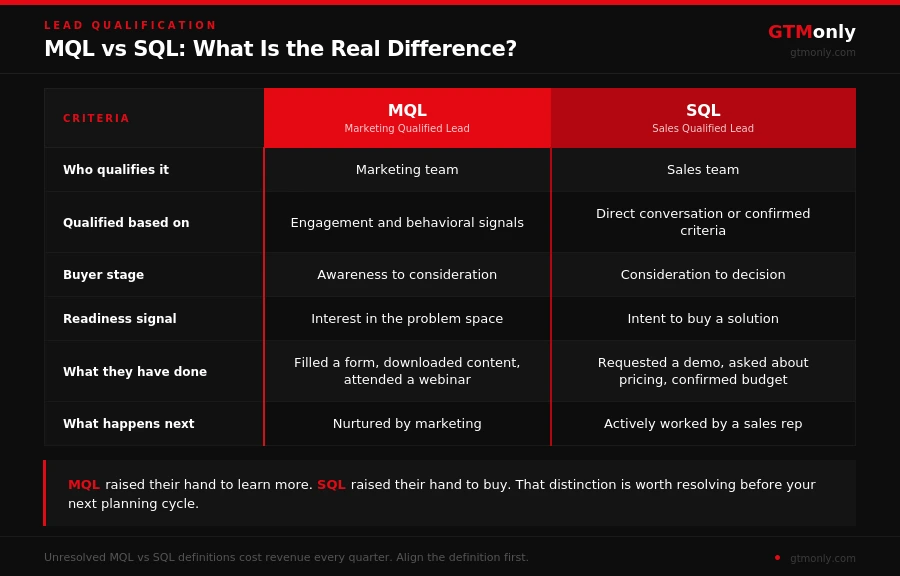
The average MQL-to-SQL conversion rate in B2B sits at around 13%, according to HubSpot benchmark data. In B2B SaaS specifically, top-performing teams hit 25% to 35%. If yours is below 10%, the issue is almost certainly your MQL criteria, not your sales team’s follow-up skills.
If your conversion rate is above 40% to 50%, your SQL bar is too low. You’re handing reps leads that need more nurturing, and they’re burning cycles on conversations that aren’t ready.
How Do You Know If a Lead Is Actually an SQL?
There are two types of signals that tell you a lead is SQL-ready. Fit signals tell you the prospect matches your ICP. Intent signals tell you they’re actively evaluating a purchase.
You need both. Fit without intent is a prospect. Intent without fit is a waste of a sales rep’s afternoon.
Fit Signals
- Company size, industry, and revenue match your ideal customer profile.
- The contact holds a title with actual purchasing authority or significant influence over the decision.
- The company is using tools or running processes that your solution directly improves or replaces.
Intent Signals
- They requested a demo, asked for a custom quote, or reached out directly asking how your product solves their specific problem.
- They visited your pricing page more than twice in the same week.
- They asked about implementation timelines, contract terms, or integration details.
- They introduced a colleague from their finance or IT team into the conversation.
- They mentioned a specific deadline, budget cycle, or triggering event driving the decision.
That last signal is one of the most underrated. When a prospect mentions a specific trigger, like a contract renewal coming up, a new hire joining, or a board deadline, the deal is real. When they can’t name a reason to move, it usually isn’t.
The Three Qualification Frameworks B2B Teams Use
Knowing what signals to look for is step one. Using a consistent framework to check those signals on every lead is step two. Here’s how the main ones compare.
| Framework | Best For | What It Checks | Watch Out |
| BANT | Mid-market and SMB sales | Budget, Authority, Need, Timeline | Can feel interrogative if used too rigidly |
| CHAMP | Consultative sales motions | Challenges, Authority, Money, Prioritization | Longer discovery cycles without budget anchoring |
| MEDDIC | Enterprise and complex deals | Metrics, Economic Buyer, Decision Criteria, Decision Process, Identify Pain, Champion | Overkill for shorter sales cycles |
If you’re at an early-stage B2B company and you don’t have a framework yet, start with BANT. It’s direct, teachable, and gets the most important questions answered fast.
The most common mistake isn’t picking the wrong framework. It’s not using any framework consistently. A rep who runs BANT on every call beats one who knows MEDDIC but applies it randomly.
The Fake SQL Problem Nobody Talks About
Here’s something that doesn’t show up in most SQL guides: leads that look like SQLs and aren’t.
Sales teams call these tire-kickers. They book demos, ask smart questions, and stay engaged throughout discovery. Then they go quiet. Or they come back six months later saying they still haven’t gotten budget approval. Or they were never actually the decision-maker in the first place.
These leads hit the sales qualified lead criteria on paper and blow up the pipeline in practice. Watch for these warning signs before marking something as an sales qualified lead:
- They can’t name a reason for the decision timeline. A real SQL almost always has a business event driving urgency. No trigger usually means no deal.
- They keep broadening the scope of the conversation. Real buyers narrow in on what they need. Tire-kickers explore everything without committing to any of it.
- They avoid introducing anyone from finance or procurement. In any deal above a certain size, the economic buyer eventually appears. If you’ve had five calls and still only speak to the same person, that person may not have the authority they implied.
- They give vague timeline answers. ‘Before end of year’ when it’s already November is different from ‘before end of year’ when it’s January. The first one is a deadline. The second one is a way to keep the conversation open without committing.
Getting this right takes practice. The devil is in the details on every qualification call. But catching a fake SQL early saves two to three weeks of sales effort per deal.
Not All Sales Qualified Leads Are Created Equal
Here’s a number most pipeline reports ignore. Referral-sourced SQLs close at around 14.7%. Email campaign-sourced SQLs close at around 7.8%. Event-sourced SQLs close at around 1%.
Same SQL label. Wildly different close probability.
When you roll everything into one SQL count and one SQL-to-close rate, you’re hiding the real performance of your pipeline. A referral SQL and a cold outbound SQL are not the same opportunity. Treating them identically produces a forecast number that lies to you every quarter.
The practical fix: track SQL source as a field in your CRM and report SQL-to-close rates by source separately. When you’re forecasting, weight referral and inbound SQLs higher than cold outbound. Your revenue predictions will get meaningfully more accurate within one quarter.
How to Define Your SQL Criteria (The Right Way)
Most companies get their sales qualified lead definition wrong for one reason: sales wrote it alone or marketing wrote it alone. A real SQL definition has to be built together and documented somewhere both teams can see it.
Here’s how to do it without a six-week project:
- Pull your last 30 closed-won deals. Look at what they had in common at the point they entered the sales pipeline. What title did the contact hold? What company size? What specific actions did they take before the first sales call? Those patterns are your SQL criteria.
- Pull your last 30 closed-lost deals. Identify the leads that made it to a late stage and still didn’t close. What were the missing signals? Where did they stop matching? That’s what your SQL criteria should screen out.
- Agree on a scoring threshold. Assign point values to fit and intent signals. Build the logic in your CRM. Set a threshold where a lead automatically flags as SQL-ready for sales review. Start simple: a Director-level title at a target-size company plus a demo request is a solid floor.
- Document it in writing. Put the SQL definition in a shared doc. Put it in your CRM as a stage description. Make it the first thing new SDRs read during onboarding. If the definition only lives in people’s heads, it doesn’t exist.
- Review it every 90 days. Your ICP shifts. Your product expands. Your buyer base changes. A SQL definition that was right at Series A may not be right at Series B. Build a quarterly review into your RevOps calendar.
The SQL Metrics That Actually Matter
Tracking sales qualified lead volume is the bare minimum. Here are the metrics that tell you whether your SQL process is working.
| Metric | What It Tells You | B2B Benchmark |
| MQL to SQL rate | Whether your MQL criteria is calibrated correctly | 13% average; 20-35% for top B2B SaaS |
| SQL to closed-won rate | Whether your SQL criteria is tight enough | 20-30% for well-qualified pipelines |
| SQL velocity (days) | How long it takes to move from SQL to close | 30-90 days for mid-market B2B |
| SQL by source | Which channels produce the best-converting SQLs | Referral: ~14.7%; Email: ~7.8%; Events: ~1% |
| SQL rejection rate | How often sales rejects MQLs as not SQL-ready | Healthy is 30-50%; over 70% signals misalignment |
If your SQL rejection rate is above 70%, marketing and sales have fundamentally different ideas about what qualifies as ready. That conversation needs to happen before next month’s pipeline review, not during it.
Conclusion
A sales qualified lead isn’t just a label in your CRM. It’s a commitment.
When you call something an SQL, you’re telling your sales team: this one is worth your time. Protect that. The more casually you use the label, the less your pipeline data means, and the harder it gets to forecast, prioritize, and close.
Get the definition right, document it, review it, and make sure both marketing and sales built it together. That single step does more for pipeline health than any tool, any sequence, or any playbook.
Once you have your SQL process locked in, the natural next question is how to keep those leads moving from SQL to closed-won without deals stalling in the middle of your pipeline. That’s where your sales funnel structure and B2B sales approach come in.
Frequently Asked Questions About SQL
What does SQL stand for in sales?
SQL stands for Sales Qualified Lead. It refers to a prospect that the sales team has reviewed and confirmed meets the criteria for a genuine buying opportunity. The term distinguishes these leads from MQLs (Marketing Qualified Leads), which are earlier in the funnel and not yet ready for a direct sales conversation.
What is the difference between an MQL and an SQL?
An MQL is a lead that marketing has identified as worth passing to sales based on engagement signals like content downloads, email opens, or webinar attendance. An SQL is a lead that sales has independently vetted and confirmed is ready to buy. The core difference is who qualifies the lead and what that qualification is based on. MQLs reflect interest. SQLs reflect intent. The average MQL-to-SQL conversion rate in B2B is around 13%.
What makes a lead SQL-ready?
A lead is SQL-ready when they meet your defined criteria across four areas: Budget (they have funding or can create it), Authority (they can influence or make the purchase decision), Need (your product solves a specific problem they’ve acknowledged), and Timeline (there’s a real reason to move within a defined window). High-intent behaviors like requesting a demo, asking about pricing, or bringing in a colleague from finance are strong signals that a lead has crossed the SQL threshold.
Why do sales teams reject so many MQLs?
Sales teams reject MQLs most often because the leads don’t match the ICP, aren’t in an active buying cycle, or haven’t shown genuine purchase intent despite heavy marketing engagement. When the MQL-to-SQL rejection rate exceeds 70%, it almost always points to a definition mismatch between marketing and sales. The fix is a joint session to align on what SQL criteria looks like, document it, and build it into the CRM as a stage definition both teams can see.
What is BANT and how does it help qualify SQLs?
BANT is a qualification framework that stands for Budget, Authority, Need, and Timeline. Sales reps use it to quickly assess whether a prospect is worth pursuing as an SQL. Budget confirms they have the funds or can create them. Authority confirms they can influence the purchase. Need confirms your product solves a real problem they face. Timeline confirms there’s urgency behind the decision. BANT is the most widely used framework in B2B sales and is a strong starting point for any team that doesn’t already have a structured qualification process.
How is a sales qualified lead different from a sales qualified opportunity (SQO)?
An SQL is a prospect that sales has confirmed is ready for a buying conversation. An SQO is the next step: an SQL that has entered a formal sales process with a defined deal stage, a projected close date, and active commercial discussion. The difference is formality. An SQL says this is worth pursuing. An SQO says this is an active deal with a real path to close. Not every SQL becomes an SQO. Some get disqualified during discovery. Tracking both stages separately gives you a more accurate view of pipeline health.