What Is B2B Sales? Meaning, Types, Process & Metrics
Okay, let me surprise you with a B2B sales fact.
In B2B sales, about 80% to 90% of the buying journey is already complete before a prospect ever picks up the phone to talk to a salesperson. Your best pitch? They’ve already heard a version of it. On your own website. At 11pm. Without you.
Surprised? Okay, one more.
In most complex B2B deals, the biggest competitor you’re up against isn’t the other vendor on the shortlist. It’s “no decision.” More deals die from internal inertia than from losing to a rival. The status quo wins more often than any salesperson does.
Still not surprised? Last one, I swear.
The best product in a B2B category regularly loses. Not to a better product. To the one that was easiest to buy. Fewer stakeholders needed, simpler procurement process, cleaner contract. The best solution and the winning solution are not always the same thing.
So here’s where that leaves you.
B2B sales is simple to explain and genuinely difficult to do well. You’re not selling to one person who wants a good deal. You’re selling to a group of people with competing priorities, limited budgets, and a strong pull toward doing nothing. Your product could be the obvious choice on paper and still lose to a slower, cheaper, easier-to-approve alternative.
What Is B2B Sales?
B2B sales stands for business-to-business sales. It’s the process of one company selling products, services, or software to another company.
That’s the textbook definition. Here’s the one that actually helps you do the job:
B2B sales is the art of helping a group of people inside another organization agree that your solution is worth the money, the effort, and the risk of changing how they work. It’s less about pitching and more about building consensus.
The buyer is not an individual consumer browsing for a good deal on a Friday night. The buyer is a committee of six to ten people (sometimes more) who all have different definitions of success, different fears about failure, and different bosses to answer to.
That’s what separates B2B from everything else. Not the deal size. Not the jargon. The group decision.
B2B vs B2C: The Differences That Actually Matter
Every article on this topic runs a comparison chart. Most of them list obvious differences like deal size and sales cycle length.
Those matter. But here’s the one difference that shapes everything else: in B2C, one person decides. In B2B, six to eleven people have to agree. That single fact explains why B2B sales cycles are long, why deals stall, and why having one good relationship inside a company is never enough.
| Factor | B2B Sales | B2C Sales |
| Buyer | A company, multiple stakeholders | An individual consumer |
| Deal size | $5,000 to multi-million | $5 to a few thousand |
| Sales cycle | Weeks to 18 months | Minutes to a few days |
| Decision driver | ROI, risk reduction, efficiency | Emotion, desire, social proof |
| Stakeholders | 6 to 11 per deal on average | One person |
| Purchase process | Formal: RFPs, legal, procurement | Informal: browse, decide, pay |
| Content’s role | Educates and supports internal champions | Triggers impulse, drives conversion |
| Post-sale motion | CS, onboarding, expansion, renewal | Returns, reviews, repeat purchase |
The bottom line: B2C sells to individuals. B2B sells to organizations. And organizations are slow, cautious, and full of people who can say no.
The 5 Types of B2B Sales
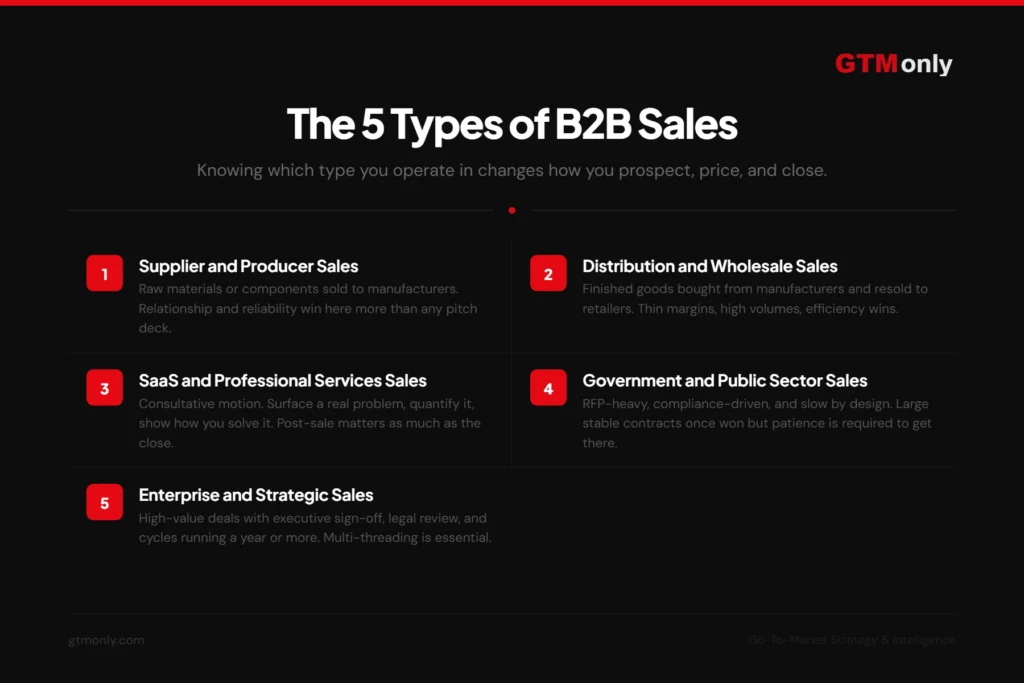
Not all B2B selling looks the same. Knowing which type you’re in changes how you prospect, price, and close.
1. Supplier and Producer Sales
One business sells raw materials or components to a manufacturer. Think chemicals to a paint company or steel to a car plant. High volume, repeat orders, long-term contracts. Relationship and reliability win here more than any pitch deck.
2. Distribution and Wholesale Sales
Distributors buy finished goods from manufacturers and resell to retailers. Margins are thin, volumes are high, and the game is efficiency and consistency.
3. SaaS and Professional Services Sales
This is where most modern B2B sales professionals operate. You’re selling software, consulting, or a subscription. The sales motion is consultative. You need to surface a real problem, quantify it, and show exactly how your solution solves it. The post-sale relationship matters just as much as the close.
4. Government and Public Sector Sales
Selling to agencies, municipalities, or public institutions. RFP-heavy, compliance-driven, and slow by design. The contracts are large and stable once won, but getting there requires patience and very specific expertise.
5. Enterprise and Strategic Sales
High-value deals often involving custom implementation, executive sign-off, legal review, and a sales cycle that can run a year or more. These deals require deep account management, multi-threading across departments, and tight internal coordination between sales, product, and customer success.
The B2B Sales Process: 7 Stages That Actually Work
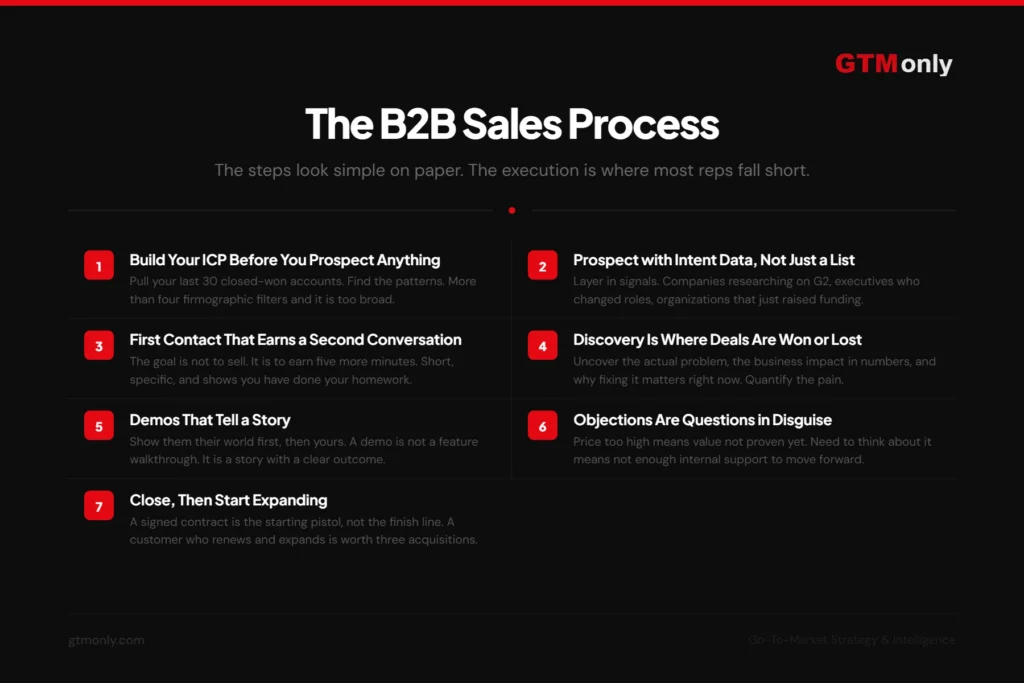
The steps look simple on paper. The execution is where most reps fall short. Here’s an honest breakdown of each stage, including where things tend to go wrong.
Stage 1: Build Your ICP Before You Prospect Anything
Most reps skip this stage or do it badly. They build the ICP they want rather than the one their data supports.
Pull your last 30 closed-won accounts. Look for patterns: company size, industry, tech stack, growth stage, trigger events. Those patterns are your Ideal Customer Profile (ICP). If you’re starting from scratch without that data, use the next ten discovery calls to gather it deliberately.
If your ICP has more than four firmographic filters, it’s too broad to be useful. Tighten it.
Stage 2: Prospect with Intent Data, Not Just a List
Old-school prospecting was: find companies that look like your best customers, then call everyone at those companies. That still works. But it’s now table stakes.
The reps hitting quota in 2026 layer in intent signals: companies researching your category on G2, executives who recently changed roles, organizations that just raised funding or crossed a headcount threshold. Those signals tell you who’s likely ready to buy right now.
Stage 3: First Contact That Earns a Second Conversation
The goal of your first message is not to sell. It’s to earn five more minutes. That’s it.
The best-performing outreach is short, specific, and shows that you’ve done your homework. Reference something real: a recent hire, a product launch, a pain you’ve seen in their industry. Generic templates get deleted without being read. (And they deserve to be.)
Stage 4: Discovery, Where Most Reps Rush
Discovery is where deals are actually won or lost. Most reps treat it like a formality before the demo they’re excited to give.
Real discovery uncovers three things. First: the actual problem, not the stated one. Second: the business impact in numbers. Third: why fixing it matters right now.
If you can’t quantify the pain, you have no leverage in the negotiation later. Ask the uncomfortable question: ‘What does it cost you not to fix this?’
Stage 5: Demos That Tell a Story
A demo is not a feature walkthrough. It’s a story with a beginning (their problem), a middle (your solution in their context), and an end (the outcome they get).
The worst demos open with a company overview slide. Nobody asked for your company’s founding story. Show them their world first, then show them yours.
Stage 6: Objections Are Questions in Disguise
When a prospect says ‘the price is too high,’ they’re usually saying: ‘I don’t yet believe the value is worth this cost.’ That’s not an objection to negotiate away. That’s a gap in your value case to fill.
When they say ‘we need to think about it,’ they’re usually saying: ‘I don’t have enough internal support to move this forward right now.’ That’s a champion-building problem, not a waiting problem.
Stage 7: Close, Then Start Expanding
Getting a signed contract is not the finish line in B2B. It’s the starting pistol for the real race.
Customer retention and expansion revenue are where B2B companies make their money. In SaaS especially, a customer who renews and expands is worth three times the cost of acquiring them. Treat the close as the beginning of a relationship, not the end of a transaction.
The Buying Committee Problem Nobody Talks About Honestly
Every B2B sales article mentions stakeholder management. Almost none of them tell you what to actually do when six people have six different objections.
According to Gartner, the average B2B buying group involves 6 to 10 stakeholders. Outreach research puts that at 11 for complex enterprise deals. Some buying committees go well above 20.
Each one has a different reason to say no. That’s not an exaggeration.
- The champion wants the problem solved and their internal credibility strengthened.
- The economic buyer wants ROI and will kill a deal that looks financially risky.
- The end user wants something easy to adopt. Friction kills deals from the bottom up.
- Legal and procurement want compliance and favorable terms. They can stall for months.
- The technical evaluator wants integrations and security certifications. They have veto power.
Your job is not to sell to all of them with the same pitch. It’s to understand which person is the current blocker, address their specific concern, and move on.
Most deals don’t die because your product wasn’t good enough. They die because one stakeholder’s concern went unaddressed, and they quietly killed it in an internal meeting you weren’t in.
The Dark Funnel: Your Buyer Has Already Made Up Their Mind
Here’s something that should change how your entire sales motion works.
Forrester research shows that B2B buyers complete 57% to 70% of their purchase journey before they ever contact a vendor. They’ve read your reviews on G2. They’ve watched your demo on YouTube. They’ve asked peers in Slack communities what tools they use. They’ve formed opinions about your company before your SDR makes first contact.
This is the dark funnel. It’s the buying research that happens in places you can’t track and conversations you can’t see.
By the time a prospect responds to your outreach, they may already have a shortlist. Your job is to be on it before the conversation starts. That’s a content and brand problem, not a sales problem.
What this means in practice:
- Your blog, your LinkedIn presence, and your review page are all part of your sales team. They work 24 hours a day.
- Reps who try to educate a buyer who is already educated waste everyone’s time.
- The reps who win know how to confirm and accelerate a decision the buyer is already leaning toward.
If you’re wondering why cold outreach feels harder than it did five years ago, this is a big part of the answer. Buyers self-educate better than ever. They don’t need your product overview email. They’ve already seen it.
MEDDIC: Qualify on Facts, Not Feelings
Here’s an honest confession: most pipeline reports are fiction.
Reps have a good call, the prospect seems excited, and the deal goes into the forecast. Three months later it’s still there, quietly rotting, making everything look better than it is. (Your manager knows. They’ve just stopped asking.)
MEDDIC fixes this. It’s a qualification framework that forces you to answer six specific questions before any deal goes into your forecast.
- Metrics: What is the measurable outcome your buyer expects? Not ‘improve efficiency.’ Something like: reduce churn by 15% within 90 days.
- Economic Buyer: Have you actually spoken to the person who can approve the budget? The champion who loves your product can’t always say yes.
- Decision Criteria: What specific factors will they use to evaluate vendors? Price, security, ease of integration, support quality? Get it in writing if you can.
- Decision Process: What are the steps from here to a signed contract? Who reviews? Who has to sign? What does legal review look like? How long does procurement take?
- Identify Pain: Can you describe their problem in their words? If not, you’ve done surface-level discovery and you’re in trouble.
- Champion: Is there someone inside the company actively selling for you when you’re not in the room? Someone who has credibility, owns the outcome, and can access the economic buyer?
If you can’t answer all six, the deal is not qualified. Move it to a nurture stage or actively work to get the answers.
For enterprise deals, the expanded version called MEDDPICC adds Paper Process (legal and procurement requirements) and Competition (who else is in the evaluation). Those additions are worth your time in any deal above $50,000 ARR.
Champion Building: Stop Finding Fans, Start Finding Allies
Every sales methodology tells you to find a champion. Almost none of them explain what a real champion actually looks like.
A fan of your product is not a champion. A fan says nice things in demos and goes quiet when the economic buyer asks hard questions.
A real champion has three qualities:
- Organizational credibility: Other people listen to them. Their recommendation carries weight.
- Personal ownership: Their reputation is tied to this decision. If it fails, they fail.
- Access to power: They can get 30 minutes with the CFO or CTO when it counts.
Building a champion is not about being likable. It’s about making them successful internally.
Give them the ROI numbers they need for their CFO presentation. Build the business case slide with them, not for them. Send them a competitive comparison they can use if someone internally raises an objection. Make them look like the person who did their homework.
When your champion leaves mid-deal (and it will happen), a single-threaded deal collapses immediately. Multi-thread early, before you need it.
Why B2B Deals Die (Price Is Rarely the Real Reason)
Win/loss analysis across B2B sales consistently tells us the same thing: price is cited as the reason for loss more often than it’s actually the reason.
When a prospect says ‘you’re too expensive,’ what they usually mean is: ‘I don’t believe the value is worth the risk of changing how we work.’ That’s a completely different problem.
Here’s where deals actually die:
- No real champion: There was a fan but nobody fighting internally when the economic buyer pushed back.
- No urgency: The prospect liked the product but had no compelling reason to buy this quarter rather than next.
- Single-threaded relationships: The contact left, changed roles, or lost budget authority. The deal had nowhere else to go.
- Shallow discovery: The proposal addressed the stated problem, not the real one. It missed the mark.
- Status quo won: The cost of changing felt higher than the cost of staying stuck. Change management risk was never addressed.
- Competitor had better internal access: Their rep was multi-threaded. Yours wasn’t.
The most honest thing you can do for your pipeline is run a real win/loss review. Not the sanitized version where everyone says ‘price.’ The uncomfortable version where you ask: who was our champion, did they have real authority, and did we know what the real buying process looked like?
AI Is Rewriting B2B Sales in 2026: What’s Real, What’s Hype
Let’s talk about the thing every B2B sales conversation eventually gets to: AI.
The hype is enormous. The reality is more complicated. And the teams getting it right are not the ones who replaced their sales reps with chatbots.
The AI SDR Reality Check
AI SDR tools have gone from embarrassing experiments to serious infrastructure. In early 2024, most AI SDR tools were sending generic emails that got flagged as spam within weeks. The models weren’t good enough for production B2B use.
That changed. Claude Opus 4 and Sonnet 4 (launched May 2025) brought the capability jump the category needed, with sustained autonomous work across multi-step workflows. By late 2025, 22% of sales teams had fully replaced their human SDR function with AI. Another 55% were running AI-augmented models.
Here’s the number the vendors won’t put in their pitch decks: AI SDRs convert meetings to sales opportunities at just 15%, versus 25% for human reps. That’s a 40% performance gap at the stage that matters most.
AI can process 1,000+ contacts per day. A human SDR manages 50 to 80. Volume is not the problem AI solves worst. Quality is.
The winning model is not AI instead of humans. It’s AI handling the top-of-funnel research and sequencing work, with humans focused entirely on the conversations that actually close deals.
Where AI Actually Wins in B2B Sales Right Now
Stop thinking about AI as a replacement for salespeople. Think about it as the thing that makes your salespeople worth twice as much.
Here’s where it actually works:
- Pre-meeting research: Teams are using custom ChatGPT assistants to generate full meeting briefs in under two minutes. Paste in the attendee list, past meeting notes, and company context. The output covers attendee backgrounds, the purpose of the call, and prospect-specific context. What used to take an SDR 45 minutes takes five.
- Signal-based outreach with Clay and n8n: The best outbound motions now combine Clay for data enrichment, n8n for workflow orchestration, and ChatGPT or Claude for personalization at scale. One team documented generating thousands of account-specific personalized emails for under $10 in AI credits. It took eight hours to set up and runs on autopilot.
- AI call coaching with Gong and Sybill: AI tools now listen to discovery calls, fill in CRM fields automatically based on what was said, and flag deals missing MEDDIC components. Your forecast gets more honest whether you want it to or not.
- Re-engagement automation: Closed-lost deals are typically three times easier to re-engage than cold outreach. AI tools can monitor job change signals, funding events, and product announcements, then trigger personalized re-engagement sequences automatically.
- Forecasting and pipeline hygiene: AI is finally doing something useful with all that CRM data: identifying zombie deals before they embarrass you in the quarterly review.
The n8n + Claude + Clay Stack That’s Worth Your Attention
If you want to understand where the most forward-thinking B2B sales teams are investing right now, look at the combination of n8n, Clay, and a large language model API (Claude or ChatGPT).
n8n is a workflow automation platform that connects your tools without requiring engineering resources. Think of it as the plumbing that lets your CRM talk to your enrichment tool, your email sequencer, and your AI model, all in one automated flow.
A practical example: a prospect visits your pricing page. n8n detects the intent signal, pulls company and contact data from Clay, enriches it with technographic and firmographic context, passes it to Claude for a personalized outreach draft, and sends it through your email tool, all within 30 seconds of the original trigger. No SDR needed for that workflow.
Signal-based prospecting with this kind of stack generates 5.4 times more pipeline with 33% fewer outbound calls. That stat comes from production deployments, not vendor marketing.
What AI Cannot Do in B2B Sales
AI is worth its weight in gold for research, enrichment, sequencing, and analysis. It is not a replacement for the things that actually close complex deals.
It cannot navigate the political dynamics of an enterprise buying committee. It cannot build the kind of trust that makes a champion fight for you in a room you’re not in. It cannot hear the hesitation in a CFO’s voice and know what question to ask next.
The teams abandoning AI tools at high rates (Gartner predicts 40% of agentic AI projects will be abandoned by 2027) are the ones who deployed AI to replace relationship-building instead of to support it.
The teams seeing real returns are the ones who got the boring stuff right first: clean CRM data, a working ICP, a real qualification process. Then they added AI on top. Garbage in, garbage out. That rule didn’t change just because the tool got smarter.
B2B Sales Metrics That Tell You the Truth
There are dozens of metrics you could track. Most teams track activity metrics that feel productive and predict nothing.
Calls made, emails sent, demos booked. Those are inputs. Here are the outputs that actually matter:
| Metric | What It Reveals | What to Watch For |
| Win rate by stage | Where deals are falling out of your funnel | Stage where your win rate drops most = your biggest process gap |
| Average sales cycle length | Deal velocity from qualified to closed | Cycles extending over time = complexity increasing or process breaking |
| Average deal size | Quality of pipeline, not just volume | Declining ACV means you’re chasing the wrong accounts |
| Pipeline coverage ratio | Open pipeline vs quota | Healthy minimum is 3x to 4x. Below 2x is a forecast emergency |
| Champion-confirmed deals | % of pipeline with a real internal ally | Low rate = your forecast is fiction. Fix this before anything else |
| Expansion revenue % | Revenue from existing customers vs new logos | Rising expansion rate = strong product-market fit and CS execution |
| Quota attainment distribution | How many reps are hitting target | Under 60% attaining quota signals a systemic problem, not a rep problem |
One metric most teams underuse: deal age by stage. Any deal that has sat in the same pipeline stage for more than two sales cycles is a zombie deal. It’s not closing. It’s flattering your pipeline report while your team wastes energy on it. Get it out.
What Separates the Teams That Win
B2B sales is not a mystery. It’s a discipline.
The teams that consistently hit quota are not running magical playbooks. They have a clear ICP built from real data. They qualify deals honestly using a framework like MEDDIC. They build real champions, not just fans. They understand the dark funnel. And they use AI where it actually works: research, enrichment, sequencing, and analysis.
The devil is in the details with all of it. An ICP that sits in a slide deck unused is no better than no ICP. A MEDDIC checklist that reps game to keep their deals in forecast is worse than no framework at all. Champions who aren’t empowered with the right materials don’t fight for you.
Get the basics right first. Then layer on the tools. In that order.
That’s how B2B sales actually works.
Frequently Asked Questions
What does B2B sales stand for?
B2B stands for business-to-business. B2B sales is the process of selling products, services, or software from one company to another company, as opposed to selling directly to individual consumers.
What is the main difference between B2B and B2C sales?
The key difference is who makes the buying decision. B2C involves a single consumer making a personal purchase. B2B involves a group of six to eleven stakeholders making a collective organizational decision. That group dynamic is what makes B2B sales cycles longer, more complex, and harder to forecast.
What are the stages of the B2B sales process?
The typical B2B sales process includes seven stages: ICP definition and targeting, intent-based prospecting, outreach and first contact, discovery and qualification, solution presentation and demo, objection handling and negotiation, and post-close onboarding and expansion.
What is MEDDIC and why does it matter?
MEDDIC stands for Metrics, Economic Buyer, Decision Criteria, Decision Process, Identify Pain, and Champion. It’s a qualification framework that forces sales reps to confirm a deal is real before it enters the forecast. Teams that use it have more accurate pipelines and fewer surprise losses at the end of the quarter.
What is a B2B sales funnel?
A B2B sales funnel represents the stages a prospect moves through from first becoming aware of a solution to signing a contract. It typically includes awareness, consideration, evaluation, and decision. Sales teams use it to spot bottlenecks, prioritize deals, and forecast revenue.