What Is an Ideal Customer Profile? How to Create + Template
TL;DR
An ideal customer profile (ICP) is a data-backed description of the type of company that gets the most value from your product and gives the most value back to your business.
It defines firmographics, pain points, buying behavior, and tech stack so your entire GTM team targets the right accounts from day one. Without one, you are guessing. With one, you are building a repeatable revenue motion.
Your ideal customer profile is the first thing that breaks in most B2B GTM motions. And it is the last thing that gets fixed.
Sales reps go out and prospect whoever picks up the phone. Marketing runs campaigns broad enough to fill a stadium. Then leadership wonders why the pipeline is full but the win rate is stuck at 18%.
The answer almost always traces back to a missing or broken ICP.
This guide shows you exactly what an ICP is, how it differs from a buyer persona, and how to build one your sales and marketing teams will actually use.
What Is an Ideal Customer Profile (ICP)?
An ideal customer profile (ICP) is a detailed, data-backed description of the type of company that is the best possible fit for your product or service. It describes the organizations most likely to buy from you, find real value in what you sell, stay loyal, and drive revenue over time.
The key word is company. In B2B, you are not just selling to a person. You are selling to an organization with a budget, a buying process, a tech stack, and a set of business problems. Your ICP captures all of that.
A well-built ideal customer profile (ICP) typically includes five layers of information:
- Firmographics: Industry, company size, annual revenue, geographic location, and company stage such as startup, scale-up, or enterprise.
- Technographics: The tools and platforms the company already uses, especially if your product needs to integrate with them.
- Pain Points: The specific business challenges your product is built to solve for this type of company.
- Buying Behavior: How they evaluate vendors, who owns the purchasing decision, and how long their typical sales cycle runs.
- Success Criteria: What does winning look like for them 90 days after they buy?
Think of your ideal customer profile as a targeting tool. It tells everyone on your revenue team which accounts are worth pursuing and which ones will drain their time.
According to HubSpot’s 2024 State of Marketing Report, 76% of high-performing marketing teams say their go-to-market strategy is built on a clearly documented ICP, compared to just 38% of low performers. That gap is not a coincidence.
So before going further, it is worth being honest about what an ICP is not. That is where most teams get tripped up.
What an ICP Is Not
An ICP is not a wishlist. That is where most teams go wrong right out of the gate.
Building an ideal customer profile from a whiteboard session based on the customers you want, rather than the customers who have already won, produces a profile that looks polished in a deck and fails in the field.
Your ICP is also not any of the following things:
- Your target market. Your target market is broad. Your ICP is the best slice within that market, the accounts most likely to close, expand, and refer.
- A buyer persona. An ICP describes a company. A buyer persona describes a person inside that company. They are related but solve different problems.
- A static document. Markets shift. Your product evolves. Your best customers in Year 1 may not look identical to your best customers in Year 3. Your ICP needs a review every six to twelve months.
Now let us get into the comparison that confuses almost every team early on.
Ideal Customer Profile vs. Buyer Persona: What Is the Difference?
Your ideal customer profile describes a company. Your buyer persona describes a person within that company.
They work together but answer different questions. Here is a clear breakdown:
| Ideal Customer Profile (ICP) | Buyer Persona | |
| Describes | A company or organization | An individual decision-maker |
| Answers | Which accounts should we target? | Who do we talk to at those accounts? |
| Includes | Firmographics, technographics, pain points, buying process | Job title, goals, daily challenges, content preferences, objections |
| Used by | Marketing, Sales, RevOps, Product | Content, SDRs, AEs, Customer Success |
| How many? | Usually one primary ICP | Three to five per buying committee |
| Scope | Organization-level | Individual-level |
Here is a concrete example. Say you sell a revenue intelligence platform.
Your ICP might be: B2B SaaS companies with 100 to 500 employees, $10M to $50M ARR, a dedicated sales team of 15 or more, using Salesforce as their CRM, and actively scaling outbound.
Within that ideal customer profile, your buyer personas might include a VP of Sales who owns the decision, a Revenue Operations Manager who evaluates the tech fit, and an SDR Team Lead who will use the product daily.
The ICP gets your team into the right accounts. The buyer personas tell them how to navigate those accounts once they are in.
You need both. But build the ICP first. It is the foundation everything else sits on.
With that distinction clear, here is why getting your ICP right matters so much across the entire business.
Why Your ICP Is Your Most Important GTM Asset
Most B2B companies treat the ideal customer profile as a marketing exercise. That is a mistake.
Your ICP is the document that aligns Sales, Marketing, Product, and Customer Success around one shared definition of the right customer. When that definition is clear, everything downstream gets sharper.
Here is what a tight ideal customer profile produces across each team:
- Sales: Reps stop chasing unqualified leads. Qualification calls get shorter. Win rates go up because reps are pitching companies that can actually use what they are selling.
- Marketing: Campaigns target accounts with real buying potential. Content speaks to real pain points. Cost per qualified lead drops.
- RevOps: Lead scoring becomes accurate. Pipeline health metrics reflect reality. Forecasting improves.
- Customer Success: Customers who fit the ICP onboard faster, hit time-to-value sooner, and churn less. They also refer more.
- Product: Roadmap decisions get grounded in what your best customers actually need, not a laundry list of one-off requests from misfit accounts.
When sales and marketing both work from a documented ICP, the impact is measurable. Marketo research found that aligned teams achieve 36% higher customer retention rates and 38% higher sales win rates, contributing to 208% growth in marketing-generated revenue.
That is not a rounding error. That is the difference between a GTM motion that scales and one that stalls.
Now that you know why it matters, let us get into the actual work of identifying your ICP.
How to Identify Your Ideal Customer Profile
You do not build an ideal customer profile in a conference room. You build it from data. Here is where to start.
Start With Your Best Existing Customers
Pull your top 10 to 15 closed-won accounts from the last 12 to 18 months. Best means the ones with the highest contract value, the shortest sales cycle, the lowest churn risk, the most product adoption, and the most referrals or case study participation.
These are your existing ICPs. You are just finding the pattern.
Look for Firmographic Patterns
Now analyze those accounts for shared characteristics. What industries do they operate in? How large are they by headcount and revenue? Are they venture-backed, bootstrapped, or public?
You will see clusters. A fintech SaaS company with 50 to 200 employees may keep showing up. An enterprise retail brand may never stick around past Year 1. Those patterns are data. Trust them.
Dig Into Technographics
Your best customers likely share a similar tech stack. Check which CRMs, marketing automation tools, and data platforms they use. If your product integrates with Salesforce and HubSpot, accounts where Salesforce is the CRM will almost always have a smoother buying and onboarding experience.
Tools like G2, Bombora, BuiltWith, or your own CRM data can surface this quickly.
Interview Your Champions
Get on calls with the contacts at your five or six best customer accounts. Ask: What was going on in your business before you started looking for a solution like ours? What problem were you hired to solve when this became a priority? What made us the right fit over alternatives?
The answers give you the qualitative layer. These are the pain points and triggers that do not show up in a spreadsheet. They become the most powerful parts of your ICP messaging.
Analyze Your Losses Too
Look at deals you lost or churned in the last 12 months. What did those accounts have in common? Were they too small? Did they lack a dedicated RevOps function? Were they using a competitor stack that does not integrate with yours?
Your disqualifiers are just as valuable as your qualifiers. Build a clear not-a-fit list alongside your ICP. It makes qualification faster for every rep on your team.
With all that data in hand, here is how to build the actual document.
How to Create an Ideal Customer Profile: A 5-Step Framework
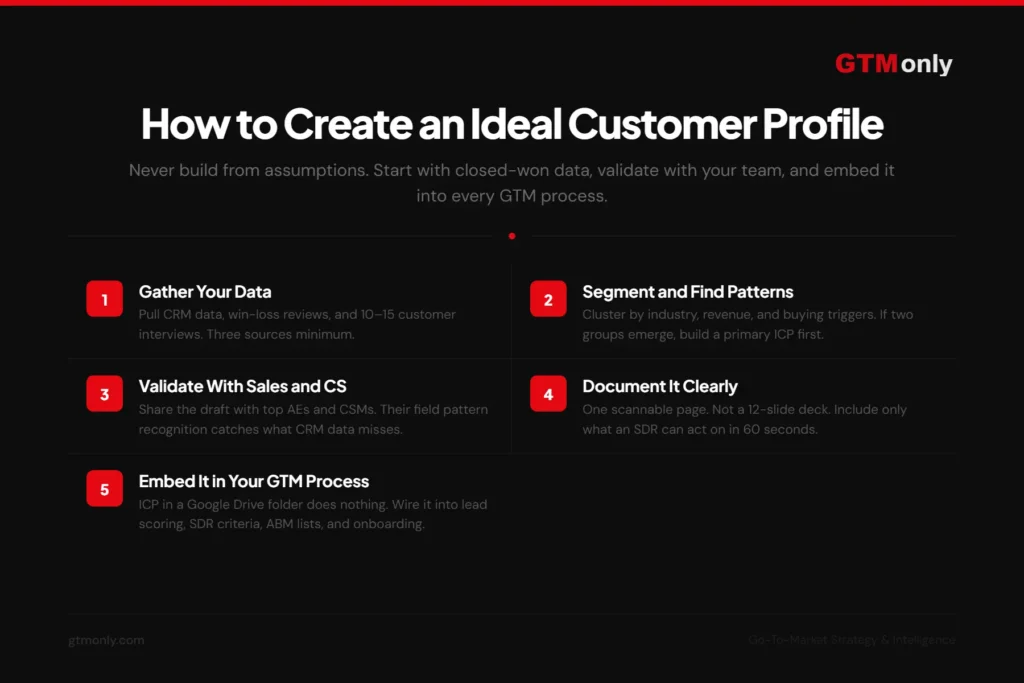
Step 1: Gather Your Data.
Pull from at least three sources: CRM data covering firmographics, deal velocity, and ACV; sales call notes and win-loss reviews; and direct customer interviews. Never build from assumption alone. Target a sample size of at least 10 to 15 closed-won accounts. The larger the sample, the more reliable the patterns.
Step 2: Segment and Find Patterns.
Group accounts by shared attributes. Industry, company size, and revenue band will give you your first natural clusters. From there, go deeper. Look at buying triggers, tech stack, team structure, and sales cycle length.
If two or three distinct clusters emerge, you may have a primary ICP and a secondary ICP. Build the primary profile first. Keep any secondary type as a Tier 2 rather than muddying the main definition.
Step 3: Validate With Sales and CS.
Share your draft ICP with your top-performing AEs and Customer Success Managers. They have pattern recognition that does not always live in CRM data. Ask them: Does this match what you see in the field?
If they say no, dig into why. Their pushback often surfaces the most important nuances.
Step 4: Document It Clearly.
Your ICP is not a 12-page deck. It is a single, scannable document your team can reference in 60 seconds. Include only what is actionable. Use the template in the next section as your framework.
Step 5: Embed It in Your GTM Process.
An ICP that sits in a Google Drive folder does nothing. Embed it into your lead scoring model, your SDR qualification criteria, your ABM target account list, and your onboarding checklist. The ICP only creates value when it changes behavior.
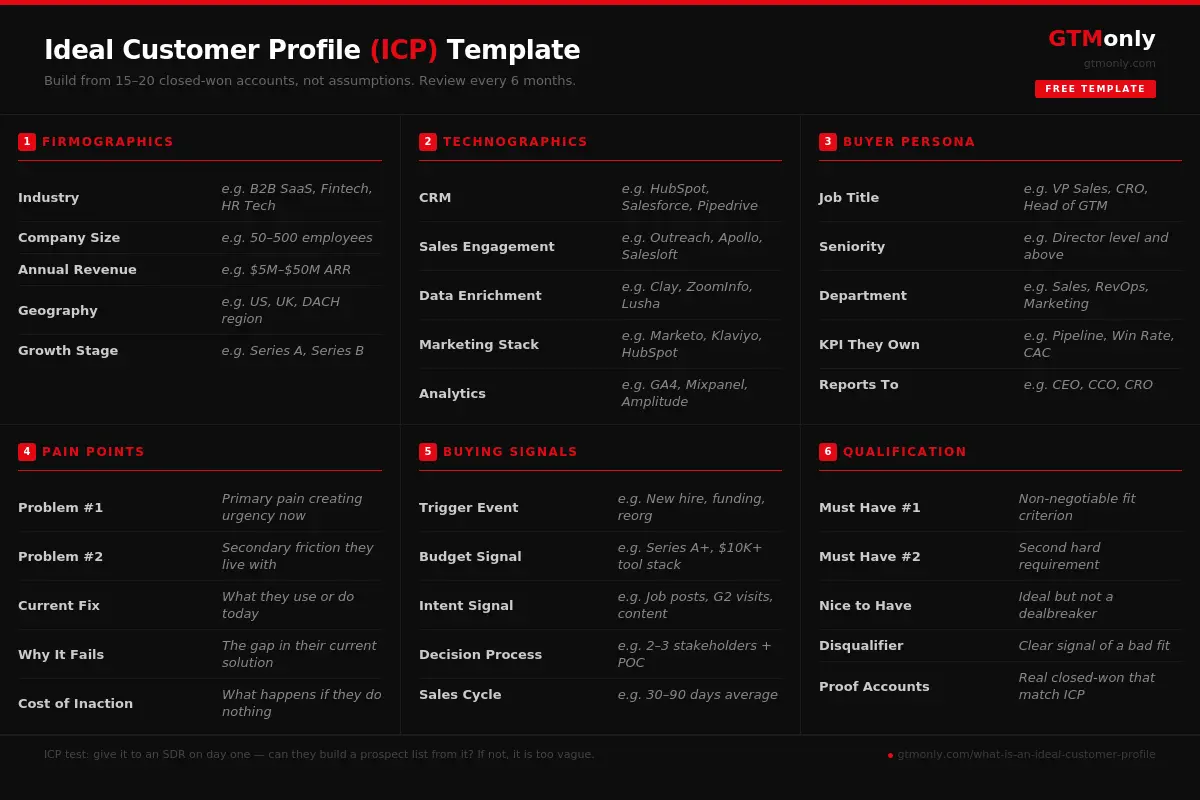
Here is the framework to build that document. Fill in every field with real data, not placeholder text.
Ideal Customer Profile Template (B2B)
ICP in Sales: How Your Team Uses It Every Day
The ICP is not just a marketing document. It is a sales operations tool. The best GTM teams put it to work across the full sales process.
Prospecting and List Building
Your ICP firmographics become your filters in Apollo, ZoomInfo, or LinkedIn Sales Navigator. Industry, headcount range, revenue band, funding stage, and tech stack are all fields you can filter by in these tools.
An SDR targeting 50 ICP-fit accounts will almost always outperform one mass-emailing 500 unqualified ones. The devil is in the details, and those details live in your ICP definition.
Lead Scoring
Your marketing automation platform should score inbound leads against your ICP. If a company’s firmographics and behavior signals match your ICP, they score high and route to Sales. If they do not match, they go into a nurture track.
This protects your AEs’ time and keeps pipeline quality tight.
Discovery and Qualification
Use your ICP’s pain points and trigger events as your qualification criteria during discovery calls. If a prospect has none of the pain points your ICP defines, they are not a fit regardless of how eager they seem on a first call.
The best sales teams use the ICP to qualify out as fast as they qualify in. Time saved on bad-fit deals is time invested in winnable ones.
Pitching and Proposal Stage
Your ICP’s success criteria define how you frame your value proposition. For an ICP account struggling with long sales cycles, lead with how your platform cuts time-to-close. For one struggling with churn from poor targeting, lead with how better fit increases retention.
The ICP tells you what matters to this type of company. Use that to make every pitch feel custom-built even when it is a repeatable motion.
Post-Sale Handoff to Customer Success
When you close an ICP-fit account, the handoff to Customer Success carries context. CS knows what success looks like for this customer type, which use cases to activate first, and what risks to watch in the first 90 days.
Customers who fit the ICP well tend to hit time-to-value faster. That shortens the payback period and reduces early churn.
Most ICP mistakes are easy to prevent once you know they are coming. Here is what to watch for.
Common ICP Mistakes and How to Avoid Them
Building the ICP You Want, Not the One Your Data Supports
This is the biggest mistake in ICP work. You want enterprise Fortune 500 logos. Your actual best customers are growth-stage Series B companies. Your CRM knows the truth. Use it.
Making It Too Broad
An ICP that says any B2B company with over 50 employees in North America is not an ICP. It is a cop-out. If your ICP does not disqualify most of the market, it is not doing its job.
Building It Once and Never Updating
Your ICP should be a living document. Review it every six months, especially when win rates shift, churn spikes, or your product adds a major new capability. The market changes and your ICP should too.
Keeping It in a Slide Deck No One Opens
An ICP only delivers ROI when your team uses it. Embed it in your CRM, your lead scoring model, your SDR cadence criteria, and your AE qualification rubric. If it is not in the tools your team uses daily, it does not exist.
Ignoring the Disqualifiers
Most ICP documents list who you should target. Fewer list who you should not target. Your not-a-fit criteria are just as important. They prevent your team from chasing deals that will never close, or worse, closing deals that churn in 60 days.
The Bottom Line
Most B2B GTM failures share one root cause: teams targeting the wrong accounts with the wrong message.
An ideal customer profile is how you fix that. Not with a whiteboard exercise, but with real data from your best existing customers. Build it from win patterns. Test it with your sales team. Embed it into every tool your revenue org touches.
The best GTM teams do not guess who their ideal customer is. They know. And that knowledge compounds over time: better leads, shorter cycles, higher retention, and a revenue motion that actually scales.
Start from scratch if you have to. Your ICP is worth getting right.
Frequently Asked Questions
What tools help me build and apply my ICP?
Your CRM is the starting point for data. Salesforce and HubSpot both store the firmographic and behavioral data you need. For prospecting against your ICP, Apollo, ZoomInfo, and Clay are purpose-built for filtering by firmographic and technographic criteria. Gong or Chorus can surface pattern data from sales calls.
What is an ICP in sales specifically?
In sales, an ICP functions as a qualification framework. It defines the account characteristics that make a company worth pursuing. SDRs use it to build target lists, AEs use it to qualify opportunities, and RevOps uses it to build lead scoring models. A well-embedded ICP reduces wasted pipeline and increases win rates.
How many ICPs should a company have?
Most B2B companies should have one primary ICP and no more than two or three tiers. If you are trying to serve five different ICPs equally, you do not have an ICP. You have a sales strategy problem. Start with your single best-fit customer type and build from there.
How often should you update your ICP?
Review it every six to twelve months. Revisit it immediately when win rates drop significantly, churn spikes from a particular segment, you launch a major new product capability, or your go-to-market motion changes significantly, such as moving upmarket or launching a PLG layer.
Can startups and small businesses use an ICP?
Yes, and they should. Startups especially benefit from ICP discipline because every sales and marketing dollar matters more when resources are limited. Even a basic ICP helps a small team avoid wasting time on leads that will never convert.