SEO Trends in 2026: What I’m Actually Seeing as a B2B SEO Specialist
I have read a lot of SEO trends articles this year. Occupational hazard.
Most of them are written by people who spent an afternoon reading other SEO trends articles. You can tell. They all land in the same place. AI is changing everything. Optimize for intent. Build EEAT.
Thanks. Truly.
I work in B2B SEO every day. I live in Google Search Console. I see what these shifts are actually doing to real content programs. Some of what is happening in 2026 is genuinely different from anything in the past five years.
So here are 11 things I am actually tracking. Real data behind each one, linked to the source. A GTM lens on what it means. And no advice about creating high quality content that you have heard a hundred times.
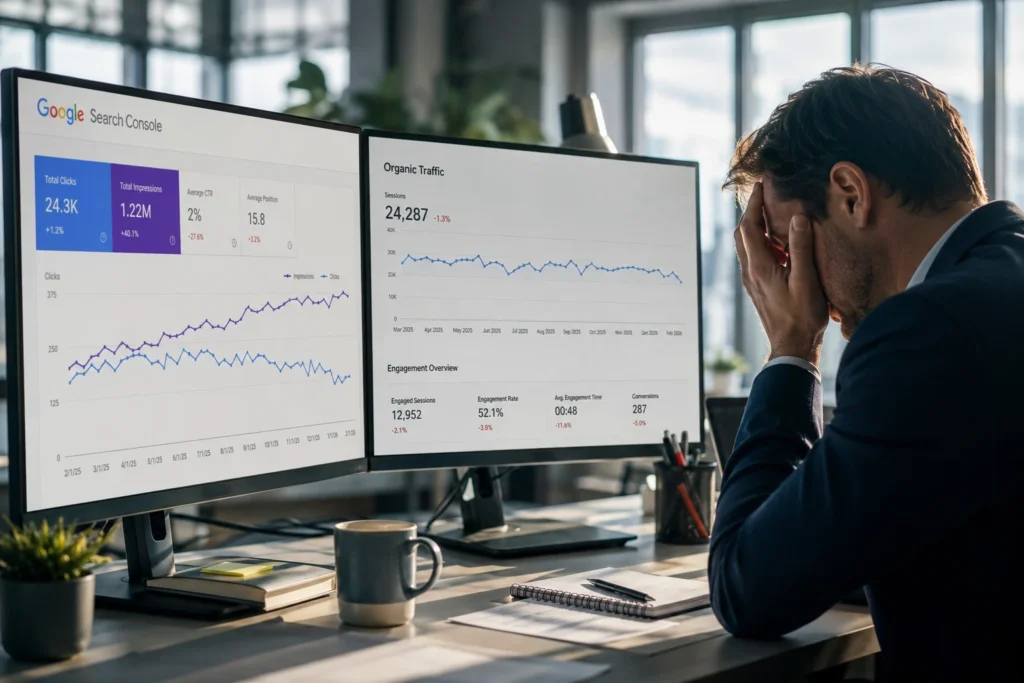
1. Your Impressions Are Going Up. Your Traffic Is Not. Your Search Console Is Technically Correct.
I hear this from B2B SEO teams almost every week now.
“Impressions are up 40% year over year. Traffic is kind of flat. Should we be worried?”
Yes. But not for the reason you think.
This is not a tracking problem. It is not a GA4 migration issue. What you are seeing is the direct effect of AI Overviews landing on your content.
When an AI Overview appears above organic results, the number one result loses 34.5% of its clicks. Not impressions. Clicks. The page still shows up. People just do not click because they already got the answer.
By early 2026, AI Overviews appeared on 48% of all tracked queries, up from 31% in February 2025. A 58% year over year increase.
For B2B technology queries specifically, the share of searches triggering AI results grew from 36% to 82% in twelve months. (BrightEdge, February 2026)
82%.
More than 8 in 10 searches your ideal buyer types into Google are returning an AI-generated answer before they reach your content.
And zero-click searches now account for 60% of all Google searches, rising to 77% on mobile. (Bain and Company, 2025)
Impressions went up because Google is using your content as a source. Traffic went down because nobody had to click to get the answer. That is not a problem you fix by tweaking your title tag.
Stop measuring success purely by ranking. Start tracking whether you are cited inside the AI Overview. Brands cited in AI Overviews earn 35% more organic clicks than non-cited brands for the same queries. Being the source beats being number one.
Google Search Console added an AI Overview filter under Search Appearance in mid-2025. If you have not turned that on yet, do it today. It is the most useful new data point in Search Console in years.
2. Position Number One Is Not Worth What It Used to Be
For most of my career, ranking number one was the goal. Full stop.
In 2022, a position one ranking on a competitive keyword averaged a 28 to 30% click-through rate. Worth every hour of effort.
Today, when an AI Overview appears above the results, CTR at position one drops to roughly 8%. (Pew Research Center, July 2025)
Seer Interactive’s September 2025 study found that organic CTR drops 61% for queries where an AI Overview appears. That is not a rounding error.
Here is what actually surprised me more than the CTR data.
The overlap between top ten Google rankings and AI Overview citations collapsed from 75% in mid-2025 to between 17 and 38% by early 2026. (Demand Local, 2026)
You can rank number one and never appear in the AI Overview. You can rank seventh and be the only source the AI cites. The signals that drive traditional rankings and the signals that drive AI citations are two different sets of rules. Most SEO strategies are still playing by the old set.
This is the biggest structural shift in organic search in a decade. Understanding search intent has never been more important, but the intent landscape just got considerably more complicated.
3. B2B Buyers Are Building Vendor Shortlists in ChatGPT Before They Ever Search Google
This one took me a while to fully appreciate. Then I read the data and could not unsee it.
85% of B2B buyers already have a preferred vendor list before they ever speak to a sales rep. That list is now being built in AI conversations. Not in Google.
G2’s April 2026 report found that 51% of B2B software buyers now start their research with an AI chatbot more often than traditional search. Up from 29% just 11 months earlier.
Think about what that looks like. A buyer opens ChatGPT and asks what the best sales intelligence tools are for mid-market SaaS. ChatGPT names three vendors. Those three are on the shortlist. Everyone else does not exist at that stage.
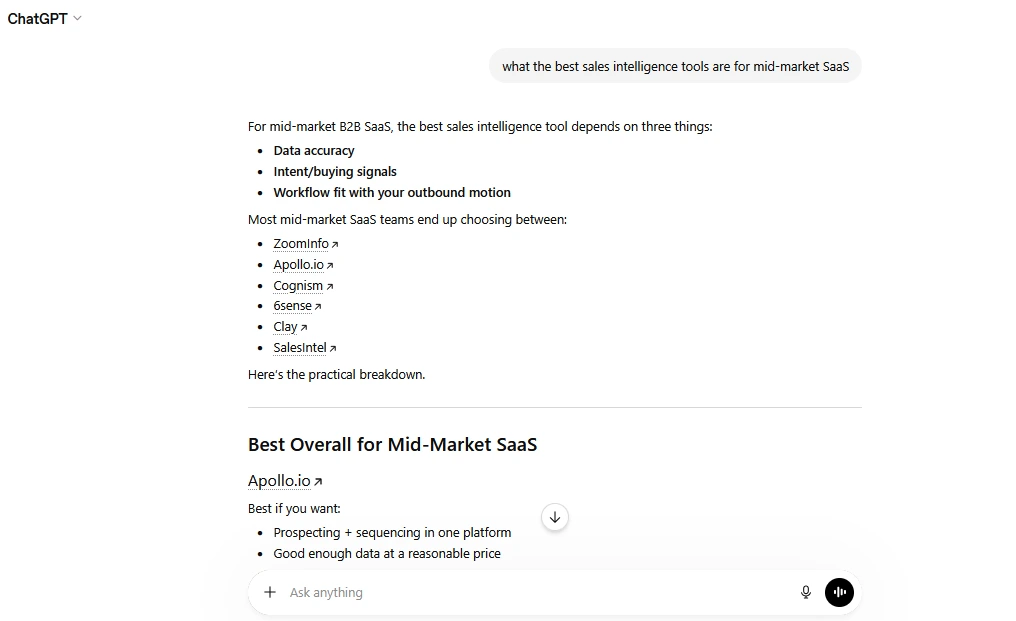
And it gets sharper. 69% of those buyers chose a different software vendor than they initially planned because of what an AI chatbot recommended. One in three bought from a vendor they had never heard of before.
Google shows ten results. AI gives three or six. The competition for inclusion is tighter, and citations are driven by completely different signals than traditional SEO. Structured content, third-party mentions, Reddit discussions, domain credibility, and clear factual answers all matter here.
I will be honest. When GEO started appearing everywhere, I rolled my eyes. Sounded like someone needed a new acronym to sell a consulting package. But the G2 data is from a March 2026 survey of over 1,000 real B2B buyers. The early buyer journey moved.
4. Reddit Is Being Cited in Roughly 40% of AI Responses. Let That Sink In.
I did not expect this to be on the list either.
OtterlyAI analyzed over 5.5 million social media citations across AI search platforms and found that Reddit accounts for 46.4% of all social media citations in AI search. YouTube is second at 31.8%. The two platforms together make up 78.2% of all social media citations in AI search. (OtterlyAI, April 2026)
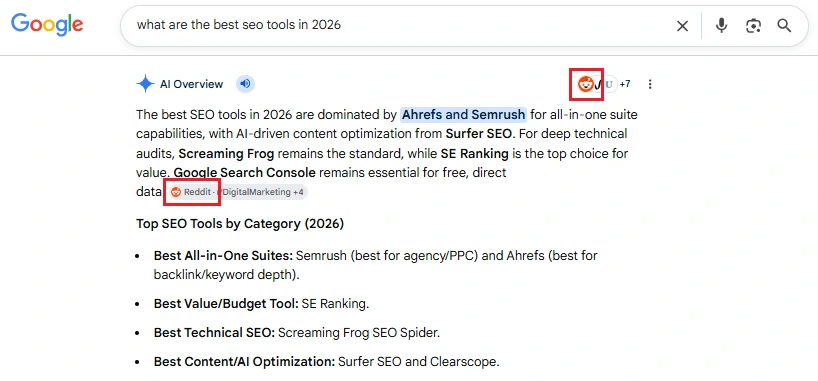
And when you look at total AI citations across all content types, the 5WPR Citation Source Index analyzed 680 million citations from ChatGPT, Google AI Overviews, Perplexity, Gemini, and Claude between August 2024 and April 2026. Reddit topped the list across every major model, accounting for roughly 40% of all citations.
A site made primarily of anonymous arguments and product complaints is one of the most cited sources in AI-generated answers. Every SEO agency is now a Reddit strategy agency too. Funny how that works.
There is a real reason for this. Google extended its data-sharing agreement with Reddit in 2024. More importantly, AI systems trust community content because it is harder to manufacture than polished brand copy. Real people describing real problems and real solutions. That is what AI engines keep going back to.
For B2B, the implication is direct. When someone asks ChatGPT what real users think about a product category, the answer is being built from Reddit threads, G2 reviews, and community discussions. Not from your product page.
5. Google Just Rewarded First-Hand Experience and Punished Polished Fakes
Some of the worst-performing content I have seen in 2026 is also some of the most expensive.
Beautifully written. Technically complete. No lived experience behind it.
Google’s March 2026 core update was the most significant EEAT-focused update in three years. What happened was clear: sites demonstrating genuine first-hand experience gained positions on competitive queries. Sites with high domain authority but thin experiential content lost ground to lower-authority sites with real practitioner knowledge.
After December 2025’s core update, generic content farms saw traffic drop sharply while sites with genuine experience signals gained 23%. (BKND Development, 2026)
I have watched this play out in B2B niches. A solo practitioner blog outranking a well-funded SaaS company’s resource center. A founder-written guide ranking above a polished agency article. The solo practitioner wrote from doing the actual work. The agency article was technically correct and completely impersonal.
EEAT in 2026 is not about adding an author bio at the bottom of a page. It is about writing content that could only exist because someone actually did the thing. Specific tools used. Real outcomes. Documented failures. Observations that contradict standard advice.
Google spent two years improving its ability to tell the difference between content by someone who knows about a topic and content by someone who has done it. The March 2026 update tells us the detector is working.
Good on-page SEO has always started with matching intent. In 2026, it also requires proving you were actually there.
6. Human Content Is Outranking AI Slop at the Top of Page One
Let me be direct here.
Google does not penalize AI-generated content. They have said this repeatedly. What Google penalizes is low-quality content. And a very large share of AI-generated content being published in 2026 fits that description.
The pattern I keep seeing: human-first content built on lived experience holds or gains top three positions. AI-generated content optimized for volume sits in positions four to ten or falls off page one after updates.
AI-generated content can capture broad keyword coverage and rank in positions four to ten. Human-first content with genuine practitioner expertise takes positions one to three and holds them through algorithm updates.
Both approaches can produce results depending on your goal. If your goal is B2B authority and conversion, human content wins by a margin that is only widening.
7. Multimodal Discovery Is Changing SEO
Most SEO articles still focus only on Google search rankings.
But that is no longer how people discover content online.
In 2026, people search in many different ways. They use Google Lens to search with photos. They ask questions to voice assistants. They search on TikTok and YouTube instead of typing into Google. Many users now talk to AI tools instead of clicking through search results.
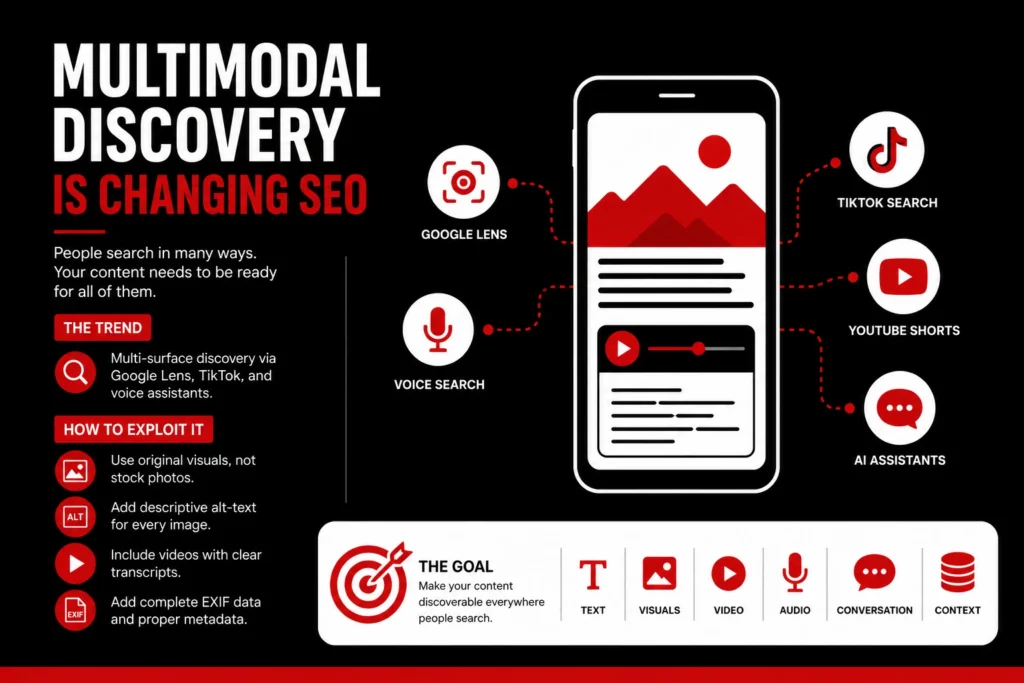
The way people search is becoming more visual and conversational.
The pattern I keep seeing is simple: websites that only publish text content are losing attention. Websites that create useful visuals, videos, screenshots, and voice-friendly content are getting discovered more often.
A blog post today is not just competing with another article.
It is competing with TikTok videos, YouTube Shorts, Reddit screenshots, podcast clips, and AI-generated answers.
That changes how SEO works.
The shift in practice is clear. Generic stock photos are becoming less useful. Original images, product screenshots, charts, short videos, and clear transcripts perform much better. Search engines and AI systems understand content better when they can read text, analyze visuals, and understand audio together.
Small details matter more now too.
Image file names, alt text, captions, video transcripts, and even image metadata help search engines understand what your content is about. Most websites still ignore this completely.
The companies winning in 2026 are building content for multiple discovery platforms, not just Google Search.
The goal is no longer “rank one article.”
The goal is to make your brand discoverable everywhere people search.
8. Topical Authority Now Beats Individual Article SEO
A few years ago, one excellent article on a topic could rank well for years. That still occasionally happens. But it is getting less reliable.
What consistently wins in 2026 is topical authority. Google and AI engines both favor sites that demonstrate connected, comprehensive knowledge about a subject over sites with isolated excellent articles surrounded by thin content.
Niche content targeting specific audience segments, company sizes, and use cases consistently outperforms broad category content. LLMs use those specific pages to answer precise conversational prompts. Humans feel understood. Both outcomes reinforce the brand as the authority on that topic.
The shift in practice: ‘How does X work’ used to be enough. Today, the sites that hold authority are covering ‘How does X work for early-stage SaaS teams’ and ‘How does X work for enterprise RevOps’ and ‘How does X work without a dedicated SEO hire.’ The specificity signals depth. Depth signals expertise.
Good keyword research in 2026 is not just about finding search volume. It is about mapping out the full territory of a topic and deciding whether you are going to own it or not.
9. Branded Search Is Your Only Real Moat in the AI Era
Here is the simplest framing in modern SEO.
AI can disintermediate every generic keyword.
It cannot disintermediate your brand name.
When someone searches ‘best sales intelligence tool,’ AI gives them three vendor names. Maybe yours is one of them. Maybe not. You are at the mercy of the AI’s training data and citation logic.
When someone searches your brand name directly, no AI answer is useful without naming you. You are the answer.
Branded queries carry 2 to 3 times higher conversion rates than generic queries, because those visitors already know you exist and are close to a decision.
Growing your branded search volume creates a tide that lifts all keyword rankings. When people actively search your brand plus a category keyword, Google associates your brand with that topic and rewards all related rankings.
In the AI era, this dynamic becomes even more important. AI systems favor brands with strong entity signals. Consistent third-party mentions, Reddit discussions, structured data, and a recognizable presence in their category. The brands being cited in ChatGPT answers are not always the biggest. They are the most recognizable.
10. Search Is No Longer Just Google. But Google Is Not Dead Either.
This one gets overstated a lot, so let me put some actual numbers around it.
Google’s worldwide search market share dropped below 90% in early 2026 for the first time since 2015. That drop represents real searches moving to AI platforms and other surfaces.
For B2B specifically, 89% of buyers now consider AI search a top source throughout their buying process. And ChatGPT crossed 1 billion weekly active users this year.
It is less about search engine optimization and more about search everywhere optimization. That framing is useful. But it can also become a trap.
You cannot be present everywhere at once, especially as a small team or solo operator. Trying to optimize for Google, ChatGPT, Perplexity, YouTube, Reddit, LinkedIn, and TikTok simultaneously usually means doing none of them well.
The practical move is to find out where your specific buyers actually spend time during their research process. Ask your three most recent customers how they found you and what they searched before reaching out. The answer often surprises people.
11. SEO Is No Longer a Traffic Game. It Is a Revenue Signal.
The metrics that defined SEO for fifteen years are quietly losing meaning.
Sessions can go down while pipeline from organic goes up. Rankings can hold steady while clicks drop 61%. A site can rank number one and be cited in zero AI Overviews. Traffic volume no longer tells you whether SEO is working.
Organic search traffic was ‘declining globally’ and that ‘AI Overviews are giving answers, and fewer people are clicking through to websites.
The teams winning at SEO in 2026 track different numbers. Citation share in AI Overviews. Branded search growth. Organic influence on closed pipeline. The ratio of non-branded to branded traffic. These are GTM questions. They just require SEO work to answer them.
Good SEO strategy and good GTM strategy are converging. The question is no longer how much traffic the blog drove this month. It is how much of your pipeline was influenced by organic content, and whether your brand appears in the AI answers your buyers use to form their shortlists.
The Bottom Line
SEO is not dying. The old way of measuring it is.
The fundamentals still hold. Clear content, real expertise, consistent publishing, structured data. What changed is where the returns show up. They show up in AI citations, branded search growth, and pipeline influence now. Less so in sessions and page rankings.
I wrote this because most SEO trends content right now is either panic-driven or dangerously optimistic. Neither helps you make real decisions about where to put your time.
Every piece of experience-backed content you publish, every AI Overview citation you earn, every branded search you generate stacks up over time. It compounds.
It just looks slow at first.
Frequently Asked Questions
What are the biggest SEO trends in 2026?
The 11 most important trends are: AI Overviews appearing on 48% of Google queries and cutting CTR by 61%, the collapse of the ranking-to-citation overlap to 17-38%, 51% of B2B buyers forming vendor shortlists in ChatGPT, Reddit accounting for 40% of AI citations, schema markup becoming a key AI visibility signal, Google’s March 2026 EEAT update rewarding first-hand experience, human content outranking AI-generated content at the top of page one, topical authority beating individual article SEO, branded search becoming the only defensible moat in the AI era, search expanding beyond Google, and the shift from traffic metrics to revenue attribution.
Is SEO still worth investing in for B2B companies in 2026?
Yes. First Page Sage’s 2026 analysis found a three-year ROI of 702% for B2B SaaS companies investing in SEO. The model is changing from ranking for clicks to earning AI citations and building branded search, but the investment case for organic visibility remains stronger than paid channels on a cost-per-lead basis.
What is GEO and why does it matter for B2B?
GEO stands for generative engine optimization, the practice of structuring content to be cited in AI-generated answers from platforms like ChatGPT, Perplexity, and Google AI Overviews. It matters for B2B because G2’s April 2026 report found that 51% of buyers now start their research with AI chatbots more often than traditional search. If you are not cited in those answers, you do not exist at the start of the buyer journey.
How do you measure SEO success in 2026?
The most useful metrics in 2026 are branded search query volume in Google Search Console, AI Overview citation share measured through monthly manual testing across ChatGPT, Perplexity, and Gemini, and content-influenced pipeline tracked through CRM attribution. Traditional rankings and session counts are less reliable indicators because of AI Overview CTR impact and the growing decoupling between rankings and citations.
Why is Reddit showing up so much in AI search results?
Reddit is one of the most cited sources in AI-generated answers because AI engines prefer community-driven content with genuine user perspectives over polished brand copy. OtterlyAI’s April 2026 analysis of over 5.5 million social media citations found Reddit accounting for 46.4% of all social media citations in AI search. Google also extended its data-sharing agreement with Reddit in 2024, giving AI systems better access to Reddit content.
What did Google’s March 2026 core update change for content strategy?
The March 2026 core update amplified the first-hand experience component of Google’s EEAT framework. Sites with named authors, verifiable credentials, and content built on lived practitioner experience gained positions. Sites with high domain authority but thin experiential content lost ground. High domain authority no longer overrides thin content written without genuine experience. That is a meaningful change from how EEAT worked in 2024.
What is the difference between SEO and GEO?
SEO optimizes for clicks from search engine results pages. GEO optimizes for citations within AI-generated responses. A page can rank number one in Google and never be cited by ChatGPT if it lacks the structural elements AI engines prioritize, including clear factual answers, cited sources, structured data, and a verifiable brand entity. In 2026, both matter because the B2B buyer journey now spans traditional search and AI-generated answers, often in that order.