What Is Warm Calling? Definition, Tips, and How It Works
TL;DR
- Warm calling is outbound calling to a prospect who has had prior contact with your brand, content, team, or referral network. The call is “warm” because some form of recognition already exists.
- Not all warm signals are equal. A demo request is hot. A content download is warm. A single website visit is still cold. Know the difference before you dial.
- Warm leads convert 15 to 30 times more often than cold ones. The conversion rate improvement comes from one thing: the prospect already sees a reason to take the call.
- Speed matters. Contacting a warm lead within 5 minutes of their signal makes them 8 times more likely to qualify than waiting 30 minutes or longer.
- The best warm calling sequence is: engage on LinkedIn, send a value-first email, wait 48 to 72 hours, then call. By the time you dial, your name is familiar.
- Warm leads go cold. A prospect who downloaded your white paper four months ago and has not engaged since is not warm anymore. Treat them like a cold prospect.
A lot of outbound teams still work through cold lists the same way. Open the spreadsheet, start dialing, repeat the same opener, and hope someone listens. The reps booking consistent meetings usually take a different approach. They create familiarity before the call ever happens.
That is the idea behind warm calling.
It is not about clever scripts or sales tricks. It is about making sure the prospect already has some context before you reach out. Maybe they saw your name on LinkedIn, opened an email, engaged with your content, or heard about your company somewhere else. So when the phone rings, you are not a complete stranger.
This guide breaks down what warm calling actually is, what makes a lead warm enough to contact, how to build sequences that create familiarity, and how to open the conversation naturally once you get them on the phone.
What Is Warm Calling?
Warm calling is outbound phone outreach to a prospect who has had some prior contact with your brand, content, team, or network. That contact could be a content download, a webinar sign-up, a referral introduction, an email exchange, or a social media interaction. The call is “warm” because some level of recognition exists on the prospect’s side before you dial.
The key word in that definition is recognition. A warm call is not just a well-researched cold call. Doing your homework before dialing a stranger is good practice, but it does not make the call warm. What makes a call warm is that the prospect has already encountered your name, your brand, or someone who knows you. That changes the dynamic of the conversation before a single word is spoken.
On a cold call, you are spending the first 20 seconds earning the right to exist in the prospect’s attention. On a warm call, you have already done some of that work before you dialed.
Cold, Warm, and Hot: Understanding the Three Temperatures
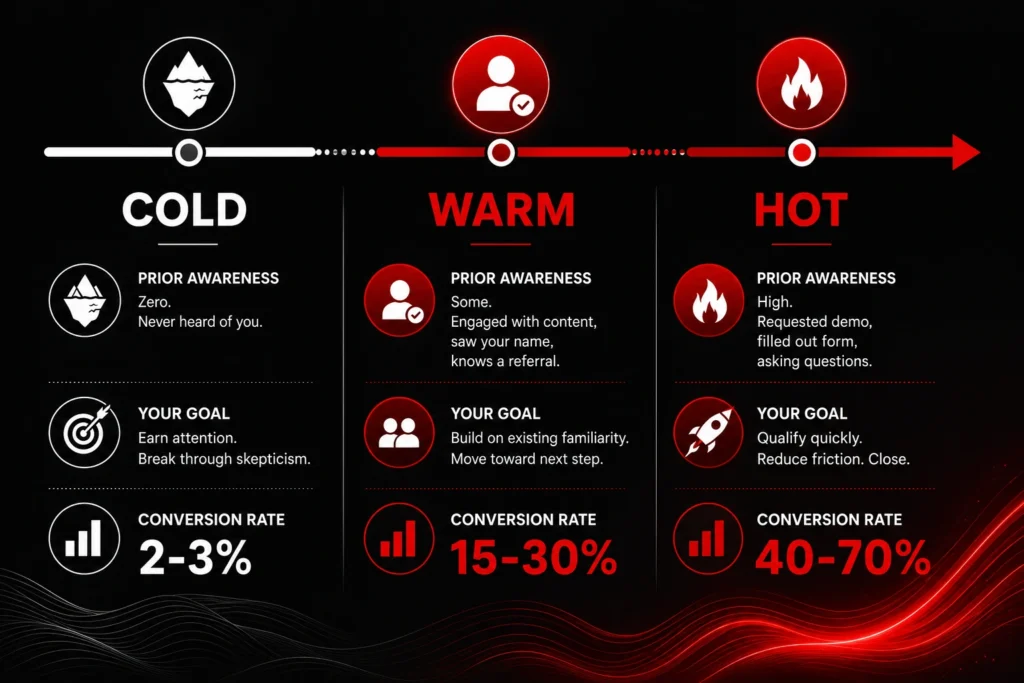
Warm calling makes the most sense when you understand where it sits relative to cold and hot outreach. These are not just labels. Each temperature represents a different level of buyer readiness, and each requires a different approach.
| Type | Prior Awareness | Your Goal | Conversion Rate |
|---|---|---|---|
| Cold | Zero. Never heard of you. | Earn attention. Break through skepticism. | 2-3% |
| Warm | Some. Engaged with content, saw your name, knows a referral. | Build on existing familiarity. Move toward next step. | 15-30% |
| Hot | High. Requested demo, filled out form, asking questions. | Qualify quickly. Reduce friction. Close. | 40-70% |
A few things worth noting about this spectrum.
Cold calls are not inferior. They are essential for expanding into new accounts where you have no warm leads yet. The entire pipeline has to start somewhere, and cold outreach is how most B2B teams create the top of the funnel.
Hot calls require speed and directness more than relationship-building. When someone fills out a demo form, they are already evaluating. Your job shifts from creating interest to qualifying fit and reducing friction. Do not show up to a hot call with a warm calling script.
The best-performing outbound teams work all three temperatures at once. Cold outreach generates new leads. Warm calling converts engaged prospects. Hot calls close them.
Why Warm Calling Works
The numbers are not subtle. Warm leads convert at 14.6%, compared to just 1.7% for cold leads, making them over 8x more effective in many B2B sales environments. Warm prospects also tend to close faster and generate significantly better ROI because trust and familiarity already exist.
The reason is simple. On a cold call, you are an unknown interruption. On a warm call, you are a familiar name calling about something the prospect has already shown interest in. That is a completely different opening position.
There is also a compounding effect across channels. Research from Leads at Scale found that combining a personalized email with a warm call increased response rates by 25% compared to calling alone. Using LinkedIn plus email plus a warm call can push that even further. The more touchpoints that precede the call, the easier it is to open.
Another factor is the length of the conversation. Calls that last longer than five minutes are far more likely to result in a meeting. Getting a prospect to that five-minute mark is much easier when they already have context on who you are and why you are calling.
What Actually Makes a Prospect Warm Enough to Call?
This is the question most warm calling guides skip. They list signals without telling you which ones are actually strong enough to justify picking up the phone. Not every signal is equal.
Here is an honest breakdown of the most common warm signals, their actual temperature, and what to do with each one.
| Signal | Temperature | How to Handle It |
|---|---|---|
| Demo or contact form request | HOT. Call within 5 minutes. They are actively evaluating. | Qualify immediately. Get them to the next step. |
| Pricing page visited 2+ times | WARM-HOT. High intent signal. Budget research underway. | Call the same day. Reference their research. |
| Webinar or event registrant | WARM. Topic interest confirmed. No product interest yet. | Call within 48 hours while the event is fresh. |
| Content download (e-book, guide) | WARM. Problem awareness. No product interest yet. | Call within 72 hours. Lead with the topic they downloaded. |
| Email opened and clicked | WARM-LOW. Mild interest. Not a strong signal alone. | Combine with other signals before calling. Follow up by email first. |
| LinkedIn connection accepted | WARM-LOW. Neutral signal. Politeness, not buying intent. | Engage on LinkedIn first. Do not jump to a call immediately. |
| Referral from a customer or contact | WARM-HOT. Trust transferred. They expect your call. | Call within 24 hours. Name-drop the referral immediately. |
| Past customer or previous trial user | WARM. Knows your product. Has a history with you. | Lead with what has changed since they were last with you. |
| Single website visit, no other signals | COLD. Not enough to call warm. | Do not call. Nurture with content until a second signal appears. |
The single most important principle in that table: a single weak signal does not make a prospect warm. One email open, one LinkedIn view, one website visit means almost nothing on its own. You need either a strong signal (demo request, referral, pricing page visit) or multiple weak signals that stack up over time.
The purpose of tracking engagement in your CRM is to watch for that stacking. A prospect who downloaded a guide six weeks ago, opened two of your follow-up emails, and visited your product page three times this week is genuinely warm. That is a calling priority for today, not next month.
Speed Is Everything with Warm Leads
The 5-Minute Rule
Research shows that contacting a warm lead within 5 minutes of their signal makes them 8 times more likely to qualify than following up 30 minutes later. After 24 hours, the warm lead effect drops dramatically. After a week with no contact, treat them as cold again.
Most teams wait. The lead comes in, gets assigned, sits in a CRM queue, and someone calls three days later. By then, the prospect has moved on. The window where your brand is actively in their mind is narrow.
The teams that consistently convert warm leads fastest are the ones who have built follow-up speed into their process. That means lead routing in the CRM that assigns and notifies immediately, and SDRs who treat an inbound signal the way they would treat a scheduled callback.
You do not need a perfect pitch for a warm follow-up. You need to move fast.
The Best Sources of Warm Leads for B2B Teams
Before you can warm call, you need warm leads. Here are the sources that consistently produce the strongest signals for B2B outbound teams.
Inbound Content and Lead Magnets
Anyone who exchanges their contact information for a resource is signaling problem awareness. White papers, guides, checklists, and webinar registrations all create a warm list of people who are at least thinking about the problem you solve.
The strength of the signal depends on what they downloaded. A white paper on a broad industry topic is a weak warm signal. A pricing guide or ROI calculator is a strong one. Build your content to attract the signals that matter.
Website Intent Data
Most B2B website visitors do not fill out a form. But their visits leave a signal. Tools like Leadinfo, Lead Forensics, and Clearbit Reveal identify the companies visiting your website by matching IP addresses to company records. When a company visits your pricing page twice in a week, that is a warm signal worth acting on.
Intent data platforms like 6sense, Bombora, and G2 go further. They tell you which companies are actively researching your category across the web, not just on your site. A company that is searching competitor comparison terms and visiting industry review sites is in a buying cycle, whether or not they have touched your brand directly.
Referrals
Referrals are the warmest warm leads you will ever have. A current customer who connects you to a colleague transfers their own trust to the conversation before you even dial. The prospect already has a favorable first impression because someone they respect handed them your name.
The best time to ask for a referral is right after a customer has had a success with your product. One referral request per customer per quarter is a simple habit that compounds into serious pipeline over time.
Event and Webinar Attendees
Someone who registered for and attended your webinar or industry event has already invested time in your topic. They are warmer than a content download and easier to call with context: “I saw you attended our session on X last week.” That is a specific, natural reason to reach out.
The follow-up window for event leads is short. Call within 48 hours while the event is still in their recent memory. Waiting a week turns a warm lead into a cold follow-up.
Past Customers and Churned Accounts
Past customers already know your product. They do not need an introduction. They need a reason to come back.
The warm calling angle here is not “we want your business back.” It is “here is what has changed since you were last with us.” A product update that solves the reason they left, a new pricing structure, or a new use case they had not considered. That is a reason to call.
How to Build a Warm Calling Sequence
A warm call rarely happens in isolation. The best ones are the result of a deliberate multi-channel sequence that creates recognition before you dial. Here is a practical five-step sequence that works for B2B outbound teams.
- Identify a high-fit prospect who matches your ICP. Check if any warm signals already exist: website visits, content engagement, LinkedIn connection requests, event attendance. If signals exist, skip to step three.
- If no signal exists, create one. Connect on LinkedIn with a short, specific message (not a pitch). Like or comment on a post they published. Send a value-first email that shares something relevant to their role or company, with no ask attached.
- Wait 48 to 72 hours after your first touch. If they engaged with the email or LinkedIn interaction, note it. If they visited your website, note it. You are now collecting signals, not pitching.
- Send a follow-up email that references the first touchpoint and includes a specific reason to talk. This is where you make the soft ask. A short, relevant opener about a problem they likely have, followed by a one-line question. Not a pitch deck. Not a case study. One question.
- Call 24 to 48 hours after the follow-up email. By now, your name has appeared two or three times. You are no longer a stranger. Open the call by referencing the prior touchpoint and leading with the same specific problem you raised in the email.
That five-step sequence takes roughly 5 to 7 days from first touch to call. The outcome is a call where the prospect has context, and you have a legitimate reason to reference before asking for time.
How to Open a Warm Call
The opener of a warm call is different from a cold call opener. You are not trying to earn the right to exist. You are building on something that already exists. That changes the first sentence.
The structure is: reference the prior touchpoint, confirm they remember it, and move to a relevant question or observation. Keep it short. You still have limited time before the prospect decides whether to stay on the call.
Warm Call Openers by Signal Type
"Hi [name], this is [your name] from [company]. You downloaded our guide on [topic] a few days ago. I had a quick question for you -- is [specific pain point from the guide] something your team is actively working through right now?"
"Hi [name], I'm [your name] from [company]. You joined our session on [topic] last week. I just wanted to follow up and ask of the things we covered, what felt most relevant to what you're dealing with right now?"
"Hi [name], I'm [your name] from [company]. [Referrer's name] suggested I reach out. They thought what we do with [specific outcome] might be relevant for your team. Have you got two minutes for me to explain why they said that?"
"Hi [name], I noticed your team has been looking at our pricing page this week. I did not want to assume anything, but I wanted to reach out directly in case you had questions I could actually answer. What was driving the interest?"
A few things to notice about those openers. None of them start with a pitch. All of them lead with a question. The goal of the first 30 seconds is not to explain your product. It is to get the prospect talking about their situation. Everything else follows from that.
When Your Warm Lead Has Gone Cold
Warm leads are not permanent. They have a shelf life. A prospect who engaged with your content four months ago and has not opened an email or visited your site since is not warm anymore. Calling them as if they are is one of the most common mistakes in outbound.
Here is a practical guide to assessing whether a warm lead is still warm:
- 30 days or fewer since last engagement: still warm. Call with confidence.
- 31 to 60 days since last engagement: cooling. Send a re-engagement email first before calling. Remind them of the context and ask a relevant question to see if the interest is still there.
- 61 to 90 days since last engagement: cold. Treat the call like a cold call, but reference the prior interaction as a starting point. Do not assume they remember you or care.
- More than 90 days: cold. Start the sequence from scratch. New touchpoints, new angle, new context.
The exception is a referral or a past customer. Those warm signals do not expire the same way. A referral from three months ago is still worth a call. A past customer from 18 months ago is still worth calling with a relevant reason.
Warm Calling vs. Cold Calling: When to Use Each
The debate between warm and cold calling is mostly a false one. You need both. The question is which tool fits which situation.
| Factor | Cold Calling | Warm Calling |
|---|---|---|
| Prior contact | None. The call is the first touch. | Yes. You have a reason to reference. |
| Opener goal | Earn the right to a conversation. | Build on existing familiarity. |
| Trust level | Zero. You start from scratch. | Low to moderate. Some recognition exists. |
| Conversion rate | 2-3% to a meeting | 15-30% to a meeting |
| Sales cycle | Longer. 3-6 months typical in B2B. | Shorter. 1-3 months when signals are strong. |
| Best use case | Expanding into new accounts or markets. | Following up on content, events, or inbound signals. |
| Volume needed | High. You need scale to hit conversion targets. | Lower. Quality over quantity. |
| Data requirement | Good ICP fit and verified contact data. | ICP fit plus engagement history and context. |
The practical answer for most B2B teams is to build a pipeline that uses cold outreach to create new contacts and warm signals to prioritize who to call first. Cold calling fills the top of the funnel. Warm calling converts the middle of it.
If you have a pool of warm leads waiting for follow-up, call those first. If that pool is empty, cold outreach is how you fill it back up. The goal is never to choose one or the other permanently. It is to always have a warm pool to work from.
The Bottom Line
Warm calling is not a replacement for cold outreach. It is what cold outreach becomes when you add process, timing, and multi-channel touchpoints in front of the phone call.
The core shift is simple. Instead of treating every dial as a fresh start, you create recognition before you call. A LinkedIn interaction, an email, a relevant piece of content. By the time you pick up the phone, you are not a stranger. You are someone the prospect has already seen.
Start by identifying the warm signals that already exist in your pipeline. Prioritize those contacts for immediate follow-up. Then build a sequence that creates new warm signals for the accounts where none exist yet. Cold calling fills the funnel. Warm calling moves people through it.
Frequently Asked Questions
What is warm calling?
Warm calling is outbound phone outreach to a prospect who has had prior contact with your brand, content, team, or referral network. The call is “warm” because some level of recognition or familiarity already exists before you dial. This is different from a cold call, where the prospect has had zero prior interaction with you or your company.
What is the difference between warm calling and cold calling?
The core difference is prior engagement. On a cold call, you are an unknown contact reaching a prospect who has no context on who you are or why you are calling. On a warm call, some recognition already exists. That might come from content they downloaded, an event they attended, a referral from someone they trust, or a prior email exchange. Warm calls have higher conversion rates (15-30% to a meeting vs. 2-3% for cold calls) and shorter sales cycles because the early trust-building work has already been started.
How do you warm up a prospect before calling?
The most effective way is a multi-channel sequence: connect on LinkedIn with a short, specific message, send a value-first email with no ask attached, wait 48 to 72 hours, send a follow-up email with a relevant question, then call. By the time you dial, your name has appeared two or three times. The prospect is not a stranger, and you have a real reason to reference at the start of the call.
What makes a prospect “warm” enough to call?
The signal needs to indicate genuine interest, not just passive contact. Strong warm signals include: demo requests, pricing page visits, webinar attendance, referral introductions, and past customer status. Weaker signals like a single email open or a one-time website visit are not strong enough on their own. Stack multiple weak signals together, or wait for one strong signal before picking up the phone.
How quickly should you follow up on a warm lead?
As quickly as possible. Research shows that contacting a warm lead within 5 minutes of their signal makes them 8 times more likely to qualify than following up 30 minutes later. After 24 hours, the impact of the warm signal begins to fade significantly. After a week without follow-up, treat the lead as cold again and restart the warming sequence.
Can a warm lead go cold?
Yes. Warm leads have a shelf life. A prospect who engaged with your content four months ago and has had no interaction since is no longer warm. As a guideline: 0-30 days since last engagement is still warm; 31-60 days is cooling and warrants a re-engagement email first; 61-90 days means you should treat the call like a cold call with context; over 90 days means starting the sequence from scratch. The exceptions are referrals and past customers, whose warmth fades more slowly.
What is the difference between warm calling and hot calling?
A warm call happens when the prospect has shown some engagement or interest. A hot call happens when the prospect has clearly signaled buying intent, such as filling out a demo request, asking for a proposal, or reaching out directly to your team. Hot calls require speed and qualification more than relationship-building. The prospect already wants to buy. Your job is to confirm fit and remove obstacles, not to generate interest.