What is Cold Calling? The Ultimate Guide for Sales Success
If you work in sales, you know the feeling. You stare at a list of names and phone numbers. The phone feels like it weighs a hundred pounds.
You dial the numbers, listen to the rings, and brace yourself for the response.
This is cold calling.
For decades, people have argued about whether this sales tactic still works. Some say it is a waste of time. Others build multi-million dollar companies using nothing but a phone and a solid list of leads.
The truth is somewhere in the middle. Cold calling is tough. It requires thick skin, excellent timing, and a clear strategy.
But when you do it right, it remains one of the fastest ways to generate pipeline and close deals.
This guide covers the basics, how to prepare, the best strategies for the phone, and how to turn a cold lead into a customer.
The Basics of Cold Calling
Before you pick up the phone, you need to understand what you are doing. Sales has changed over the years, and your approach must change with it.
The Definition of Cold Calling
Cold calling is the process of contacting a prospect who has not previously expressed interest in your product or service. The “cold” part means there is no prior relationship. You are interrupting their day to pitch your solution.
In a typical B2B sales process, reps use cold outreach to find potential buyers who match their ideal customer profile. The goal is rarely to sell the product on the first call. Instead, the goal is to spark enough curiosity to secure a meeting or a discovery call.
Cold Calling vs. Warm Calling
Many people confuse cold outreach with warm outreach. The difference comes down to intent and prior contact.
When you make a cold call, the buyer does not know who you are. They did not download your ebook. They did not fill out a contact form on your website.
They are entirely cold.
Warm calling, on the other hand, involves reaching out to someone who already knows your brand. Maybe they attended a webinar you hosted. Maybe they connected with you on LinkedIn.
Because they already have some context, warm calls generally have higher connection and conversion rates. Both tactics are important, but cold outreach requires a different set of skills to succeed.
Is Cold Calling Dead?
If you search the internet, you will find countless articles claiming this method is dead. Usually, the people saying this are trying to sell you a different marketing tool.
So, is cold calling dead? No. But the old way of doing it certainly is.
You can no longer buy a random list of 10,000 numbers, dial them blindly, and expect good results. Modern buyers are busy. They screen their calls.
To succeed today, your outreach must be highly targeted and relevant. You need to call the right people, at the right companies, with a message that solves a specific problem they face.
Phone calls still connect you with prospects faster than most other channels. That is especially true in B2B, where a real conversation moves things forward. It is not about making more calls; it is about making better calls.
Is Cold Calling Legal?
This is a common and valid concern. Nobody wants to face massive fines for dialing the wrong number.
Is cold calling legal? Yes, but it is heavily regulated. In the United States, you must comply with the Telephone Consumer Protection Act (TCPA) and the National Do Not Call Registry. In Europe, you must follow the General Data Protection Regulation (GDPR).
In B2B sales, the rules are often more relaxed than in B2C (business-to-consumer) sales, since you are contacting a business for legitimate commercial reasons.
You still cannot use automated robocalls to mobile phones without consent. You must also respect a prospect’s request to be removed from your list. Always consult a legal professional to confirm your specific practices follow local laws.
How to Prepare for a Cold Call
Preparation is the secret weapon of top-performing sales reps. If you just grab a phone and start dialing without a plan, you will fail. You need a rock-solid foundation.
Building Your B2B Sales Foundation
Before you prospect, you must know what you are selling and who you are selling it to. You need to understand the fundamentals of what is B2B sales and how your product fits into the market.
Who is your ideal buyer? Are you selling to CEOs of small startups or IT directors at enterprise companies? What pain points do they deal with every day?
If you cannot answer these questions, you are not ready to make a call. Your product must offer a clear solution to a problem your prospect cares about.
Creating a Targeted Prospect List
Your success rate depends directly on the quality of your list. Calling bad leads is a waste of your time and theirs.
You need to master sales prospecting. Start by looking at your best current customers. What industries are they in?
How big are their companies? Once you spot the trends, you can learn how to build a prospect list filled with lookalike companies.
Use tools like LinkedIn Sales Navigator to find the exact decision-makers within those companies. Look for trigger events. Did the company just raise funding?
Did they just hire a new VP of Sales? These triggers give you a relevant reason to call.
Using Sales Intelligence to Warm Up Your List
The days of calling out of a phone book are over. To push your success rates higher, you need data behind every name on your list.
Sales intelligence is the data and software that gives you real insight into a prospect before you dial. It tells you what software a company uses, whether they are expanding their team, or whether their revenue is dropping.
When you use this data, your calls stop being completely “cold.” You can call a prospect and say, “I saw your company just posted three job openings for SDRs. Usually, when teams scale that fast, they struggle with onboarding. Is that something you are dealing with?”
This level of personalization proves you did your homework and instantly earns you credibility.
Setting Up Your Cold Calling Database
You cannot keep track of hundreds of leads on a spreadsheet. You need a central hub for your data.
A reliable cold calling database or CRM (Customer Relationship Management) system is mandatory. Your CRM tracks every interaction. It tells you when you last called a prospect, what they said, and when you should follow up next.
Keeping your database clean is just as important. Remove bounce backs. Update job titles when people move companies.
A clean database ensures you spend your time selling, not doing admin work.
Choosing the Right Cold Calling Dialer
Manually typing phone numbers into a keypad slows you down. If you want to make 50 to 100 calls a day, you need technology to help you.
Investing in a good cold calling dialer speeds up the process. Dialers connect to your CRM. You can click a button on your screen and the software dials the number for you.
Some dialers can even dial multiple numbers at once and connect you only when someone answers. This keeps your momentum going and prevents call reluctance from setting in between dials.
How to Cold Call
Now that you have your list and your tools, it is time to pick up the phone. This is where strategy meets execution.
The Best Time to Cold Call
Timing matters. If you call an accountant during the first week of April, they will hang up on you. If you call a restaurant owner at noon, you will get the same result.
While every industry is different, studies show there are general trends for the best time to cold call. Generally, late mornings, between 10:00 AM and 11:30 AM, and late afternoons, between 3:30 PM and 5:00 PM, work best for B2B prospects.
Avoid calling early on Monday mornings when people are planning their week. Likewise, Friday afternoons are tough because people are clocking out for the weekend. Test different times and track your connection rates to see what works best for your specific audience.
Crafting Cold Calling Scripts
Many reps hate scripts. They think scripts make them sound like robots. But a script is not meant to be read word-for-word.
A script is a map that keeps you from getting lost.
Effective cold calling scripts follow a specific structure:
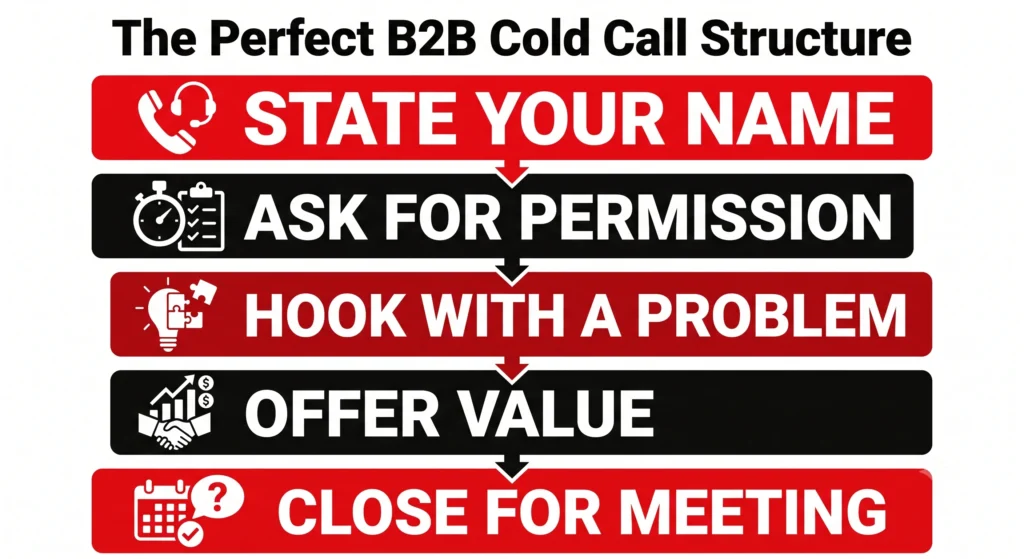
- The Introduction: State your name and company clearly.
- The Permission (Optional but effective): Ask for 30 seconds of their time.
- The Hook: State the reason for your call. Mention a specific problem they might be facing.
- The Value Proposition: Briefly explain how you solve that problem.
- The Call to Action (CTA): Ask an open-ended question to start a conversation or ask for a meeting.
When you have a script, you do not have to panic and think about what to say next. You can focus entirely on the prospect’s tone of voice and how they react.
Nailing Your Cold Calling Opening Lines
You have about five seconds to grab a prospect’s attention before they decide to hang up. Your opening line is the most critical part of the call.
Standard greetings like “How are you today?” scream “I am a salesperson!” and trigger an automatic hang-up. Instead, you need cold calling opening lines that disrupt their normal pattern.
Try a pattern interrupt. For example: “Hi Sarah, this is John from [Company]. I know I’m catching you out of the blue. Got a brief minute, and if not, I’ll let you go?”
This approach is honest. It acknowledges the interruption and gives the prospect control. Many people will grant you that one minute just because you were respectful of their time.
How to Get Past the Gatekeeper
Often, you will not reach the decision-maker directly. You will reach an executive assistant or a receptionist. These people are gatekeepers, and their job is to keep salespeople away from their boss.
Do not treat the gatekeeper like an obstacle. Treat them like an ally. If you want to get past the gatekeeper, you must be polite and professional.
Never lie to a gatekeeper. Do not pretend to be a personal friend of the prospect. Instead, ask for their help.
Nobody signed up to be a human spam filter, and treating them like one is the fastest way to get nowhere.
Say something like, “Hi, I was hoping to speak with David about your software infrastructure, but I want to make sure I’m not wasting his time. Are you the best person to point me in the right direction?”
Sometimes, the gatekeeper will give you valuable information about the company that you can use when you finally speak to the decision-maker.
Handling Objections and Closing
If you do everything right, the prospect will stay on the line. But they will almost certainly push back. Handling this pushback is where average reps fail and great reps win.
Common Cold Calling Objections
Prospects use objections as a defense mechanism. They are busy, and they want to get off the phone. You will hear the same objections over and over again.
Common cold calling objections include:
- “We don’t have the budget.”
- “Send me an email.”
- “We already use a competitor.”
- “Call me back next quarter.”
You must practice sales objection handling before you make calls. When a prospect says “send me an email,” do not just say “okay” and hang up. That is a polite rejection.
Instead, say: “I can definitely send you an email. Just to make sure I don’t send you a generic brochure, what specific area of your outbound strategy is giving you the most trouble right now?” This keeps them talking. If they answer, you have started a real conversation.
Moving to the Discovery Call
Remember the goal of the call. You are not trying to close a massive deal on a cold outreach attempt. You are trying to sell the next step.
The next step is usually a formal discovery call. Once you uncover a slight pain point, stop pitching. Suggest a longer meeting where you can dive deeper.
Say: “It sounds like lead routing is a real headache for your team right now. I have a few ideas on how we could fix that, but I want to be respectful of your time today. Do you have 15 minutes next Tuesday for a proper introduction?”
This removes the pressure. You are just asking for a brief chat at a scheduled time.
Sales Closing Techniques on the Phone
Even though you are only closing for a meeting, you still need to use solid sales closing techniques.
Be confident. Assume the meeting. Do not ask, “Would you want to meet maybe sometime next week?” That sounds weak.
Use an alternate choice close instead: “Does Tuesday at 10 AM or Wednesday at 2 PM work better for your calendar?”
If they agree to the meeting, lock it in immediately. Send the calendar invite while you are still on the phone with them and ask them to confirm they received it. This dramatically reduces no-show rates.
Measuring Success and Improving
You cannot improve what you do not measure. To get better at cold outreach, you need to track your numbers and analyze your performance.
What Counts as a Good Success Rate
Many reps get discouraged because they face constant rejection. It helps to understand the baseline metrics so you can set realistic expectations.
What is a good cold calling success rate? If you dial 100 numbers, you might only speak to 10 people. Out of those 10 conversations, booking 1 or 2 meetings is a strong performance.
The average conversion rate from a raw cold call to an appointment hovers around 1% to 2%.
Top-performing sales organizations focus on lead quality over call volume. If your success rate is lower than 1%, look at your list quality first. If you are calling the wrong people, no script in the world will save you.
If your list is great but your conversions are low, record your calls and listen back to fix your delivery.
What is a Sales Qualified Lead (SQL)?
Not every meeting you book is a good meeting. You only want to spend time with buyers who have the potential to buy.
That is where a sales qualified lead, or SQL, comes in. An SQL is a prospect who has been vetted and meets your core criteria for budget, authority, need, and timeline (BANT).
Your cold outreach efforts feed your pipeline with raw leads. Your discovery calls turn those raw leads into SQLs. Tracking how many cold leads eventually become SQLs will tell you if your initial targeting is accurate.
Top Cold Calling Tips
To round out your strategy, here are the core habits that separate the top 1% of sales reps from everyone else.
Habits of the Top 1%
If you want to dominate the phones, keep these cold calling tips in mind:
- Stand up while you dial: It changes your physiology, opens your diaphragm, and makes you sound more confident and energetic on the phone. Your coworkers may wonder why you’re pacing the office, but your connect rate won’t care.
- Smile when you talk: Prospects can hear your facial expressions. Smiling softens your tone and makes you sound friendly.
- Use silence: When you ask a hard question or deliver a price, stop talking. Do not rush to fill the quiet air. Let the prospect think and answer.
- Embrace the “No”: You will hear “no” constantly. Do not take it personally. Every “no” gets you mathematically closer to a “yes.”
- Review your tape: Athletes watch game film to get better. Sales reps should listen to their call recordings. You will notice filler words and missed opportunities you didn’t catch in the moment.
Where Cold Calling Fits in the Sales Funnel
Cold outreach does not exist in a vacuum. It is the very top of your revenue engine.
You need to know what is a sales funnel to understand your role. Your job on the phone is to pull prospects into the top of the funnel. Once they are in, marketing and account executives help move them down the funnel until they become a closed-won deal.
If you do not put enough prospects into the top of the funnel, the bottom of the funnel dries up. Consistent daily prospecting is the only way to ensure a steady stream of revenue.
B2B Sales Funnel Simulator
Funnel Results
Key insight: Even a 1-2% increase in your initial cold calling conversion rate can mathematically double your closed-won revenue at the end of the quarter, as long as you maintain consistent metrics further down the funnel.
Conclusion: The Phone Still Works
Cold calling is hard work. It demands resilience, preparation, and constant skill development. But it is far from dead.
When you combine a highly targeted prospect list with excellent sales intelligence and a value-driven script, the phone remains a highly effective tool for B2B growth.
Stop viewing the phone as a necessary evil. View it as a direct line to your next best customer. Prepare your database, practice your opening lines, and learn how to handle rejection gracefully.
Focus on solving your prospect’s problems first. Put the buyer first, and your cold calling success rate will climb while your pipeline stays full.