
What Is Sales Intelligence? Everything B2B Teams Need to Know
Without sales intelligence, your team is selling in the dark.
Your reps have a list. Maybe a long one. But the contacts are six months out of date, half the accounts have no reason to buy right now, and no one can tell which ones are actually worth calling today. So they guess. Deals stall. The post-mortem always points to the same root cause: selling without context.
Sales intelligence changes that equation. It’s the layer of data and signals that tells your reps who to call, when the timing is right, and what to say when they get there.
This guide covers what sales intelligence actually means, what types of data it includes, how it works inside a real GTM motion, and where most teams go wrong with it.
What Sales Intelligence Actually Means
Sales intelligence is the collection, analysis, and use of external data to help sales teams identify, prioritize, and engage the right buyers at the right time.
That’s the clean version. The practitioner version is shorter: it answers the three questions your CRM never can. Who should my rep call today? Is this account actually in-market right now? What’s the best angle for the first conversation?
A contact database gives you a name and an email address. Sales intelligence gives you context. It tells you that the VP of Operations at your target account joined three months ago, their biggest competitor just launched a competing product, and three people from that team have been actively reading comparison content for the past two weeks.
That kind of context changes everything about how a rep approaches the call.
Why B2B Sales Intelligence Is Not the Same as Your CRM
This confusion costs B2B teams more pipeline than almost anything else. Let’s clear it up.
A CRM is a system of record. It tracks what already happened: calls made, deals won, deals lost, notes logged. It is your company’s memory of the past. It’s essential, but it only knows what your team put into it.
Sales intelligence is what enriches that CRM with the outside world. Fresh contact data. Real-time company signals. What tech tools an account is running. Which companies are actively researching solutions in your category right now. None of that lives inside your CRM unless something is actively feeding it in.
Think of it this way. Your CRM looks backward. Sales intelligence looks forward. When both work together, your reps stop asking “who should I call?” and start asking “what do I say to the account that’s ready right now?”
That’s a completely different kind of selling.
The Four Types of Data That Make Up Sales Intelligence
Sales intelligence isn’t one thing. It’s a combination of data types that, when layered together, give a rep a full picture of any account before the first email is sent.
Here are the four core types.
1. Firmographic Data
Firmographic data describes the company itself. Industry, headcount, annual revenue, growth stage, geography, and business model. It’s the starting point for every prospecting filter.
If your best customers are mid-market SaaS companies with 200 to 500 employees and a U.S. headquarters, firmographic data is what helps you build a list of 500 more accounts that look exactly like them. Without it, your reps are working from gut feeling instead of pattern recognition.
The best revenue teams also use firmographics to update their Ideal Customer Profile (ICP) on a regular schedule. They pull win data, identify the firmographic patterns that actually closed, and tighten the targeting criteria. That loop makes everything downstream sharper.
2. Technographic Data
Technographic data tells you what software a company is actively using right now.
This is more powerful than it sounds. If your product integrates with a specific platform or replaces a legacy tool, technographic data tells you which accounts to prioritize without any guesswork. You’re looking directly at the tech stack and acting on what you see.
There’s a timing angle here too. A company that just added a new hiring platform is probably scaling fast. A company that just removed a competitor’s product from their stack is likely evaluating alternatives. Technographic data turns those moments into outreach triggers.
3. Intent Data
Intent data is behavioral. It captures which companies are actively researching topics in your category right now, before they ever fill out a form or respond to an outreach.
Thousands of companies read comparison articles, browse review sites, and consume category content every single day. Intent data aggregates that activity and surfaces the accounts showing active in-market behavior. The signal tells you someone at that company is in a buying motion. Your job is to show up before your competitors do.
Getting there first is worth its weight in gold in competitive B2B markets.
4. Trigger Events and Buying Signals
A trigger event is a specific, observable change at a company that creates a buying window.
A new VP of Sales joins the leadership team. A Series B closes and headcount plans double. A competitor’s pricing change pushes customers out. A new regulation forces a category purchase. Each of these moments represents a window where a company is more open to new solutions, new conversations, and new vendors.
Reps who act on trigger events within one or two days of them happening close at significantly higher rates than reps who reach out six weeks later. The window exists. The question is whether your team sees it in time.
How Sales Intelligence Actually Works
Understanding the data types is useful. Understanding how they flow into your team’s day-to-day workflow is what makes the difference in practice.
Here’s the process at each stage.
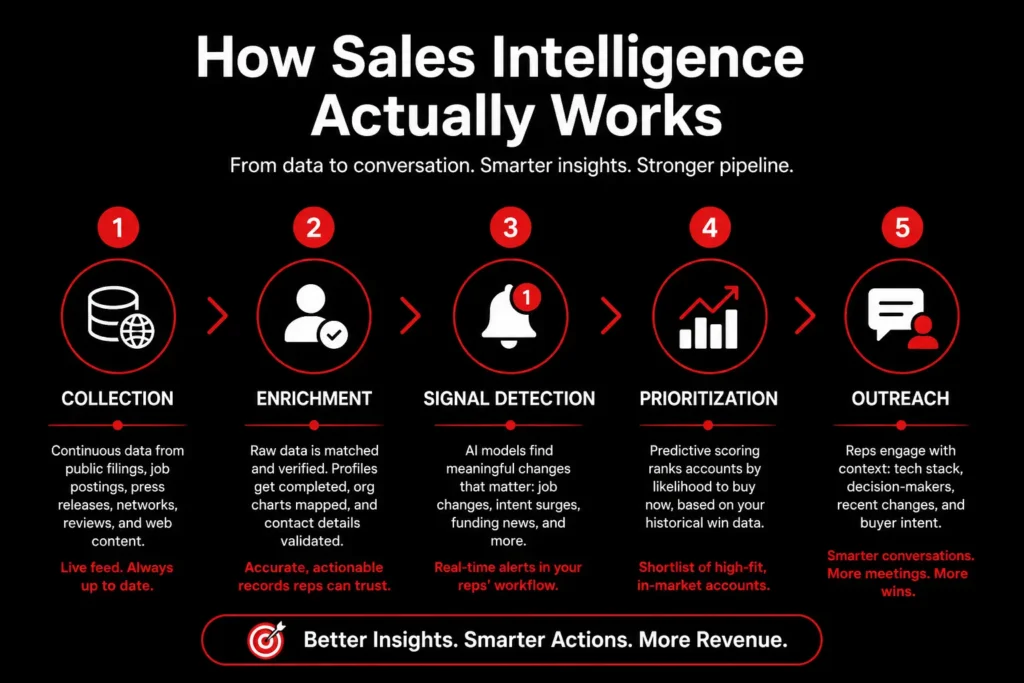
- Collection: The intelligence layer pulls data from external sources continuously: public company filings, job postings, press releases, professional networks, review sites, and web content. This isn’t a one-time database download. It’s a live feed that updates as the market changes.
- Enrichment: Raw data gets matched to your company and contact records. Profiles get completed. Org charts get mapped. Phone numbers get verified. The goal is actionable, accurate records your reps can trust before they pick up the phone.
- Signal Detection: AI models scan the enriched data for meaningful changes. A key contact at a target account just changed jobs. An account has surged in intent activity for your category. A funding announcement dropped this morning. These become alerts that reach your reps in their existing workflow, not buried in a dashboard no one opens.
- Prioritization: Not every signal carries the same weight. Predictive scoring models analyze your historical win data to rank accounts by their actual likelihood to buy right now. Your reps get a shortlist of high-fit, in-market accounts instead of an unsorted list of 600 companies with no direction.
- Outreach: The rep enters the conversation prepared. They know the account’s current tech stack, who the real decision-makers are, what organizational changes happened recently, and what topics the buyer is actively researching. That context shapes every word of the opening message.
That’s what separates reps who hit quota consistently from ones who spend three months running the same generic sequences and wondering what’s wrong with the messaging.
What It Looks Like on the Sales Floor
To understand why this tech stack is non-negotiable, let’s look at how the exact same GTM motion plays out for two different reps targeting the exact same mid-market logistics account.
Here is the difference between pitching in the dark and pitching with context:
| Phase | Without Sales Intelligence (The Old Way) | With Sales Intelligence (The Modern Way) |
| Targeting | Pulling a static list of 500 companies that match your basic ICP. | Getting a daily alert for 10 specific companies actively researching your category. |
| Research | Spending 45 minutes manually digging through Google and LinkedIn. | Viewing an instant summary of an account’s tech stack, recent hires, and intent signals. |
| Outreach | Sending a generic 12-step email sequence focused on “driving efficiency.” | Sending one highly specific email referencing the account’s new warehouse expansion. |
| The Result | Ignored. The buyer isn’t ready or the message misses the mark. | Meeting booked. You intercepted a live buying motion with a relevant solution. |
Why the Modern Way Wins
The old approach fails because B2B buyers are fiercely independent. According to Gartner’s B2B buying research, buyers spend only 17% of their total journey actually meeting with potential suppliers. The rest of their time is spent researching solutions quietly on their own.
If your reps can’t see that independent research happening, they are just guessing when to reach out.
Worse, guessing eats up the clock. The Salesforce State of Sales report shows reps now spend over 70% of their week on non-selling tasks like manual data entry and blind account research.
Sales intelligence flips this dynamic. Instead of burning hours trying to find a needle in a haystack, the platform simply highlights the needle. Your rep intercepts the buyer exactly when they are looking to buy, with a message that proves they understand the immediate problem.
The Data Quality Problem Most Teams Don’t See Coming
Here’s the thing no vendor puts in their pitch deck.
B2B contact data goes stale fast. People change jobs. Companies get acquired. Teams restructure. Titles change and direct dial numbers go dead. Roughly 30% of B2B contact records become inaccurate within a year. That means if your CRM hasn’t been properly enriched in the past 12 months, about one in three records is already wrong.
And here’s why that’s expensive. Bad data doesn’t just cause bounced emails. It cascades.
Stale contacts mean reps cold-call decision-makers who left the company months ago. Inaccurate firmographics break ICP scoring. Wrong job titles send outreach to the wrong person in the wrong role. Bad routing sends qualified leads to reps who don’t cover that territory. Every downstream process inherits the problem.
Most teams don’t fail at sales intelligence because they picked the wrong platform. They fail because they built intelligence workflows on a dirty data foundation and expected clean results. The data quality has to come first. Everything else is built on top of it.
Who Uses Sales Intelligence (And How Each Team Benefits)
Sales intelligence isn’t just a tool for SDRs. When it’s properly set up, the whole revenue team operates at a different level.
SDRs and BDRs use it for prospecting and outbound list building. Instead of spending two or three hours manually researching an account before a cold call, they get a pre-built, enriched profile with the right contact, the right context, and a clear opening angle. That reclaimed time goes into more conversations.
Account Executives use it for deal research and stakeholder mapping. Buying committees in B2B have grown significantly larger over the past few years. Knowing who all the decision-makers are, how long they’ve been at the company, and what their stated priorities are changes how you run discovery calls and shape your close plan.
RevOps teams use it for CRM hygiene and data governance. They’re the ones who build enrichment workflows, set data quality standards, and ensure that the information flowing into the sales motion is both current and accurate. They’re also the ones who set the scoring models that define which accounts reps should focus on.
Marketing teams use it for account-based marketing campaigns. Knowing which accounts are in-market right now, what they’re actively researching, and how the buying team is structured lets marketers build campaigns that feel specific and relevant rather than broadcast-style noise.
When all four functions work from the same clean, real-time data layer, the revenue motion gets sharper. Forecasts become more reliable. Win rates climb. The whole team operates from the same version of reality.
What Sales Intelligence Will Not Do for You
A lot of platforms are sold with a version of the same promise: buy this, and your reps will book more meetings, close faster, and hit quota every quarter.
That’s not how it works.
Sales intelligence improves how you find, prioritize, and time outreach to accounts. It does not replace the skill it takes to have a real conversation, handle a tough objection, or build trust with a skeptical buyer. The intelligence gets your rep to the right door at the right moment. What happens after the door opens is still entirely on them.
The teams that see strong ROI treat sales intelligence as one layer of a disciplined system. Clean data. A tightly defined ICP. Reps who act on signals quickly and consistently. A RevOps function that keeps the data layer current. Without those supporting elements, even an excellent platform becomes a tool no one trusts.
Anyone who sells you less than the whole picture is cutting corners on your behalf.
First-Party vs. Third-Party Intelligence
This distinction matters more as your GTM motion matures, and it’s worth getting clear on now.
Third-party intelligence comes from external data vendors who aggregate contact information, intent signals, and firmographic profiles from sources across the web. It gives you broad coverage of your total addressable market and helps your team find accounts that have never interacted with your brand. It’s where prospecting starts.
First-party intelligence comes from your own properties. When a prospect visits your pricing page three times in one week, that’s first-party intent. When someone opens every email in a drip sequence and clicks through to your case study, that’s first-party intent. These signals are the strongest you’ll get, because they’re direct and specific to your brand, not category-level research behavior someone else tracked.
The strongest GTM teams build both layers intentionally. Third-party data fills the top of the funnel and helps you discover accounts. First-party signals close the loop and help you prioritize the accounts already moving toward a decision on their own.
Together, they tell the complete story of where every account stands.
How AI Changed Sales Intelligence
This is not a small shift. It changed what these platforms are capable of doing at a fundamental level.
Old-school intelligence platforms gave you a database to search. You applied filters, exported a list, and handed it to your reps. That was the product.
Today’s platforms detect signals without you asking for them. They push an alert to your rep within hours of a trigger event firing, not days later when someone finally logs in to check. They pull together company news, intent spikes, and CRM history into a one-paragraph account brief that would have taken a rep 45 minutes to build manually. They surface the right accounts at the right moment without requiring your team to constantly monitor dashboards.
AI also transformed how accounts get scored. Instead of static rules like “flag any company with over 200 employees in this industry,” modern models learn from your actual historical win and loss data. They identify what a company that actually buys from you looks like, and they update that model as your business evolves.
The shift is from reactive to proactive. Reps used to go looking for signals. Now the signals find the reps. In a competitive B2B market, that timing advantage compounds fast.
Signs Your Team Actually Needs It
Some teams know they need sales intelligence. Others aren’t sure. Here’s how to tell.
Your reps spend more than two hours per week doing manual account research before outreach. Your CRM has duplicate records, missing job titles, and contacts at companies that no longer exist. Your outbound response rates are flat even after you’ve changed messaging, sequences, and channels. You have no reliable way to tell which accounts in your total addressable market are actually in-market right now.
Any one of those is a signal. All four together means you’re paying for the problem every single quarter in wasted pipeline and missed quota.
The cost of waiting is real. Every quarter your reps prospect from a stale list, a certain percentage of that pipeline goes to competitors who started from scratch with cleaner, more current data.
The Bottom Line
Sales intelligence is not a nice-to-have anymore. It’s the operating layer that separates B2B revenue teams running modern, signal-driven GTM motions from ones still cold-calling from stale spreadsheets and hoping for the best.
When it works, reps spend less time guessing and more time having conversations that actually convert. Pipeline becomes more predictable. Win rates improve. The whole team operates from the same current, reliable picture of the market.
But that only happens when you build it right. Clean data first. A clear ICP to guide your filters and scoring. Reps who act on signals quickly when the window is open. A RevOps function that keeps the data layer current and the workflows running.
Get those three things in order. Then the intelligence layer does what it’s supposed to do.
And your reps can get back to the part of the job that actually closes deals.
Frequently Asked Questions About Sales Intelligence
What is sales intelligence in simple terms?
Sales intelligence is the data and context that helps sales teams know who to reach out to, when the timing is right, and what to say. It includes company data, contact data, buying signals, and technology information. It sits above your CRM and makes every rep more targeted and better prepared.
How is sales intelligence different from a CRM?
A CRM stores and tracks your existing prospect and customer data. Sales intelligence enriches that data with external information: fresh contacts, buying signals, firmographic updates, and real-time context your CRM cannot generate on its own. They work together. The intelligence feeds the CRM, not the other way around.
What types of data does sales intelligence include?
The four core types are firmographic data (company characteristics like size and industry), technographic data (software tools the company currently uses), intent data (research behavior that signals buying readiness), and trigger events (observable changes like funding rounds or leadership hires that open buying windows).
Can a small B2B team use sales intelligence?
Yes. Small teams often see the fastest ROI because every hour saved on manual research goes directly into selling time. The right approach is to start simple: verified contact data and basic firmographic filtering. Then add intent signals and trigger event alerts as the team and motion mature.
What’s the biggest mistake teams make with sales intelligence?
Buying a platform before fixing the underlying data quality problem. Sales intelligence built on a dirty CRM doesn’t fix the mess. It amplifies it and makes it move faster. Clean the foundation first. Then add the intelligence layer on top of it.
Does sales intelligence work without a strong ICP?
No. Your ICP defines who you’re targeting. Sales intelligence tells you where those accounts are, what they’re doing right now, and when to engage them. Without a clear ICP, your filters are guesswork and your prospect lists reflect that uncertainty.