
B2B data decay rate statistics you need to know
Every key B2B data decay statistic in one place. Decay rates, email list decay, job changes, and tenure by age, role, and industry.
Your B2B data decay rate is quietly eating your pipeline.
Every month, a slice of your contacts change jobs, get promoted, or leave. Nobody tells your CRM. (Rude, but true.)
So your sequences keep following up with inboxes that stopped existing months ago.
The good news is that the data on how fast this happens is better than ever. The Bureau of Labor Statistics released fresh job tenure numbers in September 2026. The latest email decay data covers more than 11 billion addresses.
I’ve rounded up every B2B data decay stat worth knowing below, with a source for each one.
Key B2B data decay statistics
- B2B data decays at 2.1% a month, or about 22.5% a year.
- At least 23% of an email list degraded in 2025, according to ZeroBounce.
- Only 62% of the emails submitted to ZeroBounce for verification in 2025 were valid.
- 20.6% of US wage and salary workers had been with their employer for 12 months or less in January 2026.
- Sales workers have a median job tenure of 3.3 years, compared with 6.1 years for managers.
How fast does B2B data decay?
According to MarketingSherpa research cited by HubSpot, B2B data decays at 2.1% per month. That works out to an annual B2B data decay rate of 22.5%.
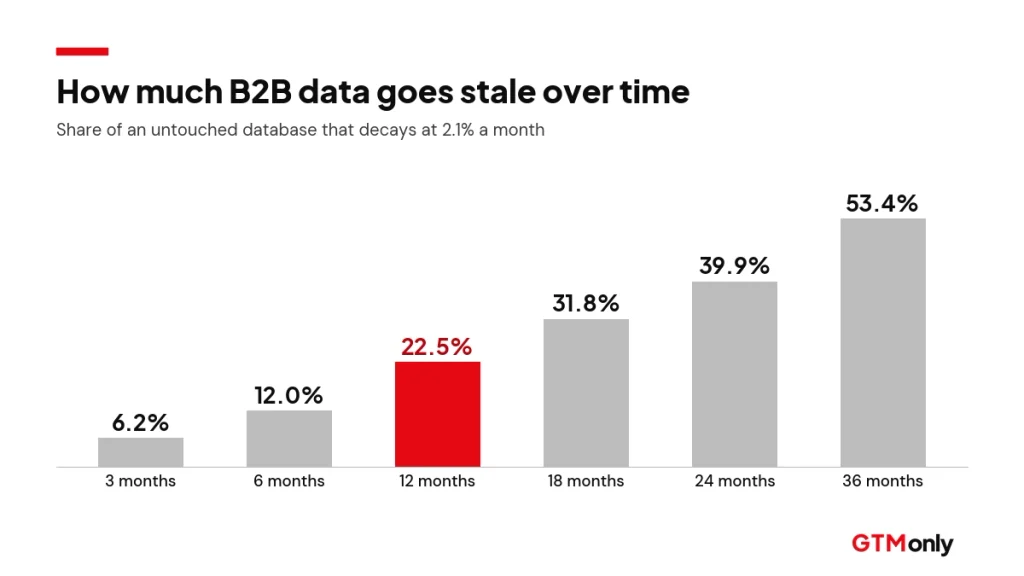
Decay compounds, so the damage grows fast. I ran the numbers for a database that nobody updates:
| Time since last update | Share of database decayed |
|---|---|
| 3 months | 6.2% |
| 6 months | 12.0% |
| 12 months | 22.5% |
| 18 months | 31.8% |
| 24 months | 39.9% |
| 36 months | 53.4% |
At that rate, 39.9% of records go stale within two years. After three years, more than half the database is wrong, and those stale titles quietly skew your lead scoring and routing.
Source: HubSpot (citing MarketingSherpa)
Email list decay rate
According to ZeroBounce’s Email List Decay Report, at least 23% of an email list degraded in 2025.
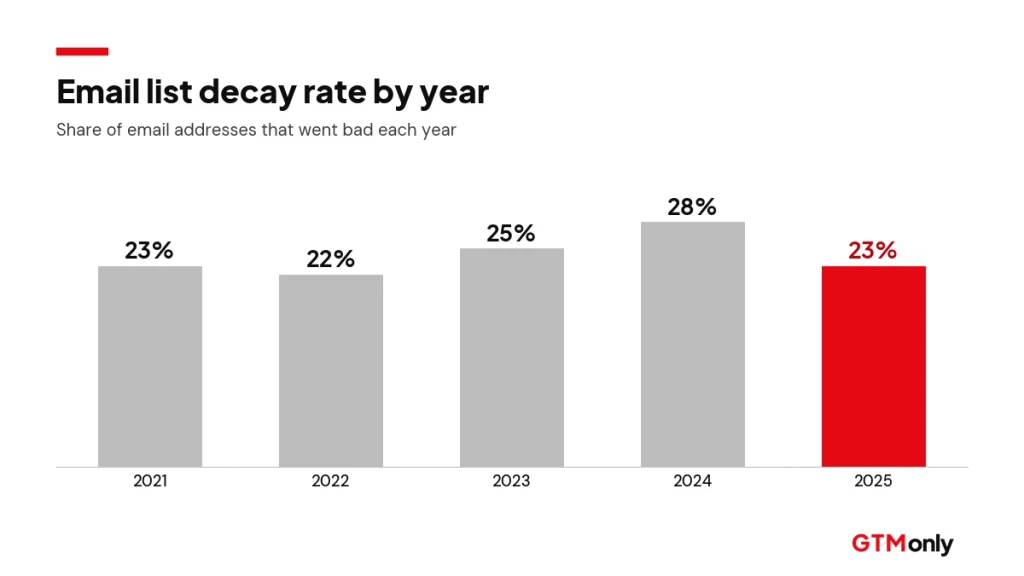
That figure comes from more than 11 billion email addresses ZeroBounce verified during the year. It’s down from 28% in 2024.
Here’s how the email list decay rate has changed since 2021:
| Year | Email list decay rate |
|---|---|
| 2021 | 23% |
| 2022 | 22% |
| 2023 | 25% |
| 2024 | 28% |
| 2025 | 23% |
Only 62% of the emails submitted to ZeroBounce in 2025 were valid. More than 2.6 billion were invalid outright.
More than 9% were catch-all addresses, which you can’t confirm without sending an email. That’s why ZeroBounce treats 23% as a low-end estimate, and why every unchecked list puts your email deliverability at risk.
Source: ZeroBounce
How often do B2B contacts change jobs?
According to the Bureau of Labor Statistics, 20.6% of US workers were in their first year with an employer in January 2026.
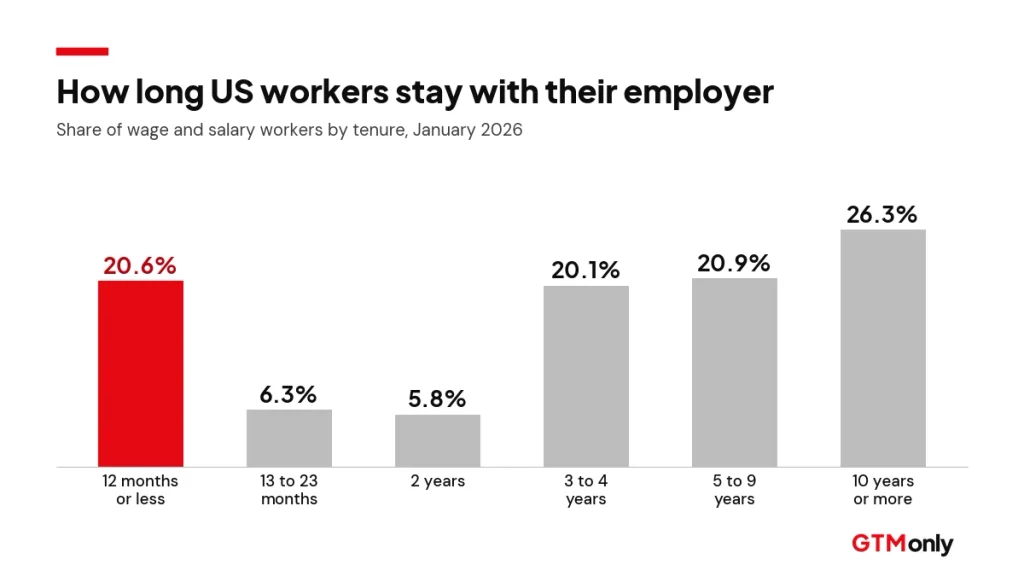
That’s down from 22.2% in January 2024. Still, roughly one in five workers was new to their employer, and every one of those moves can break a contact record.
This is how long US workers have been with their current employer:
| Tenure with current employer | Share of workers |
|---|---|
| 12 months or less | 20.6% |
| 13 to 23 months | 6.3% |
| 2 years | 5.8% |
| 3 to 4 years | 20.1% |
| 5 to 9 years | 20.9% |
| 10 to 14 years | 10.3% |
| 15 to 19 years | 5.8% |
| 20 years or more | 10.2% |
The median worker had been with their employer for 4.1 years in January 2026, up from 3.9 years in 2024.
| Year | Median tenure with current employer |
|---|---|
| 2016 | 4.2 years |
| 2018 | 4.2 years |
| 2020 | 4.1 years |
| 2022 | 4.1 years |
| 2024 | 3.9 years |
| 2026 | 4.1 years |
Private-sector workers, where most B2B buyers work, had a median tenure of 3.9 years. Public-sector workers stayed longer, at 5.6 years.
B2B contact turnover by age
25.5% of workers aged 25 to 34 had been with their employer for 12 months or less in January 2026. Among workers aged 55 to 64, the share was just 9.2%.
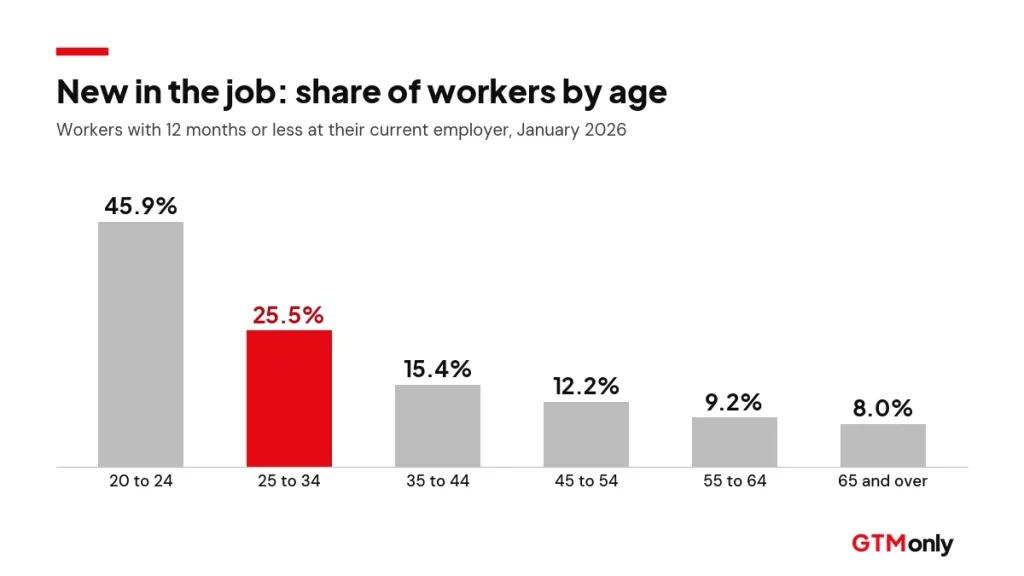
That means early-career contacts are nearly three times as likely to be new in their job. If you build a prospect list around junior titles, plan to re-verify it more often. (Your SDRs probably suspected this already.)
This is the share of new hires and the median tenure by age group:
| Age group | Share with 12 months or less at employer | Median tenure |
|---|---|---|
| 20 to 24 | 45.9% | 1.5 years |
| 25 to 34 | 25.5% | 3.0 years |
| 35 to 44 | 15.4% | 4.7 years |
| 45 to 54 | 12.2% | 7.0 years |
| 55 to 64 | 9.2% | 9.6 years |
| 65 and over | 8.0% | 9.9 years |
Median job tenure by role
Workers in sales and related occupations had a median tenure of just 3.3 years in January 2026. That’s the shortest of any occupation group outside service jobs.
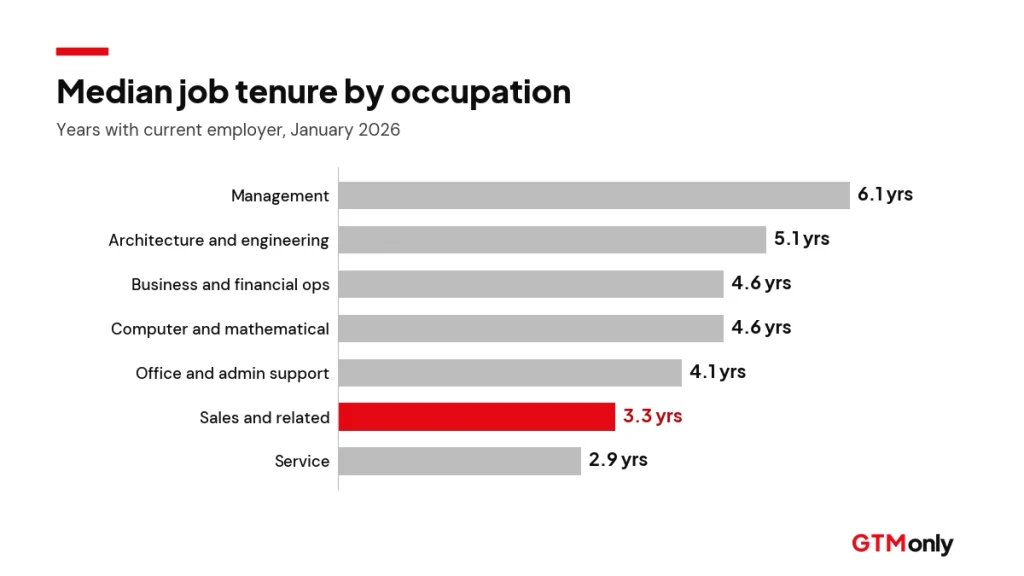
Managers sit at the other end, with a median tenure of 6.1 years, the longest of any occupation group in the data. When they do move, the change often creates a buying signal at their new company.
Median tenure by occupation group:
| Occupation group | Median tenure |
|---|---|
| Management | 6.1 years |
| Architecture and engineering | 5.1 years |
| Business and financial operations | 4.6 years |
| Computer and mathematical | 4.6 years |
| Office and administrative support | 4.1 years |
| Sales and related | 3.3 years |
| Service | 2.9 years |
Median job tenure by industry
Workers in financial activities had the longest median tenure of any major private-sector industry in January 2026, at 5.0 years. Leisure and hospitality had the shortest, at 2.4 years.
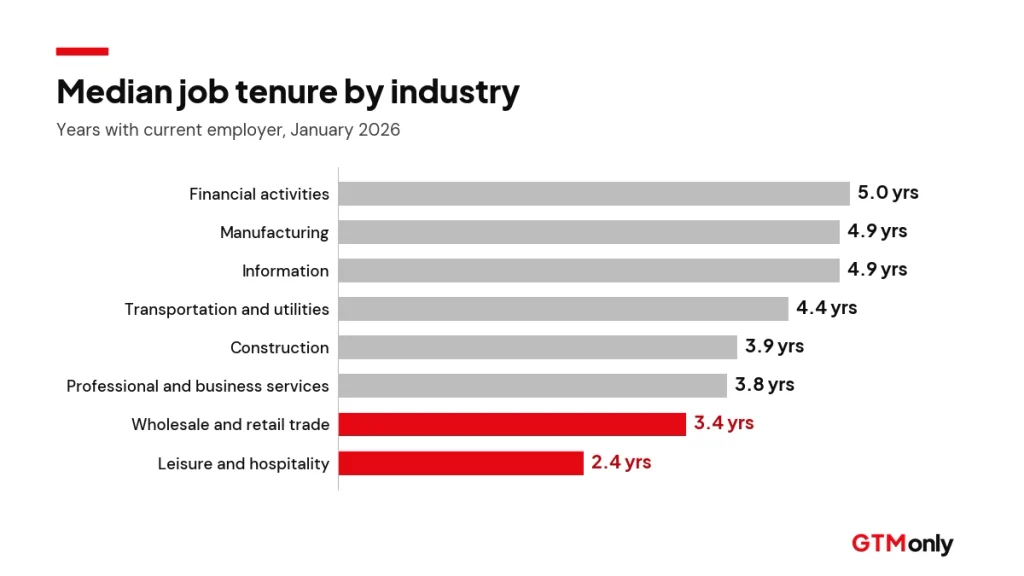
If your ideal customer profile sits in retail or hospitality, expect your data to decay faster than the 22.5% average. Finance and manufacturing lists should hold up better.
Median tenure by major private-sector industry:
| Industry | Median tenure |
|---|---|
| Financial activities | 5.0 years |
| Mining, quarrying, and oil and gas extraction | 4.9 years |
| Manufacturing | 4.9 years |
| Information | 4.9 years |
| Agriculture and related industries | 4.8 years |
| Transportation and utilities | 4.4 years |
| Other services | 4.2 years |
| Construction | 3.9 years |
| Education and health services | 3.9 years |
| Professional and business services | 3.8 years |
| Wholesale and retail trade | 3.4 years |
| Leisure and hospitality | 2.4 years |
Source: U.S. Bureau of Labor Statistics
B2B data decay FAQs
What is B2B data decay?
B2B data decay is the gradual loss of accuracy in business contact and company records. It happens when people change jobs, get promoted, or leave, and when companies merge, rebrand, or switch email domains. A decayed record has at least one field that’s no longer true, such as an email, job title, or phone number.
How much B2B data goes bad every year?
About 22.5% of B2B contact data goes bad every year. That’s based on a 2.1% monthly decay rate from MarketingSherpa research cited by HubSpot. Email data decays at a similar pace, with ZeroBounce finding at least 23% of an email list degraded in 2025.
What percentage of B2B contacts change jobs each year?
Roughly one in five US workers is new to their employer at any point in time. In January 2026, 20.6% of US workers had 12 months or less with their employer. That’s per the Bureau of Labor Statistics, down from 22.2% in 2024.
Which job titles have the highest data decay rate?
Early-career and sales titles decay fastest. Workers in sales and related occupations had a median tenure of 3.3 years in January 2026, compared with 6.1 years for managers. Among workers aged 25 to 34, 25.5% had been with their employer for a year or less.
How often should you clean your B2B database?
Clean your B2B database at least once a quarter. ZeroBounce recommends quarterly email list cleaning at minimum, and monthly checks if your database grows quickly. For active cold email campaigns, verify contacts right before each send, since even a list cleaned last quarter can hold dead addresses.
Conclusion
That’s every B2B data decay stat worth bookmarking.
Plan for a B2B data decay rate of roughly 22.5% a year. Expect more if your list skews junior, sales-heavy, or high-turnover. Even records from the best B2B contact database providers start aging the day you export them.
So build regular data enrichment into your workflow. Treat decay like rent, because it comes due every month whether you check the bill or not.