
What Is a GTM Engineer? Role, Skills, Salary and How to Hire
TL;DR
A GTM engineer is a technical operator who designs, builds, and maintains the automated systems that power B2B sales, marketing, and customer success.
The role emerged in 2023 when Clay coined the title. By January 2026, LinkedIn listed over 3,000 open GTM engineering roles, a 205% jump year over year. GTM engineers are not a RevOps rebrand. They build what RevOps governs. Salary ranges from $127K to $241K, with AI-skilled engineers earning significantly more.
B2B GTM teams are drowning in tools, data, and manual work. The average SaaS company runs on more than 150 different software applications. And most of them are not talking to each other.
That is the problem a GTM engineer is hired to solve.
The role is new. Clay coined the title in 2023. But by early 2026, it had become one of the fastest-growing jobs in B2B tech, with over 3,000 open positions on LinkedIn and salaries rivaling software engineers.
This guide covers everything: what a Go-to-market engineer actually does, how the role differs from RevOps and Sales Engineers, the skills and tools required, salary benchmarks, and how to know if your company needs one.
What Is a GTM Engineer?
A GTM engineer is a technical professional who designs, builds, and maintains the automated systems that connect your sales, marketing, and customer success teams into one functioning revenue engine.
They do not just manage your CRM or clean up your Salesforce fields. They build the infrastructure that makes your entire go-to-market strategy run without constant manual effort.
Think of them as the person who sits at the intersection of business strategy and technical execution. They understand the sales funnel as well as any AE. And they can write Python, call an API, and build a data pipeline from scratch.
According to ZoomInfo, hiring for the GTM engineer role doubled year over year for two consecutive years before exploding 205% in 2025 alone. This is not a job title trend. It is a category-defining moment.
Where Did the Role Come From?
Clay coined the GTM engineer title in 2023. But the work itself is not new.
Companies like Ramp, Stripe, and Figma had people doing this exact job years earlier under titles like growth engineer, revenue systems architect, or that ops person who knows APIs. What changed was the tooling.
When Clay, Make, and AI-powered sequencers made it possible for one person to automate what previously required a full team, the role became distinct enough to name. The title first appeared in Google Trends in April 2025. Hiring exploded from there.
The Simple Version
Your VP of Sales asks you to build an outbound engine in 30 days. Not hire a team. Build a system.
One that identifies target accounts, enriches contacts, writes personalized first lines, sequences emails, handles replies, and updates the CRM without a human touching it.
The person who builds that system is a GTM engineer.
Now that you know what a GTM engineer is, here is what they actually spend their time building.
What Does a Go-to-market Engineer Do?
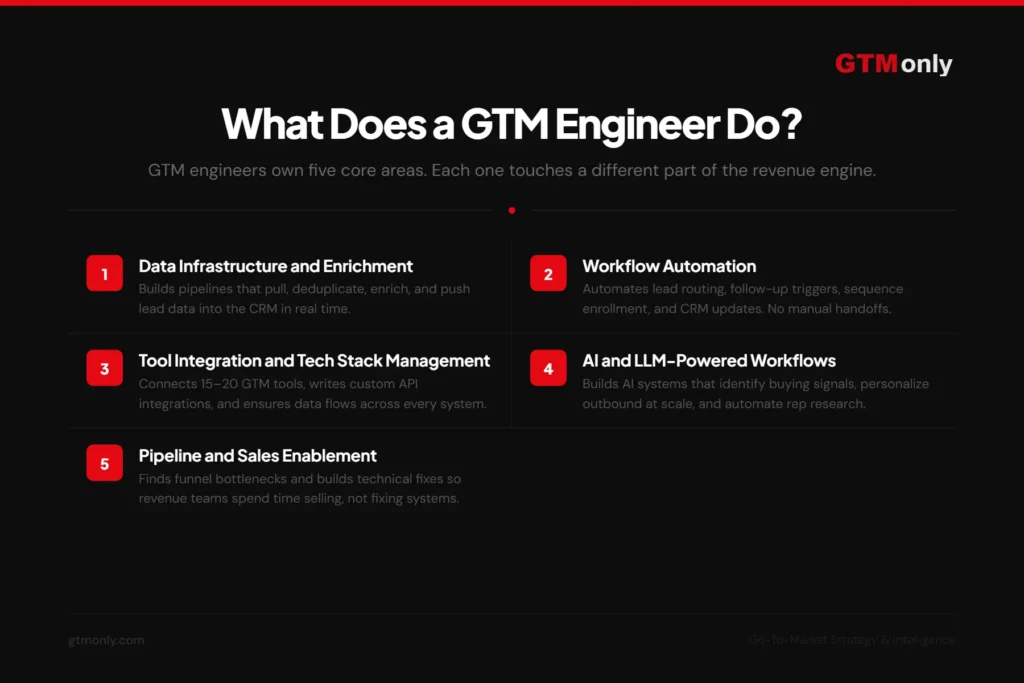
GTM engineers own five core areas. Each one touches a different part of the revenue engine.
1. Data Infrastructure and Enrichment
Clean, accurate data is the foundation of every GTM system. A Go-to-market engineer builds the pipelines that pull leads from multiple sources, deduplicate records, enrich contact and company data, and push it all into the CRM in real time.
Without this, your SDRs are working from stale lists. Your lead scoring is wrong. Your outbound hits the wrong people. GTM engineers fix this at the infrastructure level, not with a spreadsheet cleanup.
2. Workflow Automation
Manual handoffs kill revenue team efficiency. Go-to-market engineers automate the repetitive work that slows teams down: lead routing, follow-up triggers, data normalization, sequence enrollment, and CRM updates.
A lead fills out a form. The system enriches it, scores it, routes it to the right rep, enrolls it in the right sequence, and notifies the rep on Slack. No human required. That is a Go-to-market engineer’s work.
3. Tool Integration and Tech Stack Management
The average B2B company runs 15 to 20 GTM tools. Most of them are not integrated properly. Go-to-market engineers connect the stack, write custom API integrations where native connectors fall short, and ensure data flows consistently across every system.
They decide which tools to keep, which to consolidate, and how to wire them together into one coherent revenue engine.
4. AI and LLM-Powered Workflows
This is where the role has shifted most dramatically in 2025 and 2026. GTM engineers now build AI-powered systems that identify buying signals, personalize outbound at scale, score leads using machine learning, and automate research tasks that used to take hours per rep.
Go-to-market engineers who can deploy and govern AI agent workflows are earning 15 to 25% more than those working with traditional automation only, according to Bloomberry’s 2025 job analysis.
5. Pipeline and Sales Enablement
GTM engineers identify bottlenecks in the sales funnel and build technical solutions to clear them. If SDRs are spending three hours a day on manual research, a GTM engineer builds an automated enrichment workflow. If AEs lack real-time buyer signals, a GTM engineer builds the alert system.
Their goal is always the same: remove friction so revenue teams can focus on selling instead of fixing systems.
This is the comparison that causes the most confusion in hiring. Let us settle it clearly.
GTM Engineer vs. RevOps: What Is the Real Difference?
The short answer: RevOps runs the machine. A Go-to-market engineer builds it.
They are not the same role. They are not interchangeable. And companies that confuse them end up hiring the wrong person and building the wrong GTM motion.
| GTM Engineer | RevOps | |
| Primary function | Build new automated systems from scratch | Govern, optimize, and maintain existing systems |
| Orientation | Builder and architect | Operator and strategist |
| Technical depth | APIs, Python, SQL, LLM integration | CRM configuration, process design, reporting |
| Owns | Revenue infrastructure and automation | Forecasting, pipeline governance, enablement |
| Reports to | Head of Growth, CRO, or COO | CRO or VP of Revenue |
| Hired when | You need scale and automation leverage | You need alignment and operational order |
| Company stage | Post Series A, complex tech stack | Early stage through enterprise |
Jake Gill, founder at Engineered GTM, put it well: RevOps improves the machine. GTM Engineering engineers it. One requires operational discipline. The other requires technical depth and commercial instinct at the same time.
The rule is simple. If your business needs alignment, hire RevOps first. If your business needs scale, hire GTM Engineering first. Getting this wrong costs you both money and momentum.
There is a second comparison worth covering, because the titles get mixed up in job postings constantly.
GTM Engineer vs. Sales Engineer: Not the Same Role
A Sales Engineer (SE) is deal-centric. They join late-stage sales calls, run technical demos, answer integration questions, and help AEs close specific opportunities.
A GTM engineer is systems-centric. They never touch individual deals. They build the infrastructure that makes every deal easier to close.
- Sales Engineers report to VP of Sales and are measured by win rates and technical validation.
- GTM Engineers report to Head of Growth or CRO and are measured by pipeline velocity and automation coverage.
- Sales Engineers serve 2 to 10 AEs in a deal-support ratio. GTM Engineers serve the entire revenue org.
The simplest test: If the role requires joining prospect calls to answer technical questions, that is a Sales Engineer. If the role requires writing code and building pipelines to scale outbound, that is a GTM engineer.
Not every GTM engineer looks the same. Bloomberry’s analysis of 288 unique job postings identified four distinct archetypes.
The Four Go-to-Market Engineer Archetypes
1. The Automation Operator (Entry Level)
Focuses on no-code and low-code tools. Builds workflows in Clay, Make, and Zapier. Sets up basic outbound sequences and CRM automation. Typically earns $100K to $132K.
This is the most common early-hire archetype. It is also the one most at risk from AI automation. The durable version of this role evolves toward systems architecture.
2. The Data and Enrichment Engineer
Specializes in data pipelines. Writes SQL and Python. Builds enrichment flows, deduplication logic, and lead scoring models. Works closely with RevOps on data governance. Earns $132K to $185K.
This archetype is in high demand. Clean data is the prerequisite for every other GTM system. Companies with broken data infrastructure hire this profile first.
3. The Revenue Systems Architect
Owns the entire GTM tech stack. Designs cross-functional workflows that span marketing, sales, and CS. Writes custom API integrations. Architects the full data layer. Earns $185K to $241K.
This is the senior individual contributor. They build what everyone else uses. They have 4 to 7 years of experience and can own a GTM engineering function independently.
4. The AI GTM Engineer (2025 and 2026 Emerging Archetype)
Builds and deploys AI agent workflows. Integrates LLMs into enrichment pipelines, personalization engines, and lead qualification systems. Commands a 15 to 25% salary premium over traditional automation specialists.
This is the highest-growth archetype in 2026. Companies like OpenAI, Vercel, and Ramp are paying $184K to $252K for this profile. Demand is outpacing supply significantly.
Now that you know the archetypes, here are the skills that separate strong Go-to-market engineers from weak ones.
GTM Engineer Skills: Technical and Commercial
A GTM engineer needs two things most roles do not require simultaneously: the ability to write code and a deep understanding of how B2B revenue teams work.
Neither alone is enough. A software engineer without sales context builds systems that technically function but practically miss the mark. A sales ops person without coding skills hits a ceiling on what they can automate.
Technical Skills
- APIs and webhooks: Building custom integrations between GTM tools where native connectors do not exist.
- Python and SQL: Writing enrichment scripts, querying data warehouses, building scoring models, and automating analysis.
- CRM configuration: Deep Salesforce or HubSpot expertise, including custom objects, workflows, lead routing logic, and data hygiene.
- Workflow automation platforms: Make, n8n, Zapier, or Workato for orchestrating multi-step automated processes.
- Data pipelines: Building and maintaining flows that pull, clean, enrich, and push data across systems in near real time.
- AI and LLM integration: Deploying AI tools for research automation, personalization, signal detection, and lead qualification.
Commercial Skills
- Funnel understanding: A clear mental model of how leads move from awareness to closed-won, and where friction lives at each stage.
- ICP and buyer signal knowledge: A GTM engineer needs a clear ideal customer profile to build any targeting or scoring system. They use that definition to identify which accounts show buying intent and route them to the right rep.
- Sales process fluency: Enough familiarity with how reps work to build systems that match their actual workflows.
- Revenue metrics: Knowing which numbers matter, such as CAC, pipeline velocity, conversion rates, and time-to-close, and building systems that move them.
Bloomberry’s job analysis found that Python and SQL appear in a significant share of GTM engineering postings. Candidates who bring coding skills command a pay premium that tool-only operators do not.
The tools change fast. But these seven categories appear in almost every GTM engineering role.
GTM Engineer Tools: The 2026 Tech Stack
| Category | Key Tools | What GTM Engineers Use It For |
| Data Enrichment | Clay, ZoomInfo, Apollo, Clearbit, Lusha | Build lead lists, enrich contacts, surface buying signals |
| CRM | Salesforce, HubSpot, Attio | Pipeline management, lead routing, deal tracking |
| Workflow Automation | Make (Integromat), n8n, Zapier, Workato | Connect tools, automate handoffs, trigger sequences |
| Outbound Sequencing | Apollo, Outreach, SalesLoft, Smartlead | Automated email and call sequences at scale |
| Intent and Signals | Bombora, G2 Buyer Intent, 6sense | Identify accounts showing active buying behavior |
| Analytics | Looker, Tableau, Google Looker Studio | Revenue dashboards, attribution, funnel reporting |
| AI and LLM Tools | ChatGPT, Claude, Gemini, custom GPTs | Personalization, research automation, AI scoring |
Clay is the most widely cited tool in GTM engineering job postings. It pulls data from over 75 sources, runs AI research on prospects, and outputs enriched lead lists ready for outbound.
One important caveat: roles that mention Clay in the job description pay $26K less than those that do not, according to Bloomberry’s analysis. Clay is the floor, not the ceiling. The most valuable GTM engineers own the full stack, not just one tool.
Compensation reflects technical depth. Here is what the market actually pays.
GTM Engineer Salary: What the Market Pays in 2026
Go-to-market engineer salaries vary significantly based on seniority, technical skill depth, company stage, and AI expertise. Here is the breakdown from aggregated job posting data and self-reported compensation.
| Level | Base Salary (US) | Experience | Primary Focus |
| Junior GTM Engineer | $100K – $132K | 0-2 years | Tool config, basic workflows |
| GTM Engineer | $132K – $185K | 2-4 years | Automation architecture, data pipelines |
| Senior GTM Engineer | $185K – $241K | 4-7 years | Full-stack GTM systems, AI integration |
| Lead / Head of GTM Eng. | $220K – $335K+ | 7+ years | Org-wide revenue infrastructure |
Glassdoor’s April 2026 data puts the average total compensation at $185,373, with top earners at or above $335,000. The 25th to 75th percentile range runs from $139K to $255K.
The top-paying companies in 2026 include Vercel at $252K, OpenAI at $250K, LILT AI at $221K, Air at $208K, and Ramp at $184K. All are AI-native or developer-tool companies. They treat GTM engineering as a core function, not a support role.
AI specialization is the biggest salary lever. Data from Captivate Talent shows that individual contributors with AI skills saw a 23% earnings increase in 2025. GTM engineers who can build and deploy AI agent workflows earn significantly more than those working with traditional automation only.
Most GTM engineers grew into the role rather than training for it directly. Here is the pattern that keeps showing up.
How to Become a GTM Engineer
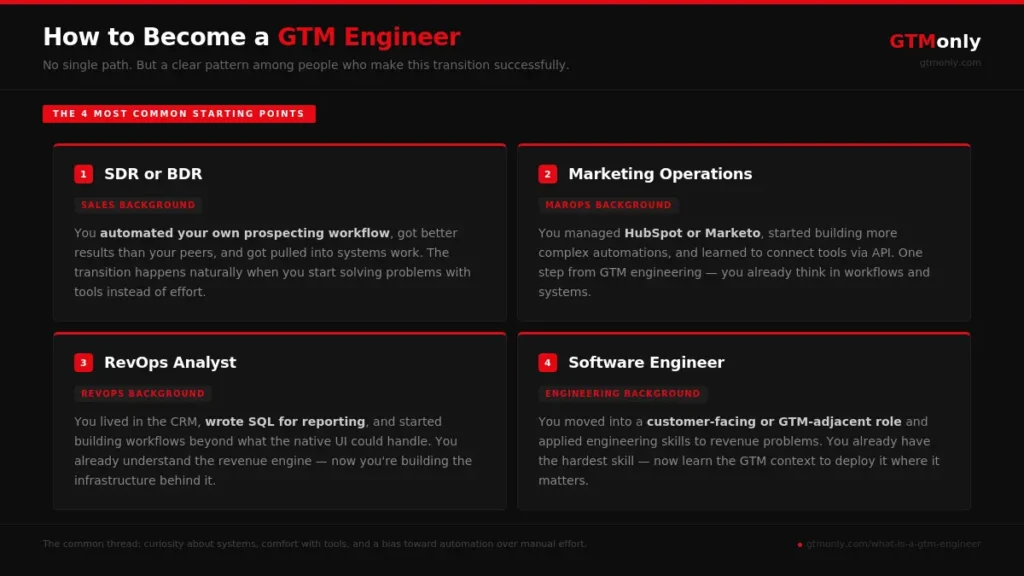
There is no single path. But there is a clear pattern among people who have made this transition successfully.
The Most Common Starting Points
- SDR or BDR: You automated your own prospecting workflow, got better results than your peers, and got pulled into systems work.
- Marketing Operations: You managed HubSpot or Marketo, started building more complex automations, and learned to connect tools via API.
- RevOps Analyst: You lived in the CRM, wrote SQL for reporting, and started building workflows beyond what the native UI could handle.
- Software Engineer: You moved into a customer-facing or GTM-adjacent role and applied engineering skills to revenue problems.
The Skills to Build First
- Learn Clay. It is the entry-level requirement for most GTM engineering roles and the fastest way to build a portfolio.
- Pick up SQL. Start with basic queries, then move to writing enrichment logic and scoring models. Most companies use Snowflake, BigQuery, or Redshift.
- Get comfortable with one major CRM at a deep level. Salesforce or HubSpot. Go beyond admin-level knowledge and learn custom objects, flows, and API access.
- Learn a workflow automation platform. Make and n8n are the most powerful options. Zapier works for simpler use cases.
- Build a proof-of-work portfolio. Hiring managers want to see your Clay tables, automation workflows, and measurable outcomes. Before-and-after metrics make your work real.
Average experience required for Go-to-market engineer roles is 4.1 years, according to Bloomberry’s job analysis. But the field is new enough that strong portfolios with demonstrated results can accelerate hiring decisions significantly.
The career path is still forming since the role only emerged formally in 2023. But a clear progression has appeared among the first wave of practitioners.
GTM Engineer Career Path
- GTM Associate or Junior Engineer (0-2 years): Tool configuration, basic workflow automation, data cleanup, outbound support.
- GTM Engineer (2-4 years): Full automation architecture, enrichment pipelines, AI tool integration, cross-team projects.
- Senior GTM Engineer (4-7 years): Revenue systems ownership, advanced AI workflows, mentoring, architecture decisions.
- Lead GTM Engineer or Head of GTM Engineering (7+ years): Org-wide revenue infrastructure, team building, strategic partnership with CRO.
- Director of Revenue Operations or VP of GTM Systems: The natural executive progression for GTM engineers who move into leadership.
The GTM engineering career path typically runs from individual contributor to engineering manager to director of revenue infrastructure over five to seven years. Candidates with deep AI expertise are compressing this timeline.
Knowing when your company needs a GTM engineer is just as important as knowing what one does.
When Does Your Company Need a GTM Engineer?
Not every company needs a GTM engineer. At very early stages, a strong RevOps hire does the job. The GTM engineer becomes essential when your motion gets complex enough that manual processes and existing tools cannot keep up.
Strong Signals That You Need One Now
- Your SDRs spend more than two hours per day on manual data work instead of having sales conversations.
- Your tools are not talking to each other and you have no single source of truth for pipeline data.
- You are adding headcount but revenue per GTM employee is flat or declining.
- Marketing attribution is unreliable and you cannot trace revenue back to campaigns or channels.
- You are sitting on AI tools you paid for but have not been able to implement effectively.
- Your CRM is a mess and no one trusts the data in it.
Company Stage Guide
Under $5M ARR: A strong RevOps generalist covers what you need. GTM engineering is premature.
$5M to $15M ARR: Consider a GTM engineer if outbound is a core motion and your tech stack is growing. This is often the first time the role makes financial sense.
$15M ARR and above: At this stage, a dedicated GTM engineer is almost always justified. The automation leverage more than covers the cost. Companies over $50M ARR often need a small GTM engineering team.
If you are hiring a GTM engineer, these signals will save you a bad hire.
Red Flags When Hiring a GTM Engineer
The market for GTM engineers is hot enough that titles have inflated. Not everyone calling themselves a GTM engineer has the skills to back it up. Here is what to watch for.
- They cannot show you a portfolio. Strong GTM engineers have documented systems they built with before-and-after metrics. If there is nothing to show, the role may have been largely administrative.
- They only know one tool. Clay fluency alone does not make someone a GTM engineer. Ask how they have connected multiple systems, written custom integrations, or built data pipelines. One-tool specialists hit a ceiling fast.
- They cannot explain what they are automating and why. A GTM engineer should understand the business logic behind every system they build. If they cannot explain how a workflow maps to revenue outcomes, they are a technician, not an engineer.
- They have never worked closely with Sales or Marketing teams. GTM engineers who have only sat in ops roles without exposure to quota-carrying teams often build systems that technically function but practically miss what reps actually need.
- They treat RevOps and GTM engineering as the same thing. They are not. A GTM engineer who thinks they are just a technical RevOps person will scope their work too narrowly to deliver the leverage you are hiring them for.
Before we get to the FAQ, here is how to measure whether your GTM engineering investment is paying off.
How to Measure GTM Engineering ROI
GTM engineering impact shows up in four categories: speed, cost, quality, and scale. Track at least one metric in each bucket.
Speed Metrics
- Lead-to-contact time: How fast does a new inbound lead get enriched, scored, and contacted? Target under 5 minutes for high-intent leads.
- Sales cycle length: GTM-engineered teams average 30% shorter CAC payback periods according to Factors.ai’s 2026 benchmarks.
Cost Metrics
- Revenue per GTM headcount: Are you generating more revenue with the same or fewer people? This is the ultimate automation leverage metric.
- Manual hours eliminated: Quantify the hours per week your team gets back from automated workflows. Convert to dollar value at blended rep cost.
Quality Metrics
- Pipeline quality score: Are more opportunities fitting your ICP? ICP-fit rate in pipeline should improve as lead scoring and enrichment improve.
- Data accuracy rate: What percentage of CRM records have verified, complete contact data? Target above 85%.
Scale Metrics
- Outbound volume per rep: How many quality touches can one SDR make per day with automation support versus without?
- Automation coverage: What percentage of your routine GTM workflows are fully automated versus still manual?
There is a legitimate debate in the industry worth addressing directly.
Is a GTM Engineer Just a RevOps Rebrand?
Some operators argue the GTM engineer title is LinkedIn hype. That it is the same as RevOps dressed up with a trendier name to command higher salaries.
Here is the honest answer: they are partly right and mostly wrong.
The responsibilities overlap in tools, data, and process. A senior RevOps professional and a GTM engineer may use some of the same platforms. But the orientation is fundamentally different.
RevOps optimizes what already exists. A GTM engineer builds what is missing. One requires operational discipline. The other requires the ability to write code, design systems architecture, and deploy AI workflows from scratch.
The proof is in the pay. RevOps managers average $97K to $136K. GTM engineers average $132K to $241K. That gap reflects genuine skill differentiation, not title inflation.
The bottom line: do not hire based on hype. Hire based on what your business needs. If you need alignment and process governance, hire RevOps. If you need technical automation and scale, hire a Go-to-market engineer. They serve different functions and both matter.
The Bottom Line
The GTM engineer role exists because modern B2B revenue operations became too complex for manual processes and generalist ops teams to handle.
One person with the right technical skills and commercial understanding can now automate what used to require a team. That is the leverage this role provides.
If your revenue team is drowning in manual work, your tools are not talking to each other, and your pipeline is not scaling with headcount, the answer is not more SDRs. It is a GTM engineer.
Build the systems. Then scale the team on top of them.
Frequently Asked Questions
Is a GTM engineer the same as RevOps?
No. RevOps governs and optimizes existing systems. A GTM engineer builds new systems from scratch. RevOps owns process design, forecasting, and cross-functional alignment. GTM engineers own automation architecture, API integrations, and AI workflow deployment. They complement each other but serve different functions.
What salary does a GTM engineer earn?
US salaries range from $100K for junior roles to $335K+ for senior AI-skilled engineers. The median from 1,000+ job postings is $127,500 base salary. Glassdoor’s April 2026 data puts average total compensation at $185,373. AI and automation expertise are the primary salary differentiators.
How do I become a GTM engineer?
Most GTM engineers come from SDR, marketing ops, or RevOps backgrounds. Start by learning Clay, picking up SQL and Python basics, and getting deep on one CRM. Build a portfolio of systems you have built with measurable before-and-after results. Average experience required is 4.1 years, but strong portfolios can accelerate hiring.
When should a company hire a GTM engineer?
Consider the role once you are above $5M ARR with a growing outbound motion. Clear signals include SDRs spending hours on manual data work, tools that do not integrate properly, flat revenue per headcount despite adding people, and AI tools that went unused because no one could implement them.
What is an AI GTM engineer?
An AI GTM engineer is the 2025 and 2026 evolution of the role. They build LLM-powered workflows for lead qualification, personalization at scale, buying signal detection, and AI research agents. They earn 15 to 25% more than traditional automation specialists and represent the highest-demand archetype in the current market.