What Is a Sales Funnel? Stages, Leaks & How It Works
Here is a number that should bother you: 80% of leads never convert into sales.
Not because the product is bad. Not because the price is wrong.
Because the funnel is broken and nobody is watching it.
Most companies treat the sales funnel like a set-it-and-forget-it system. Build a website, run some ads, hand off to sales, and hope for the best. Then they wonder why pipeline looks healthy but revenue does not move.
Understanding your sales funnel, really understanding it, is one of the highest-leverage things a GTM team can do. This guide gives you the full picture: what a sales funnel is, how each stage works, where most funnels fall apart, and what a well-built one actually looks like.
What Is a Sales Funnel?
A sales funnel is the step-by-step process that moves a potential customer from first hearing about you to making a purchase.
It is called a funnel because of what happens at each stage: a large number of people enter at the top, and a much smaller number reach the bottom. That narrowing is not a failure. It is how buying works. Not everyone who learns about your product is ready to buy. Not everyone who is ready to buy will choose you.
The funnel is your system for understanding that journey and making it as smooth as possible.
Here is the definition worth saving:
A sales funnel is the structured path a business uses to guide a potential customer from initial awareness to completed purchase, with each stage filtering prospects based on their intent and readiness to buy.
Every business has a sales funnel. Some are intentional, well-mapped, and consistently optimized. Most are accidental, full of gaps, and losing money in places the team has never looked.
The goal of this guide is to put you firmly in the first group.
The Four Stages of a Sales Funnel
Most sales funnels follow four core stages. You will hear them described as TOFU (top of funnel), MOFU (middle of funnel), and BOFU (bottom of funnel). Here is what each one actually means in practice.
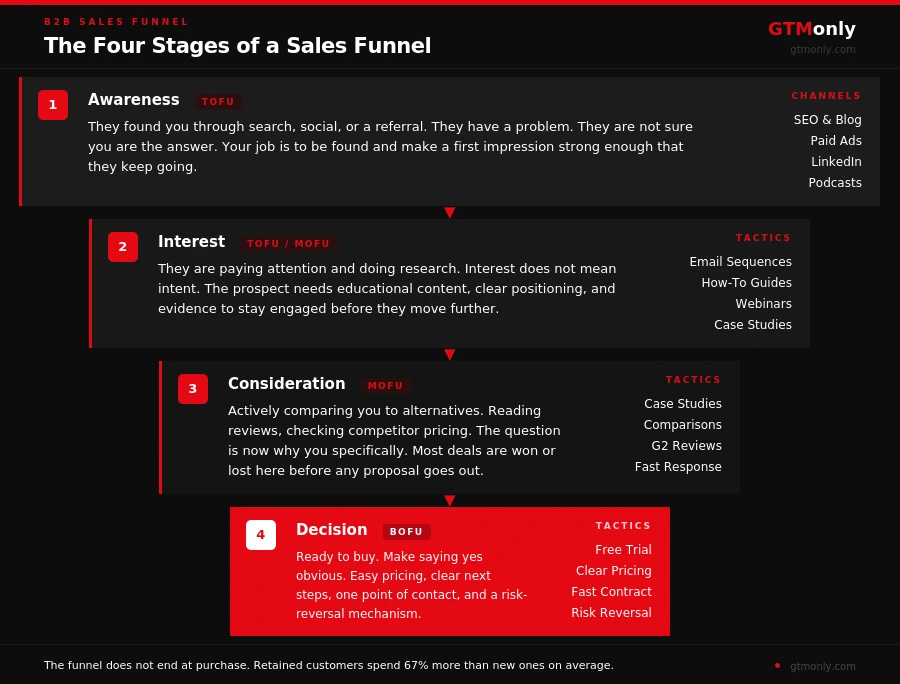
Stage 1: Awareness (Top of Funnel)
This is where someone first learns your business exists.
Maybe they Googled a problem and found your blog. Maybe a colleague mentioned you over Slack. Maybe a LinkedIn post caught them mid-scroll at 11pm while avoiding a report they were supposed to finish.
They have a problem. They are not sure you are the answer yet.
Your job at this stage is not to sell. It is to be found, and to make a strong enough first impression that the prospect keeps going. Blog content, SEO, paid ads, podcasts, and social media all feed the awareness stage.
One thing most businesses get wrong here: they optimize for volume instead of fit. They want more traffic. What they actually need is the right traffic. A funnel full of the wrong people is just an expensive waste of time.
Stage 2: Interest (Top to Middle of Funnel)
The prospect is now paying attention.
They have read more. They have looked around. They are starting to understand whether what you do is relevant to their situation.
This is the stage where most brands get lazy. They assume interest means intent. It does not. The prospect is still in research mode. They need educational content, clear positioning, and enough evidence to stay engaged.
Email sequences, detailed how-to guides, webinars, and case studies do the heavy lifting here. The goal is to help the prospect understand their problem better, with you as the expert guiding them.
Stage 3: Consideration (Middle of Funnel)
Now things get serious.
The prospect is actively comparing you to alternatives. They are reading your G2 reviews. They are on your competitor’s pricing page at the same time they are on yours. They might request a demo or download a comparison guide.
At this stage, they are not asking ‘does a solution exist?’ They are asking ‘why should it be you, specifically?’
This is where most deals are actually won or lost, long before a proposal goes out. The teams that win here are the ones with the strongest case studies, the clearest differentiation, and the fastest response times. A prospect who reaches out for a demo and hears back two days later is already halfway out the door.
Stage 4: Decision (Bottom of Funnel)
The prospect is ready to buy. They just need to commit.
This stage sounds easy. It is not. Pricing friction, slow procurement processes, unclear contract terms, and the absence of a well-timed follow-up kill deals that should have been wins.
The best GTM teams make the decision stage as frictionless as possible. Easy pricing. Clear next steps. A single point of contact. A risk-reversal mechanism like a free trial or a guarantee. The goal is to make saying yes feel obvious and saying no feel like the harder choice.
One more thing on this.
The funnel does not end at purchase. That is the biggest myth in sales.
Retained customers spend an average of 67% more than new ones. Every customer you close and then ignore is a revenue leak disguised as a win. The best teams treat post-purchase as Stage 5: onboarding, check-ins, expansion conversations, and referral programs that feed new pipeline without a dollar of ad spend.
Sales Funnel vs. Marketing Funnel: What Is the Difference?
These two terms get used interchangeably. They are not the same thing.
A marketing funnel covers the journey from stranger to lead. It ends when someone raises their hand: fills out a form, downloads a guide, subscribes to your list.
A sales funnel picks up from there. It covers the journey from lead to customer, driven primarily by your sales team.
In practice they overlap significantly. The hand-off point between the two is also where most revenue quietly disappears.
Marketing sends over 2,000 MQLs. Sales says 400 are worth calling. Finance asks why pipeline is flat while ad spend is up 30%. Everyone points fingers at a different stage.
Sound familiar? That is a broken funnel, not a broken team.
The fix is a clear, agreed-upon definition of what qualifies as a lead worth passing from marketing to sales. Without that shared definition, both teams are optimizing for different outcomes and blaming each other for the gap.
Sales Funnel vs. Sales Pipeline: Not the Same Thing Either
This one trips up a surprising number of people, including people who have been in B2B sales for years.
A sales pipeline is the seller’s view. It tracks where each specific deal sits in your sales process, from first contact to closed-won or closed-lost. It lives in your CRM. It is built for sales reps to manage their book of business.
A sales funnel is the buyer’s view. It measures how a population of prospects moves through stages over time. It tracks conversion rates, not individual deals.
Same stages. Completely different perspective.
The pipeline tells you what is happening to specific deals right now. The funnel tells you whether your overall system is working. You need both. If you only track the pipeline, you will keep fixing individual deals while missing the systemic problem underneath them.
Why Most Sales Funnels Leak
This is the section most ‘what is a sales funnel’ guides skip.
And skipping it is expensive.
Every funnel leaks. The question is not whether yours has gaps. It is where, how big, and how much revenue is bleeding out.
Here is where leaks typically show up:
- Top of funnel: You are attracting the wrong audience. Traffic looks healthy. Lead volume looks fine. But conversion rates downstream are terrible because the people entering the funnel were never going to buy in the first place. This is an ICP problem disguised as a traffic problem.
- Mid-funnel: The marketing-to-sales handoff is broken. Leads fall into a CRM and nobody follows up with the right message at the right time. Or sales follows up, finds the lead is not ready, and marks it as dead. Two months later that ‘dead’ lead buys from a competitor.
- Bottom of funnel: Deals stall at negotiation. Pricing is unclear. The internal champion cannot get budget approved. A follow-up email sits in drafts for three days. These are late-stage leaks, and they are the most expensive kind because you have already invested the most to get there.
- Post-sale: You close the deal and move on. The customer onboards slowly, never sees full value, and churns quietly at the 12-month mark. The funnel filled with water you never kept.
Here is the thing nobody tells you: pouring more leads into a broken funnel does not fix the leaks. It just makes them more expensive.
Before you spend another dollar on ads or content, find the stage with the worst conversion rate in your funnel. That is your constraint. Fix it first.
How to Build a Sales Funnel That Actually Works
There is no shortage of ‘build a sales funnel in 5 steps’ guides online. Most of them are generic enough to apply to anyone and useful to nobody.
Here is the version that holds up in practice.
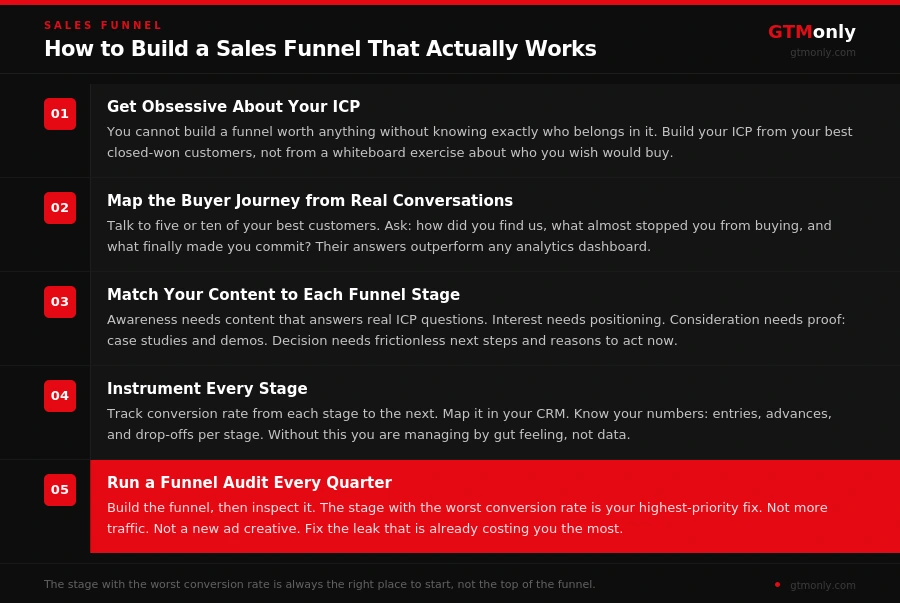
- Get obsessive about your Ideal Customer Profile (ICP). You cannot build a funnel worth anything without knowing exactly who belongs in it. Your ideal customer profile determines which prospects should enter the funnel at all. Build it from your best closed-won customers, not from a whiteboard exercise about who you wish would buy from you.
- Map the buyer’s journey from real conversations. Do not assume. Talk to five or ten of your best customers and ask: how did you find us, what almost stopped you from buying, and what finally made you commit? Their answers will tell you more about your funnel than any analytics dashboard.
- Match your content to each stage. Awareness needs content that answers real questions your ICP is already asking. Interest needs positioning that separates you from alternatives. Consideration needs proof: case studies, demos, and social proof from names your buyers recognize. Decision needs frictionless next steps and reasons to act now.
- Instrument every stage. Track the conversion rate from each stage to the next. Map it in your CRM. Know your numbers: how many people enter each stage, how many move forward, and how many fall out. Without this, you are managing by gut feeling.
- Run a funnel audit every quarter. Build the funnel, then inspect it. The stage with the worst conversion rate is your highest-priority fix. Not more traffic. Not a new ad creative. Fix the leak that is already costing you the most.
The Metrics That Tell You If Your Funnel Is Healthy
Most guides tell you to track conversion rates and leave it there.
That is not enough.
Here are the specific metrics that matter per stage, with realistic B2B benchmarks to orient your own numbers:
| Funnel Stage | Key Metric | Healthy B2B Benchmark |
| Awareness | Organic traffic, qualified traffic % | Varies by channel and spend |
| Interest | Lead to MQL conversion rate | 10 to 25% of raw leads |
| Consideration | MQL to SQL conversion rate | 20 to 40% of MQLs |
| Decision | SQL to closed-won rate | 20 to 30% of SQLs |
| Post-sale | Annual churn rate | Under 5 to 10% annually |
If fewer than 10% of your marketing qualified leads (MQLs) are becoming sales qualified leads (SQLs), the problem is lead quality, not sales execution. Go back to your ICP and your top-of-funnel targeting
If your win rate is below 15%, the problem is almost always competitive positioning or friction at the decision stage. Not volume.
The number that tells you where to spend your next hour is the stage with the biggest gap between where you are and where you should be. Start there. Always.
The Sales Funnel Is Evolving
Here is a truth that most funnel guides are not willing to say out loud.
The classic linear funnel is not how buyers actually behave.
Google’s research on the ‘Messy Middle’ showed that modern buyers bounce repeatedly between exploration and evaluation before making a decision. They read three blog posts. Then check a competitor. Then come back to your pricing page. Then read a Reddit thread about your product. Then watch a demo on YouTube. Then read the blog post again.
That is not a funnel. That is a pinball machine.
The linear funnel is still a useful planning tool. It helps you map content, define stages, and allocate resources. But if you treat it as a literal representation of how buyers move, you will misread your data and make the wrong fixes.
This is why many teams are now pairing the funnel with the flywheel model. The idea, popularized by HubSpot, is straightforward: instead of the customer being the end of the journey, the customer becomes the engine of growth. Happy customers drive referrals, generate reviews, and create new pipeline without a dollar of ad spend.
The funnel answers: how do we acquire customers?
The flywheel answers: how do we grow from the customers we already have?
You need both.
In 2026, AI tools are reshaping every stage of the funnel in ways that were not possible three years ago. Intent data platforms like Apollo, ZoomInfo, and 6sense can identify prospects who are actively researching your solution before they ever fill out a form. AI-powered sequences can personalize outreach based on funnel stage and behavior automatically. Predictive scoring can flag deals most likely to stall before a rep even notices.
The funnel is not dead. The manual, gut-driven funnel is.
The teams winning right now have instrumented every stage, automated the repetitive parts, and focused human judgment on the moments that actually require it.
Conclusion
The sales funnel is not a complicated concept.
Four stages. Awareness to purchase. Narrow as you go.
What is complicated is building one that actually works, keeping it from leaking, and evolving it as buyers change how they research and decide. Most teams get the theory right and skip the hard operational work underneath it.
If one thing sticks from this guide, let it be this: find your worst-performing stage and fix that before you do anything else. Not more traffic. Not a new ad creative. The leak is already there. Your job is to find it.
If you are running a B2B go-to-market motion specifically, the funnel gets more complex. Longer sales cycles, buying committees, multi-threaded deals, and intent data all change how you build and manage each stage. We cover all of that in the B2B Sales Funnel guide.
FAQ
Does a sales funnel actually work, or is it just marketing hype?
Yes, but only if you build it around your actual ICP and buyer behavior, not a generic template. The funnel itself is just a framework. What makes it work is the content, the targeting, and the measurement behind it. Plenty of businesses run funnels that generate zero results because they skipped those parts. The framework is not the problem. The shortcuts are.
What is TOFU, MOFU, and BOFU?
These stand for Top of Funnel, Middle of Funnel, and Bottom of Funnel. TOFU is awareness, where prospects first discover you. MOFU is consideration, where they evaluate whether you are the right solution. BOFU is decision, where they are ready to buy. Each stage requires different content, different messaging, and different KPIs. Knowing which stage a lead is in tells you exactly what to say and when.
How do you know if your sales funnel is actually working?
Track conversion rates between each stage. If 1,000 people enter your funnel and 10 become customers, your overall conversion rate is 1%. But the more useful question is: which stage has the worst conversion rate? That is where your funnel is broken. A healthy B2B funnel typically converts 20 to 40% of MQLs to SQLs and 20 to 30% of SQLs to closed-won deals. Compare your numbers to those benchmarks stage by stage.
What is the difference between a sales funnel and a customer journey?
A sales funnel is the seller’s model. It describes how your business moves prospects from awareness to purchase. A customer journey is the buyer’s model. It describes every touchpoint, emotion, and decision a buyer experiences, including the parts that happen before and after they interact with your funnel. The best GTM teams design their funnel around the actual customer journey, not just their own internal process. When those two are aligned, conversion rates go up significantly.
Do I need expensive software like ClickFunnels to build a sales funnel?
No. A sales funnel is a strategy, not a software product. You can build a functional one with a landing page tool, an email marketing platform, and a CRM. ClickFunnels, HubSpot, and similar tools make it easier to manage at scale, but they are not required to start. Most early-stage teams over-invest in tools before they have validated the funnel itself. Validate first, then automate.