What Is B2B Content Marketing? Strategy, Types and Examples (2026)
TL;DR
- B2B content marketing creates and distributes content to attract, educate, and convert business buyers.
- It’s different from B2C content because the buying cycle is longer, involves multiple stakeholders, and requires more depth.
- 91% of B2B marketers use content marketing. The ones who do it well tie every piece to a buyer journey stage.
- The five pillars of a strong B2B content strategy: audience, goals, formats, distribution, and measurement.
- The most common mistake is creating content without a documented strategy. That’s how teams publish a lot and move nothing.
Most B2B companies produce content. Very few build a B2B content marketing strategy that actually drives pipeline.
The gap between those two groups is not talent or budget. It’s structure. Teams that win in 2026 map content to buyer stages, build with intent, and measure what matters. Teams that struggle publish regularly and wonder why nothing sticks.
This guide covers what B2B content marketing is, why it works differently than B2C, and how to build a strategy your sales team will thank you for.
What Is B2B Content Marketing?
B2B content marketing is the practice of creating and distributing valuable content to attract, educate, and convert business buyers. The goal is to build trust and pipeline before a prospect ever talks to sales.
It includes blog posts, case studies, whitepapers, videos, webinars, and more. What makes it B2B is the audience: other businesses, not individual consumers.
According to the Content Marketing Institute, 91% of B2B marketers use content marketing in their strategy. The ones reporting high effectiveness share one thing in common: documented goals tied to revenue, not just traffic.
Quick definition: B2B content marketing is a strategic approach to creating and distributing content that helps businesses attract, educate, and move potential buyers toward a purchase decision. Unlike paid ads, content marketing compounds over time and builds trust at scale.
Understanding what B2B content marketing is gets clearer when you see what makes it different from the B2C version.
B2B vs B2C Content Marketing: What Changes
The mechanics of content look similar on the surface. You create, publish, and distribute. But the context is different enough that the playbooks need to split.
B2B buyers are not impulse buyers. They research for weeks or months, involve multiple stakeholders, and carry the professional risk of a bad decision. Your content needs to match that reality.
| Factor | B2B Content Marketing | B2C Content Marketing |
| Buyer cycle | Weeks to months | Days to weeks |
| Decision makers | 3 to 10+ people | Usually one person |
| Content depth | Deep, technical, data-backed | Shorter, emotional, visual-first |
| Primary channels | LinkedIn, email, SEO, webinars | Instagram, TikTok, paid social |
| Content goal | Build trust and educate | Inspire and convert fast |
| Top formats | Case studies, whitepapers, guides | Videos, reels, stories |
| Tone | Expert, direct, data-driven | Casual, emotive, brand-forward |
The practical takeaway: B2B content has to earn attention from smart, skeptical buyers who have seen every trick in the deck. Generic content does not survive contact with a VP of Sales who reads three newsletters before 8am.
Now that you know what separates B2B from B2C content, here’s why the investment pays off.
Why B2B Content Marketing Matters in 2026
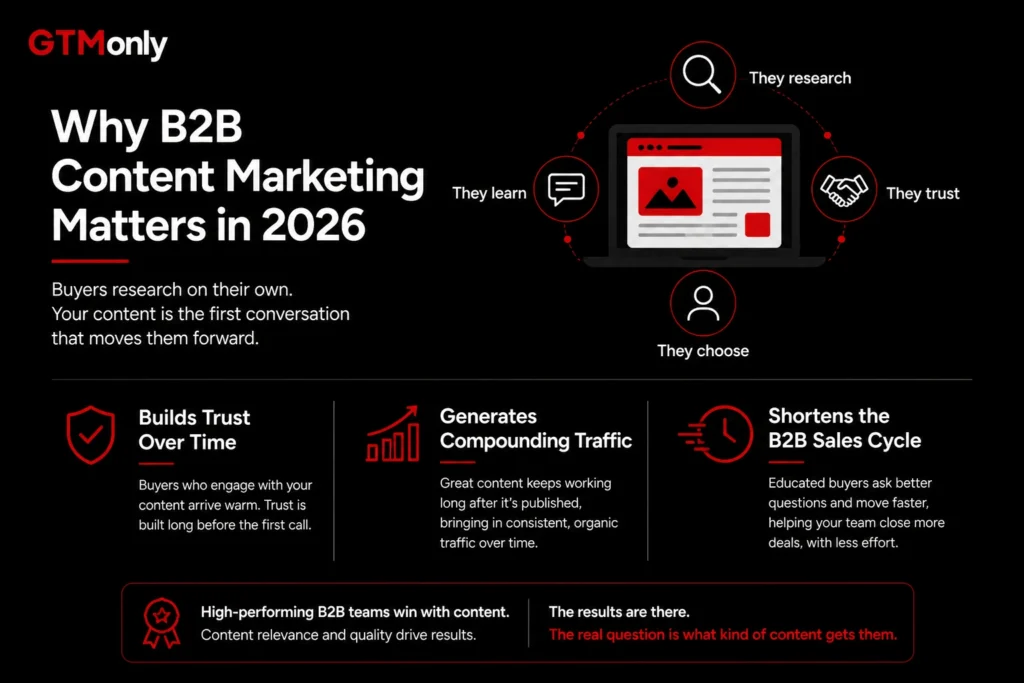
Buyers are doing more research on their own before talking to anyone. According to DemandSage, 89% of B2B buyers research products online before buying. Your content is often the first sales conversation that happens, even when no salesperson is in the room.
Gartner research finds that B2B buyers spend only 17% of their total purchase journey talking to sales reps. The rest is research. Content marketing wins the 83% that sales never sees.
There are three specific things B2B content does that other channels can’t match.
- It builds trust over time. A buyer who has read six of your articles arrives at a sales call already warm. Cold outreach has a response rate problem. Content does not.
- It generates compounding traffic. Paid ads stop working when the budget runs out. A strong SEO article from two years ago still brings in 500 visits a month. That’s the compounding effect of content done right.
- It shortens the B2B sales cycle. Buyers who arrive educated ask better questions and move faster. Your sales team closes more and spends less time re-explaining the basics.
CMI’s 2026 research confirms this: 65% of high-performing B2B marketing teams cite content relevance and quality as the top driver of their results. Not budget. Not headcount. Content quality.
The results are there. The real question is what kind of content gets them.
Types of B2B Content Marketing
There’s no single format that wins. The best B2B content programs use multiple formats because different buyers prefer different ways of consuming information.
Here’s a breakdown of the formats that work and where they fit in the buyer journey.
| Content Type | Buyer Stage | Primary Goal | Best Channel |
| Blog posts and guides | Top of funnel | Awareness, SEO traffic | Organic search |
| Case studies | Middle to bottom of funnel | Build credibility, reduce risk | Email, sales collateral |
| Whitepapers and reports | Middle of funnel | Capture leads, educate | Gated landing pages |
| Webinars and videos | Middle of funnel | Educate, build relationships | LinkedIn, email, YouTube |
| Email newsletters | Full funnel | Nurture and retain | Email list |
| Comparison pages | Bottom of funnel | Convert, close | SEO, paid search |
| Thought leadership | Top to middle funnel | Build authority and trust | LinkedIn, PR |
For a new GTM team or a new content program, start from scratch with one format and do it well. Blog posts and SEO guides are the highest-leverage starting point. They build topical authority, drive compounding traffic, and support every other format downstream.
The devil is in the details when you try to do everything at once. Pick your lane first.
With the formats clear, the next step is building the strategy that ties them together.
How to Build a B2B Content Marketing Strategy
A B2B content marketing strategy is not a content calendar. It’s a documented system that connects every piece of content to a specific audience, stage, goal, and outcome.
Only 40% of B2B marketers have a documented content strategy, according to Sprout Social. The teams without one tend to publish whatever feels right that week. That’s not a strategy. That’s just typing.
Here’s how to build one that holds up.
Step 1: Define Your Audience and ICP
Every piece of content must be written for someone specific. Before you write a single word, get clear on who that person is.
Your ideal customer profile tells you which companies to target. But your content audience is a person, not a company. Are you writing for a VP of Sales who reviews budgets every quarter? A RevOps manager who spends hours in Salesforce? A CMO building a new pipeline motion from scratch?
The more specific you get, the more useful your content becomes. Useful content gets shared, saved, and linked to. Generic content gets ignored. Read more on building a precise ICP in our guide to the ideal customer profile.
Step 2: Map Content to the Buyer Journey
The B2B buying journey has three stages. Your content needs to cover all three.
- Top of funnel (TOFU): Buyers are learning. They don’t know your product yet. Your job is to be the most useful resource on the problem they’re trying to solve. Blog posts, guides, and how-to content live here.
- Middle of funnel (MOFU): Buyers are evaluating options. They know the problem. They’re comparing solutions. Case studies, webinars, and comparison guides earn their attention here.
- Bottom of funnel (BOFU): Buyers are close to a decision. They need social proof and risk reduction. Testimonials, ROI calculators, demos, and detailed product content push them over the line.
Most content programs are heavy on TOFU and light on MOFU and BOFU. That’s why they get traffic but not leads. Balance all three.
Step 3: Choose Your Formats and Channels
The format should follow the audience, not the other way around. If your buyers spend time on LinkedIn, a long-form video series will outperform a podcast. If they’re Googling tactical questions, SEO guides win.
For most B2B teams starting out, the highest ROI stack is: SEO blog content, email newsletter, and LinkedIn distribution. Get those three working before adding anything else.
Step 4: Build a Distribution Plan
Content without distribution is a tree falling in an empty forest. Publishing is not the end of the job. It’s the beginning.
Every piece of content needs a distribution plan before it’s written. Where will it go? Who will share it? What will you do in the first 48 hours after publishing?
Demand generation starts with content. But demand generation without distribution is just writing for yourself.
Step 5: Measure What Matters
The metrics that matter depend on the funnel stage. Traffic and impressions matter at the top. MQLs and email signups matter in the middle. Pipeline influenced and revenue attributed matter at the bottom.
Avoid vanity metrics. Page views without conversion data tells you very little. The question is always: did this content move a buyer closer to a decision?
| Funnel Stage | Metrics to Track |
| TOFU | Organic traffic, keyword rankings, social shares, brand impressions |
| MOFU | Email signups, content downloads, webinar registrations, return visitors |
| BOFU | MQLs from content, pipeline influenced, sales cycle length, win rate |
A strong strategy separates the programs that build pipeline from the ones that just fill a blog. Before you publish your next piece, check you’re not making one of these.
Common B2B Content Marketing Mistakes
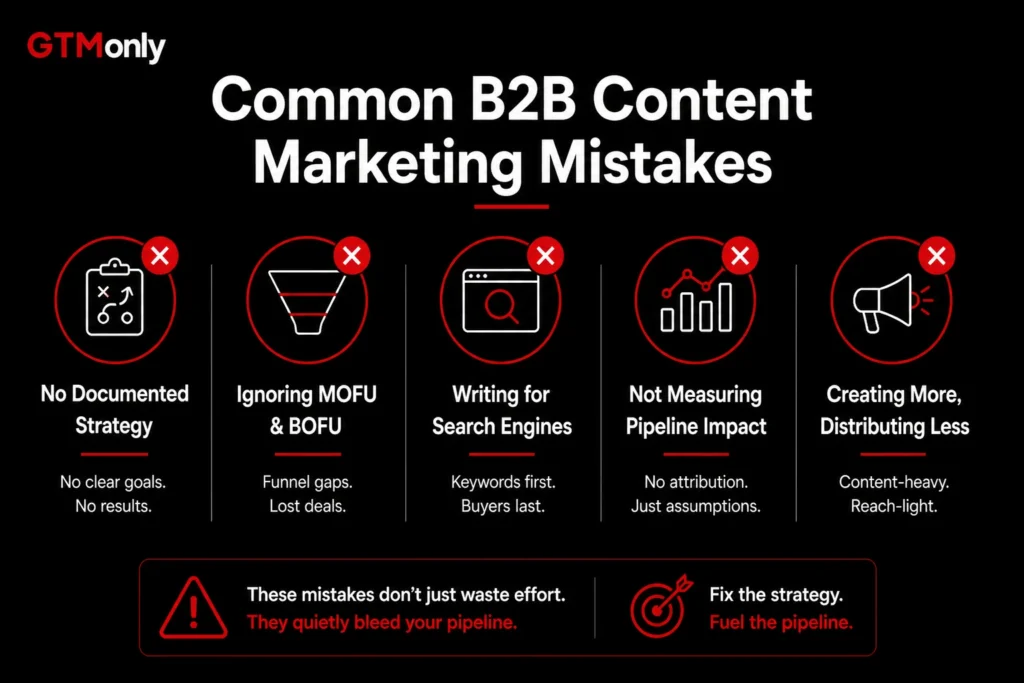
The same mistakes show up in almost every audit of an underperforming B2B content program. Most of them are strategic, not executional.
- Publishing without a documented strategy: Creating content without clear goals and audience mapping leads to content that ranks for nothing and converts nobody. Start from scratch with a strategy before worrying about output volume.
- Ignoring the middle and bottom of the funnel: Most content programs focus almost entirely on top-of-funnel awareness content. The MOFU and BOFU content that actually closes deals gets neglected. Your sales team is the best source of what’s missing here.
- Writing for search engines, not buyers: Keyword-first content that never takes a position is forgettable. The best B2B content in 2026 has a clear point of view.
- Not measuring content’s contribution to pipeline: If your content team can’t connect their work to revenue, they’re operating on assumptions. Set up attribution early, even if it’s imperfect.
- Producing content faster than distributing it: Most teams are content-heavy and distribution-light. Slow down production and invest more time in getting existing content in front of the right people.
These are not small oversights. Each one quietly bleeds the ROI from an otherwise solid content program. The good news: they’re all fixable with a clear strategy and honest measurement.
The Bottom Line
B2B content marketing is not a traffic strategy. It’s a trust strategy.
The companies that win in 2026 are the ones building content that buyers actually want to read, share, and reference when it’s time to make a decision. They’re not chasing page views. They’re building pipeline.
If you’re just getting started, pick one audience, one funnel stage, and one format. Get that working before expanding. A well-executed B2B content strategy on a small budget beats a scattered one with a big team every time.
The go-to-market strategy that sustains itself is built on content. Start there.
Frequently Asked Questions
What is B2B content marketing in simple terms?
B2B content marketing is creating and sharing valuable content to help other businesses learn, evaluate options, and make purchase decisions. Instead of pushing a product with ads, you build trust by educating your buyers over time through blog posts, guides, case studies, and other formats.
How is B2B content marketing different from B2C?
B2B content marketing targets business decision-makers with longer buying cycles, multiple stakeholders, and higher stakes decisions. It requires deeper content, more data, and formats like whitepapers and case studies. B2C content tends to be shorter, more visual, and focused on quicker emotional decisions.
What types of content work best for B2B?
The most effective B2B content types depend on the funnel stage. Blog posts and SEO guides work at the top of the funnel. Case studies, webinars, and comparison guides work in the middle. Testimonials, ROI calculators, and detailed product content perform best at the bottom of the funnel.
How do you measure B2B content marketing success?
Measure by funnel stage. Top of funnel: organic traffic and keyword rankings. Middle of funnel: email signups, content downloads, and webinar registrations. Bottom of funnel: MQLs attributed to content, pipeline influenced, and revenue generated. Avoid vanity metrics like page views without conversion context.
How much should a B2B company invest in content marketing?
CMO Survey data shows marketing leaders expect average budget growth of 8.9% in 2026, with nearly 12% going into digital channels. Content marketing spend varies widely, but B2B organizations typically allocate 25% to 30% of their marketing budget to content creation and distribution.
What is a B2B content marketing strategy?
A B2B content marketing strategy is a documented plan that defines your audience, goals, content formats, distribution channels, and measurement framework. It maps every piece of content to a specific buyer stage and business outcome. Without documentation, a content program is just guesswork with a deadline.