
ABM vs ABX: What’s the Difference (and Which One Do You Need)?
ABM vs ABX comes down to one distinction: ABM targets accounts. ABX runs the whole relationship those accounts have with you, before the deal, during it, and for as long as they stay a customer.
That’s the real difference, and it’s smaller than the marketing around ABX makes it sound. Account-based marketing picks a defined list of high-value companies and points personalized marketing and sales at them until a deal closes. Account-based experience takes that same list and keeps the coordination going after the deal, so onboarding, support, and renewal feel like part of the same relationship instead of a fresh start with a stranger.
Where this gets interesting is what happens in practice. A lot of what gets labeled ABX today is ABM with new branding, and understanding why matters more than memorizing the definitions.
What Is ABM?
Account-based marketing is a go-to-market strategy that treats a defined set of high-value accounts as a market of one, rather than chasing volume across a wide funnel. Marketing and sales pick the accounts together, map the buying committee inside each one, and run personalized campaigns and outreach aimed at winning the deal.
ABM is, by design, mostly owned by marketing and sales. It has a clear finish line: the closed deal. What happens to the account after that is technically outside ABM’s job description, even though it’s the part that determines whether the account sticks around.
What Is ABX?
Account-based experience takes the same account-first thinking and stretches it across the entire lifecycle: pre-sale, the sale itself, and everything after, onboarding, support, renewal, expansion. It adds a third team to the mix. Marketing and sales still run point on winning the account, but customer success now owns the relationship once the deal closes, working off the same account plan instead of starting fresh.
The formula the field uses is a fair summary: ABM plus customer experience equals ABX. You keep the targeting. You add the discipline of treating everything that happens after the sale as part of the same coordinated effort.
ABM vs ABX: The Key Differences
Both are account-first strategies. Both reject the wide-net approach in favor of a defined list of companies worth real investment. The differences show up in scope, ownership, and what happens once the deal closes.
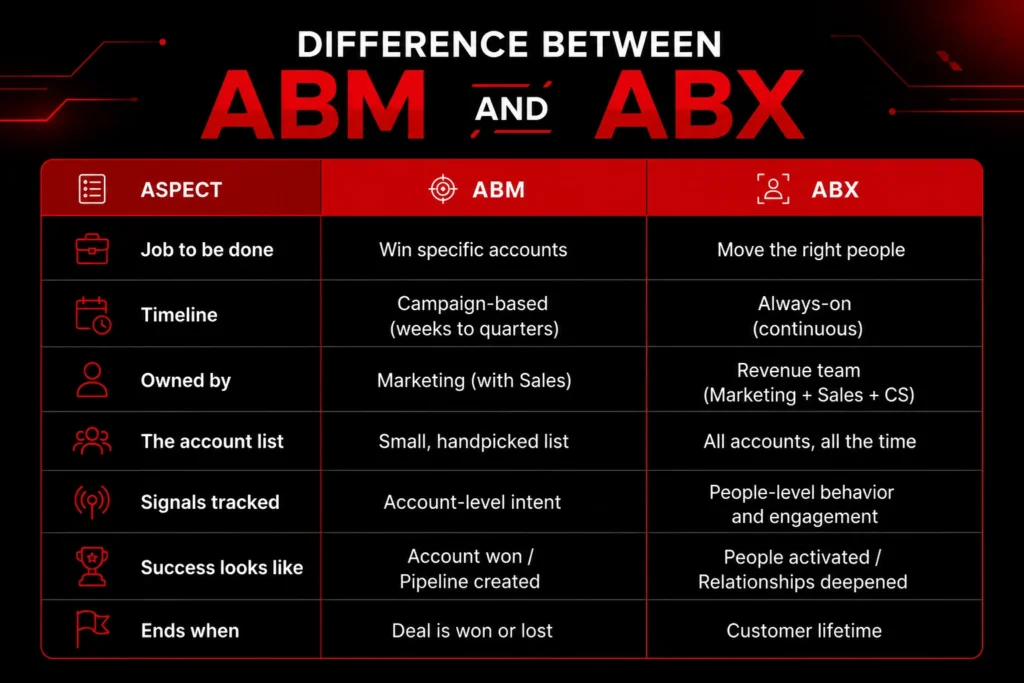
The infographic above gives you a quick overview, but the table below breaks down each difference between ABM and ABX in more detail so you can see where each approach fits.
| ABM | ABX | |
|---|---|---|
| Job to be done | Win the account | Win, keep, and grow the account |
| Timeline | Pre-sale through close | Pre-sale, sale, and post-sale |
| Owned by | Marketing and sales | Marketing, sales, and customer success |
| The account list is | A marketing target list | A shared commercial asset |
| Signals tracked | Ad engagement, content downloads | Also stakeholder changes, contract dates, product usage, support tickets |
| Success looks like | Pipeline, win rate, deal size | Plus retention, expansion, time-to-value |
| Ends when | The deal closes | It doesn’t. Renewal and expansion keep it running |
The Account List Stops Being Marketing’s Property
This is the difference that matters most and gets talked about least. In ABM, the target account list usually lives in a marketing tool, and marketing decides who’s on it, mostly with sales input. In ABX, that list becomes a shared commercial asset that customer success also has a stake in, because the accounts on it are the ones worth protecting once they’ve bought.
That shift sounds small on paper. In practice, it changes who gets notified when something happens to the account, and who’s accountable when the relationship goes sideways.
The Signals You Track Get Wider
ABM mostly runs on marketing signals: who clicked the ad, who downloaded the whitepaper, who visited the pricing page. ABX pulls in signals no marketing tool naturally sees. A stakeholder leaving the company. A contract renewal date approaching. A sudden drop in product usage. A support ticket that reveals frustration nobody upstream knew about.
Miss those signals and you can be running a technically flawless ABM program while an account quietly churns three months after close, for reasons nobody in marketing or sales ever saw coming.
Success Gets Measured Further Down the Road
ABM’s scoreboard is pipeline, win rate, and deal size. Reasonable, since ABM’s job ends at the signature. ABX keeps those numbers and adds the ones that show up later: time-to-value, retention, expansion revenue, account health. Pipeline and win rate don’t disappear in an ABX model. They just stop being the whole story.
Where ABM and ABX Actually Overlap
The differences get the attention, but the overlap is bigger than most comparisons admit.
- Both start from the same move: pick a defined list of accounts instead of running broad demand generation at everyone who might buy.
- Both depend on a sharp ideal customer profile, because neither one works if you’re targeting the wrong companies with a lot of effort.
- Both require marketing and sales to function as one team, not two departments trading handoffs.
- Both live or die on the quality of the sales intelligence behind them: firmographic data, buying signals, org charts, not guesswork.
If your ABM program already treats sales as a true partner instead of a downstream recipient of leads, you’re most of the way to ABX. The remaining gap is customer success, and it’s a bigger gap than it looks.
Why Most “ABX” Programs Are Just ABM With a New Name
This is the part worth sitting with before you decide to rebrand your ABM program as ABX.
A genuine ABX program requires customer success to be a full partner with real authority over account decisions, not a department that inherits a CRM record after the ink dries. In a lot of companies that have adopted the ABX label, that partnership never actually happens. Marketing builds better dashboards. Sales gets better account intelligence. The ads get sharper. None of that touches what customer success knows, promises, or does. The name on the strategy changed. The operating model underneath it didn’t move an inch.
The tell is usually the same story, told a hundred different ways across a hundred different companies. Sales closes a deal on the strength of a feature the product team hasn’t shipped yet. Customer success inherits the account with no context on what was promised, no visibility into the sales conversation, no warning about what the customer is expecting on day one. The customer, understandably, assumes the company they’re now dealing with is the same one that sold to them. It isn’t, not really, because nobody handed off the story.
That’s not a failure of ABX as an idea. It’s a sign that a company adopted the vocabulary without doing the harder work the vocabulary describes. The label is free. The cross-functional authority is not.
There’s also a language problem baked into the original term that makes this worse. The “M” in ABM quietly tells everyone outside marketing that the whole thing is marketing’s job. Sales treats it as marketing’s initiative to support. Customer success, if it’s even in the room, treats it as something that happens before the account becomes theirs. Swapping the acronym to ABX doesn’t fix that unless the org chart and the incentives actually change with it. A lot of companies change the letter and call it done.
The One Test That Tells You If You’re Actually Running ABX
Skip the maturity models and self-assessments for a second. There’s a simpler test, and it takes about thirty seconds to run honestly.
Pick one active account. Ask: if that account’s contact read a marketing email, talked to their sales rep, and opened a support ticket, all in the same week, would every one of those interactions feel like they came from the same company?
Would the email contradict something the rep said on the call. Would the support agent be surprised by a promise the rep made last month. Would the rep know the account had a support ticket open at all. If the honest answer to any of those is “probably,” the account is being marketed to and sold to well, and handed off to a stranger the moment the deal closes. That’s ABM, however the deck describes it.
Pass that test consistently, across accounts, without heroics from any one team member, and the label doesn’t matter much anymore. You’re running ABX.
ABM vs ABX: Which Should You Run First?
Don’t treat this as a choice between two competing strategies. Treat it as a sequence.
Start with ABM if:
- You’re building account-based motion for the first time.
- Marketing and sales aren’t fully aligned yet on target accounts, messaging, or ownership.
- Your immediate priority is pipeline from a defined account list.
A shaky ABM strategy is not a foundation you build a three-team model on top of. Fix the two-team problem before you add a third team to it.
Move toward ABX once:
- Your ABM program runs well and marketing and sales genuinely operate as one team, not two departments handing off leads.
- Customer success is ready to take on real ownership of the account relationship, with authority to act on it, not just visibility into it.
- You need growth from expansion and retention, not only new logos.
Rushing to ABX before ABM works just spreads the same coordination problem across three teams instead of two, and adds a rebrand on top. Build the base. Prove sales and marketing can run one account plan together. Then bring customer success in as a real partner, not a label.
The Bottom Line
ABM and ABX aren’t rivals. ABM wins the account. ABX is what happens when a company decides winning isn’t the finish line, and builds the operating model to prove it, with customer success as a genuine partner instead of an afterthought.
Most of the confusion around ABM vs ABX comes from companies skipping the hard part. Swapping the acronym is free. Giving customer success real authority over the account relationship is not, and that’s the actual dividing line between the two, not the letters in the name.
Get ABM working first. Marketing and sales, one account plan, no handoffs that drop context. Then bring customer success in as a full partner, and run the same-company test on your own accounts before you decide you’ve made the jump.
Frequently Asked Questions
What is the difference between ABM and ABX?
ABM is a targeting strategy: marketing and sales pick high-value accounts and run personalized campaigns to win the deal. ABX extends that across the full lifecycle by adding customer success as a full partner, so the coordinated experience continues through onboarding, support, and renewal instead of stopping at the signature.
Is ABX just ABM with a new name?
In a lot of companies, yes, and that’s the honest answer most comparisons skip. Genuine ABX means customer success can actually make decisions about an account, not just get looped in after the sale to see what happened. Many programs that adopted the ABX label kept the same marketing-and-sales operating model and never built that cross-functional partnership, which makes them ABM wearing a new acronym.
Does ABX replace ABM?
No. ABX builds on ABM rather than replacing it. The targeting and personalization stay the same. What changes is the addition of customer success as a real partner and the extension of the coordinated experience past the closed deal.
How do I know if my company is really doing ABX?
Run the same-company test. Pick an active account and check whether an email, a sales call, and a support interaction in the same week would all feel consistent, with no contradictions and no one caught off guard by a promise another team made. If that fails, the program is ABM regardless of what it’s called.
Which should a company build first, ABM or ABX?
ABM. Get marketing and sales operating as one team around a defined account list before adding customer success into the mix. Trying to run ABX before ABM works just spreads a two-team alignment problem across three teams and adds a rebrand without fixing anything underneath it.
What metrics separate ABM from ABX?
ABM tracks pipeline, win rate, and deal size, all of which resolve at the close. ABX keeps those and adds metrics that only show up after the sale: time-to-value, retention rate, expansion revenue, and account health. The shift reflects ABX’s job continuing well past the deal ABM was built to win.