
What Is a B2B Buying Group? Roles, Size, and How to Sell to One
TL;DR
- A B2B buying group is the set of people who influence, evaluate, and approve one business purchase, usually across several departments.
- Size: The average decision involves 13 internal stakeholders and nine external influencers, per Forrester. Purchases with genAI features double the core group, from seven people to 14.
- Core roles: Champion, economic buyer, technical evaluator, end users, procurement, legal and security, finance, and outside advisors. At a small company, one person can hold several roles.
- The blind spot: Finance, legal, and procurement hold roughly half the influence but rarely enter your funnel. Lead scoring never sees them coming.
- The risk: 40% of deals stall because the group can’t agree on a decision. Deals with a single contact are the most exposed.
- The fix: Map every role per deal and track coverage, meaning roles engaged divided by roles required. Then give your champion a business case they can defend alone.
A B2B buying group is the set of people inside a company who research, judge, and approve a purchase together. If you sell B2B, that group is your real buyer. (The person who booked the demo is just your way in.)
Yet open almost any CRM and you’ll find opportunities with one contact attached. One champion, one email thread.
One person carrying your whole deal through meetings you’ll never see.
That’s a fragile way to sell. LinkedIn and Bain found that 40% of deals stall because the buying group can’t agree.
No competitor required.
The fix is to sell to the whole room, and that starts with knowing who’s in it.
What Is a B2B Buying Group?
A B2B buying group is the collection of people who influence, evaluate, and approve one business purchase. It covers the people who’ll use the product, pay for it, and judge its risk, plus the outside advisors they trust.
A pile of contacts at one company isn’t a buying group yet. A real group has these traits:
- It forms around a problem. Someone needs something fixed, a group gathers, and it breaks up once the contract is signed.
- It changes mid-deal. Security shows up when data access comes up. Finance appears when the number gets big. Sometimes a key person leaves halfway through.
- It reaches past the org chart. Consultants, analysts, and peers at other companies shape the shortlist without ever signing anything.
- It decides together. One excited person can’t push a deal through if two colleagues quietly say no.
One quick clarification, because the term has a second life. In retail, healthcare, and distribution, it can also mean a purchasing cooperative, where separate companies pool orders for bulk discounts. This article covers the sales meaning.
Buying Group vs Buying Committee vs Decision-Making Unit
You’ll hear all three terms used for the same crowd. The difference comes down to who gets counted.
| Term | Who it usually includes | Counts outside advisors? | Where you’ll hear it |
|---|---|---|---|
| Buying group | Everyone who shapes the decision, inside and outside the company | Yes | Analyst research, B2B marketing |
| Buying committee | Internal stakeholders with a formal say in the decision | Rarely | Enterprise sales, deal reviews |
| Decision-making unit (DMU) | People with the authority to approve or block the purchase | No | Marketing courses, older sales training |
| Buying center | Same idea as the DMU, from classic B2B buying research | No | Textbooks and academic papers |
My take? Say buying group when you’re planning marketing. Say buying committee when you’re working a live deal.
The group is who you need to influence. The committee is who has to say yes.
How Many People Are in a B2B Buying Group?
More than you’ve planned for. Forrester’s buyer research puts the average at 13 internal stakeholders and nine external participants per buying decision. The count climbs for expensive or complex purchases.
AI makes the crowd bigger. When a purchase includes genAI features, Forrester found the core group doubles: 14 members instead of seven.
So that’s 22 people with opinions about one purchase. Your demo invite has room for maybe five.
Group size usually grows with these factors:
- Deal size. More money means more sign-offs, because every budget owner wants to see the math.
- Risk. Touch customer data, security, or compliance, and IT, legal, and security reviewers join the call.
- Reach. A tool one team uses keeps the group small. A platform three departments share brings in three department heads.
- Novelty. A first purchase in a new category gets far more scrutiny than a renewal.
And don’t expect buyers to trim the list for you. In the same research, buyers said bigger groups are worth the slower process. They get broader perspectives, lower risk, and a better shot at budget.
What to do: Stop treating group size as a problem to shrink. Plan for it from the first call, and ask your contact who else will weigh in before you send a single deck.
8 Roles Inside a B2B Buying Committee
Job titles vary by company, but the same roles show up in nearly every deal. In a 50-person startup, one person might wear three of these hats.
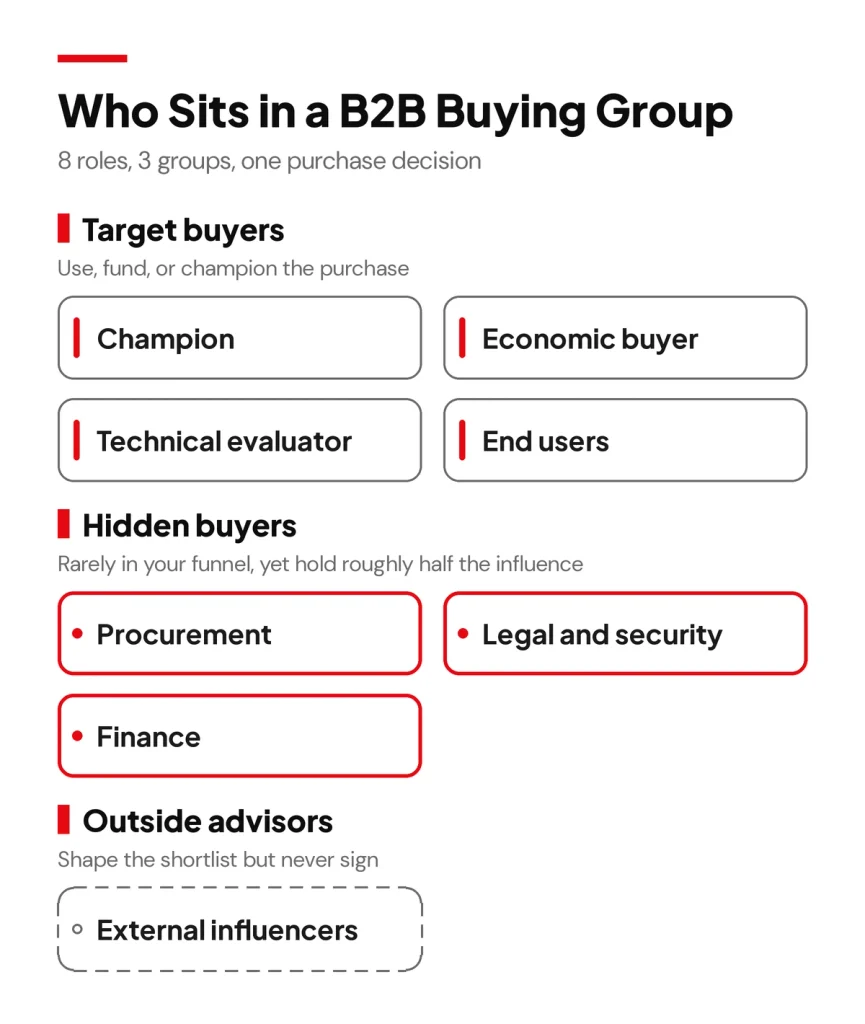
| Role | What they own | What they need from you | What makes them say no |
|---|---|---|---|
| Champion | Pushing the purchase internally | A business case they can repeat without you | Looking foolish in front of their boss |
| Economic buyer | Budget and final approval | Clear payback and a believable timeline | Fuzzy ROI or surprise costs |
| Technical evaluator | Fit with current systems | Docs, a sandbox, and straight answers on integration | Gaps found late in a trial |
| End users | Daily use of the product | Proof it saves them time | Extra work, another login, a steep learning curve |
| Procurement | Terms, pricing, and vendor risk | Clean pricing, standard contracts, fast vendor forms | Slow paperwork and pricing that keeps moving |
| Legal and security | Data, privacy, and contract risk | Security docs ready before anyone asks | Unclear data handling |
| Finance | Cash flow and budget fit | Payment terms that match how they budget | Spend nobody planned for |
| External influencers | Advice from outside the company | Peer references and third-party proof | A bad review from someone they trust |
Then watch for the blocker. That’s anyone with a reason to keep things as they are, like the person who owns the tool you’d replace.
(Nobody puts “blocker” in their LinkedIn headline, so you have to go looking.)
Bring blockers in early and give them a real job in the rollout. When they push back, ask what the change would cost them personally. That’s usually the real objection.
Hidden Buyers: Finance, Legal, and Procurement
Hidden buyers are the people who shape the decision but rarely appear in your funnel. They don’t download ebooks or book demos. LinkedIn and Bain research puts their share of the decision-making influence at roughly 50%.
They show up early, too. Forrester found that procurement acts as a decision-maker in 53% of buying cycles. It’s involved from the start, judging features and performance as well as price.
Brand carries more weight with this crowd than sellers expect. In the LinkedIn and Bain work, 81% of purchases went to vendors that almost everyone in the group already knew. If finance has never heard of you, your champion walks into that meeting on the back foot.
What to do: Build a short, boring, flawless pack for hidden buyers. Include security answers, standard terms, your pricing logic, and a one-page risk summary.
Signs a Buying Group Is Forming at an Account
These groups don’t announce themselves. They leave a trail of buying signals across several people at once:
- Several people from one company visit your site within a few weeks, especially your pricing, security, or integration pages.
- A new leader joins the function you sell to. New leaders tend to review the tools they inherit.
- The company posts jobs that describe the problem you solve.
- Your champion asks for material to “share internally,” like case studies, ROI math, or a security overview.
- A vendor form or security questionnaire lands in your inbox. Procurement is in the room now.
- New names start appearing on email threads and meeting invites.
One signal is noise. Three from the same account in the same month usually means a group is taking shape.
Intent data adds the outside view. It shows which accounts are researching your category on sites you don’t own.
Why Lead Scoring Misses Group Buying
The classic funnel scores people one at a time, so it can’t see a group forming.
Imagine three people from the same company engaging in one month.
The IT lead reads your security page. The ops manager sits through a webinar. Someone in finance checks pricing twice.
Your lead scoring model sees three lukewarm leads. Each one sits below the MQL threshold, so nobody calls.
Your CRM thinks it has three cold leads. You have one warm deal and a committee that’s already comparing notes.
Then sales finally calls whoever filled out the form. That person may have no budget and no vote.
The fix is simple, if unglamorous. Roll activity up by account and by purchase, then judge the group. Three engaged colleagues at one company tell you more than one eager researcher with a sky-high score.
One Account, Many Buying Groups: Where ABM Stops
An account is a company. A buying group is the set of people inside it working on one purchase. Big companies run dozens of purchases at once, so one account can hold several groups.
Take a 5,000-person company. Security is shopping for threat detection while marketing evaluates analytics software. Same logo, two groups, almost no shared people.
That’s where classic account-based marketing stops short. ABM tells you which companies to chase. It can’t tell you which people at those companies are buying your kind of product this quarter.
The buying group is the next layer down. ABM picks the accounts. The group view picks the people and the moment.
Your ABM metrics shift with it, too.
A marketing qualified account says a company is warm. A qualified buying group says the right roles at that company are warm. That’s a far better reason to send in sales.
How to Identify Buying Group Members
Start with deals you’ve already won. Your closed-won history is the most honest map of who buys from you.
- Pull your last 15 closed-won deals. List everyone who joined a call, filled out a form, or got copied on the contract. The roles that repeat become your template.
- Build one template per product line. A small add-on might need three roles, while a platform deal might need eight. Forcing one map onto every deal wastes everyone’s time.
- Match the contacts you already have. Tag each known person at the account by role. Then mark the empty seats.
- Fill the gaps with signals and research. Use the signs above, plus company pages and job titles, to find likely names for each empty seat.
- Check the map with your champion. On your next discovery call, ask who else will weigh in and who approved the last big purchase. Then ask who could slow things down.
Refresh the map every month while the deal is live. People change jobs constantly, and B2B contact data decays at about 22.5% a year.
Last quarter’s org chart is already lying to you.
How to Sell to a B2B Buying Group
Selling to a group takes a different approach from selling to one person. These five plays cover the essentials.
1. Multithread Before the First Demo
Get a second and third contact involved before you present anything. A single-threaded deal dies the day your contact changes jobs, and you’re usually the last to find out.
2. Match Proof to Each Role
The economic buyer wants payback math. The IT lead wants integration docs. End users want to see their week get easier.
One generic deck tries to please all of them. It convinces nobody.
3. Write Your Champion’s Business Case
Your champion will defend this purchase in rooms you’ll never enter. Give them a one-pager covering the problem, the cost of waiting, the rollout plan, and proof from companies like theirs.
Peer proof carries serious weight. The same LinkedIn and Bain research found buyers are three times more likely to pick a vendor peers heavily recommend. That beats a vendor promising a better product or a lower price.
4. Send the Paperwork Before Anyone Asks
Security answers, standard terms, and vendor forms filled out early keep things moving. Late paperwork can stall a deal that sales already counted as won.
5. Scope Trials With Success Criteria
Trials are standard now. Forrester found that more than 60% of business buyers use a trial. For purchases of $10 million or more, 78% of buyers run one first.
A trial doesn’t guarantee the sale, though. Forrester also notes that just over a third of buyers planned to convert to a fully paid version with the same provider.
So agree on what success looks like, and who judges it, before the trial starts.
When the group disagrees, don’t pick a side. Name the disagreement out loud, then propose one shared metric everyone can track.
How to Measure Buying Committee Coverage
Coverage is the share of required roles in a deal where you have a named, engaged contact. The formula is roles engaged divided by roles required.
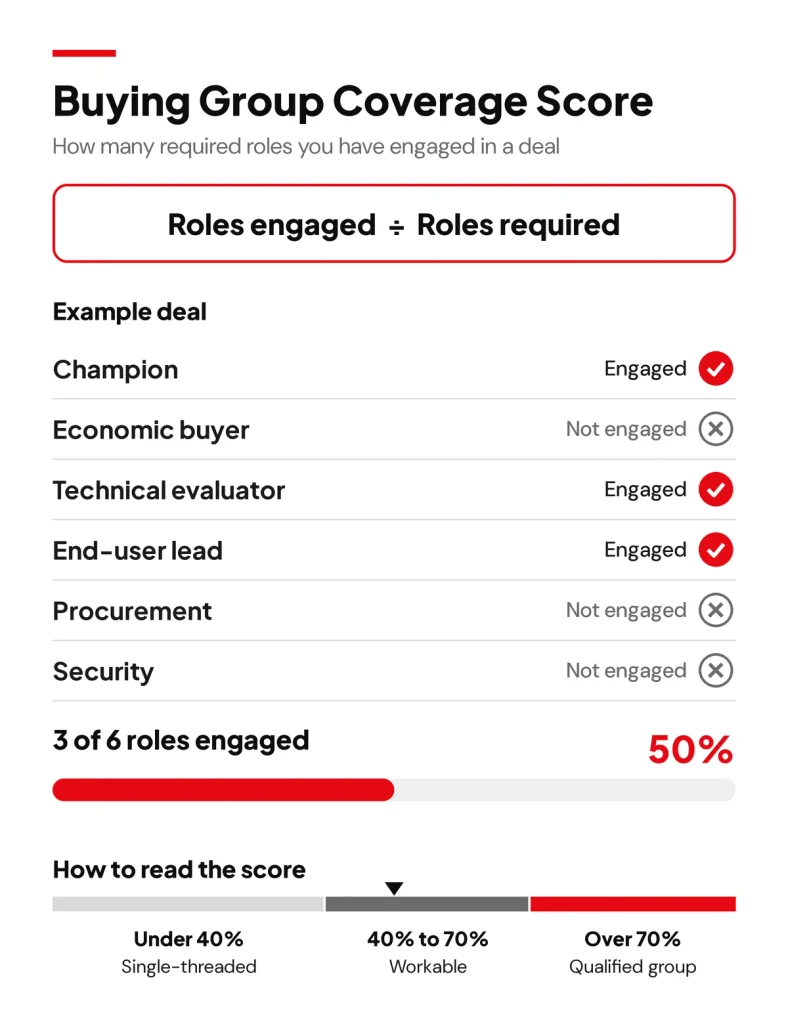
This sample worksheet tracks one live deal:
| Role | Named contact? | Engaged in last 30 days? | Stance |
|---|---|---|---|
| Champion | Yes | Yes | For |
| Economic buyer | Yes | No | Unknown |
| Technical evaluator | Yes | Yes | For |
| End-user lead | Yes | Yes | Neutral |
| Procurement | No | No | Unknown |
| Security | No | No | Unknown |
Three of six roles engaged puts this deal at 50%. The economic buyer has gone quiet, and two hidden buyers haven’t been found yet.
These are my working thresholds, not an industry benchmark:
- Under 40%: The deal is single-threaded. Treat the forecast as a guess.
- 40% to 70%: It’s workable. Name every gap and the person closing it this week.
- Over 70%, with the economic buyer engaged: I’d call this a qualified buying group, ready for a real forecast.
Think of it as lead qualification for the whole room. Log stance as well as engagement, because a role that’s engaged and against you is a risk.
FAQs About B2B Buying Groups
How many people are in a B2B buying group?
Forrester’s buyer research puts the average at 13 internal stakeholders and nine external participants per buying decision. The number rises for expensive or complex purchases. When a purchase includes genAI features, the core buying group doubles, from seven members to 14.
Who is the most important member of a buying group?
The economic buyer controls the budget and final approval, so no deal closes without them. The champion decides whether the deal moves at all. Hidden buyers in finance, legal, and procurement can still block a purchase late, which makes every role worth covering.
What is buying group marketing?
Buying group marketing targets everyone in a purchase instead of single leads, adding a people layer on top of account-based marketing. You roll activity up by account and purchase, then score the group as one unit. Each role gets content that answers its own questions.
Is a buying group the same as a buying committee?
The terms overlap heavily, and people often use them interchangeably. Strictly speaking, a buying group can include outside advisors such as consultants, analysts, and peers. A buying committee usually means the internal stakeholders who hold a formal say in the decision.
Why do buying groups slow deals down?
More people means more opinions, more reviews, and more chances for someone to delay. LinkedIn and Bain research found 40% of deals stall because the group can’t agree. Mapping every role early and agreeing on one shared goal keeps deals moving.
What is a qualified buying group?
A qualified buying group is a deal where enough required roles are engaged to justify a full sales push. Rather than waiting on one lead’s score, you check whether the champion, economic buyer, and key evaluators are all active. It replaces single-lead qualification for complex deals.
The Deal Was Never About One Person
A B2B buying group is bigger than your CRM shows. Roughly half of its influence sits with people who rarely enter your funnel.
Deals close when every role can defend the decision. People in these groups share one fear: making a call their boss will remember for the wrong reasons.
So stop chasing the one perfect contact. Make the decision easy to defend, one role at a time.
What to do this week: Pick one live deal. List every role it needs, mark the empty seats, and fill the two that matter most.