
ChatGPT SEO: How to Get Your Pages Into ChatGPT Answers
ChatGPT SEO used to mean one thing: make sure your content is indexable in Bing.
But that’s no longer enough.
Now, ChatGPT has its own index and pulls from multiple search engines. However, it ignores most results before it produces an answer.
As such, even if your content ranks in the Google top 10, it may not show up in ChatGPT. (Ask me how I know.)
Below, I will look at how ChatGPT chooses which content to source from, and then 8 things I’d improve to increase the chance of being cited.
What Is ChatGPT SEO?
ChatGPT SEO involves making sure the content on your website (and therefore your brand) is easily found, trusted and cited by ChatGPT. This includes making sure the content is crawlable, well structured, up to date, and positively referenced across the web.
Note that ChatGPT SEO is sometimes used to mean using ChatGPT as an SEO tool. I’ll cover this towards the end, as it often gets confused with the topic of this article.
In this article, I’m talking about the former. If the aim is to get your brand named in responses to prompts (such as “best X for Y”), I’ve covered that in my playbook on how to get recommended by ChatGPT.
How ChatGPT Search Finds and Picks Sources
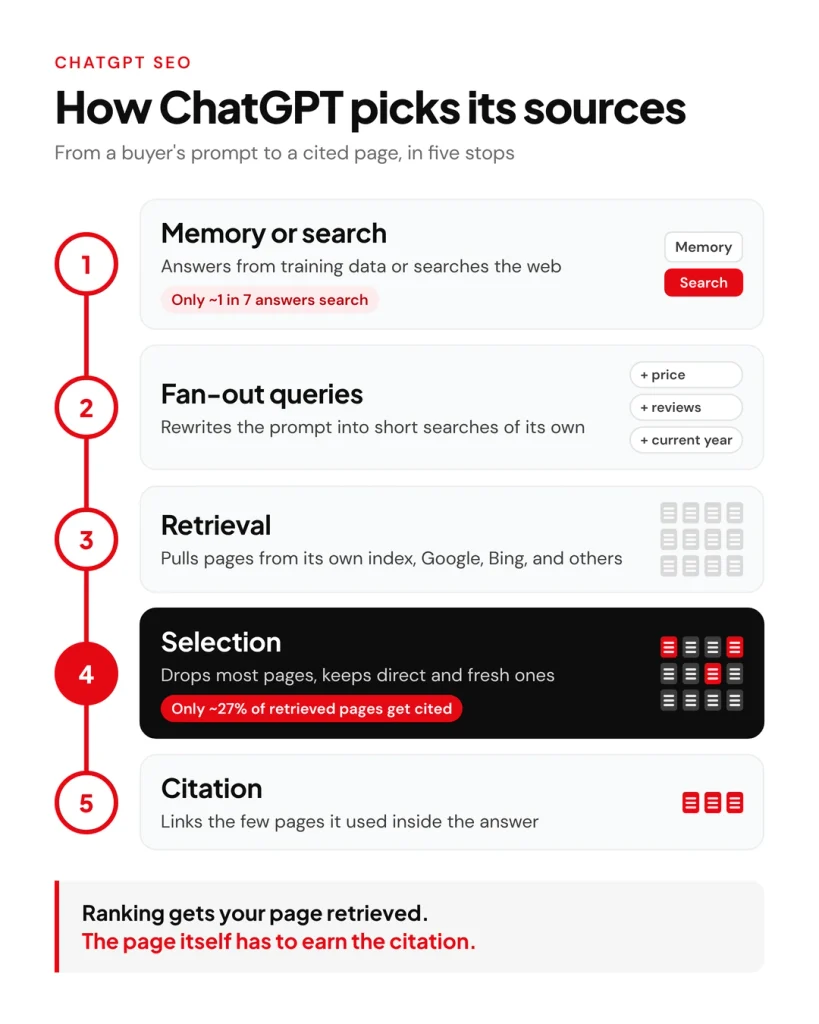
Sometimes ChatGPT answers from knowledge it was trained on. Other times, it searches the web and cites a few sources.
I assumed the second happened most of the time. It doesn’t.
Only 14.4% of the 66.6 million free, logged-out answers in Ahrefs’ fan-out study included a fan-out query. That’s about one in 7.
Therefore, there are two games to play. Your content must win when ChatGPT searches. But in addition, your brand must be present across the web sources ChatGPT was trained on.
| Stage | What happens | What you control |
|---|---|---|
| 1. Memory or search | ChatGPT decides whether it needs fresh information | How widely your brand is mentioned across the web |
| 2. Fan-out | It rewrites the prompt into short search queries | Pages that match those sub-queries |
| 3. Retrieval | It pulls pages from its own index and outside providers | Indexing, crawler access, and rankings |
| 4. Selection | It drops most retrieved pages and keeps a few | Direct answers, freshness, tables, and facts |
| 5. Citation | It links the pages it used in the answer | Clear, quotable claims on the page |
1. ChatGPT Has Its Own Index Now
It used to be advised to optimize for Bing in order to do well in ChatGPT. I gave that advice too. However, this is no longer the case.
Peec AI found that ChatGPT has its own search index (Labrador). Within this index, there are subsections for news, shopping, local searches, etc. In addition, ChatGPT can also pull results from Google, Bing, Yelp, TripAdvisor, and some others.
While Bing is still relevant in Deep Research, by just looking at Bing rankings you may be missing out.
2. Fan-Out Queries Decide What Gets Retrieved
ChatGPT rarely searches exactly what the user has put in the prompt. Instead, it breaks down the query into smaller fan-out searches. In a way, ChatGPT is doing real-time keyword research.
According to the data from Ahrefs, the most added words in this process are the current year, “official,” “price,” and “reviews.” “Price” alone increased by nearly half in one month.
Therefore, pages which give clear answers to “how much does X cost” have a higher chance of appearing in searches. Whereas pages with one broad keyword have a lower chance.
3. Retrieved Doesn’t Mean Cited
What is interesting to note is that ChatGPT reads many more pages than it cites. To be honest, this was the part that surprised me most.
Across 193,507 AI answers in TJ Digital’s study, ChatGPT cited only about 27% of the pages it retrieved. All the other pages were read but never cited.
So ranking will help your page get retrieved. But the page itself still needs to earn the citation.
ChatGPT SEO vs Traditional SEO
In general, most of your previous SEO knowledge will still apply. However, what wins at the end may differ.
| Traditional SEO | ChatGPT SEO | |
|---|---|---|
| The goal | A ranked blue link | A citation or mention inside an answer |
| The query | One keyword typed by a user | Several fan-out queries written by ChatGPT |
| Where results come from | One search engine | Its own index plus several providers |
| What wins the click | Title, snippet, and position | A direct answer, fresh facts, and clear structure |
| Page types | Blog posts often lead | Product, home, and category pages are cited heavily |
| Stability | Rankings move slowly | Citations change week to week |
| Measurement | Rank trackers and Search Console | Repeated prompt runs and citation tracking |
Google rankings do have some impact. However, it is less than you’d expect. In the TJ Digital data, only 7% of pages from Google’s top 10 for the same questions were cited by ChatGPT.
Having a high ranking increases the chance that your page will be retrieved. However, it does not guarantee you will be cited.
How to Do ChatGPT SEO: 8 Strategies
These are the changes I’d make, roughly in this order. The first three fix access and structure. The rest build the signals ChatGPT seems to reward.
1. Get Indexed Everywhere ChatGPT Looks
Although not exciting, these improvements have to come first. If ChatGPT can’t reach your pages, nothing else on this list matters.
- Allow access to OAI-SearchBot in robots.txt. This is the crawler ChatGPT search uses. GPTBot is a separate bot (this is used for training).
- Submit your sitemap to Google Search Console and Bing Webmaster Tools. Find and fix any pages which aren’t indexed.
- Enable IndexNow to quickly get new/updated content indexed in Bing.
- Make sure your CDN and firewall are set up correctly. I have seen AI crawlers blocked by bot protection (even when robots.txt allowed them).
- Don’t place key content in JavaScript. Many AI crawlers struggle to render JS.
I covered crawler setup in detail in my guide on getting recommended by ChatGPT, so I won’t do so here.
2. Build Pages Around Fan-Out Queries
Think beyond what the user is searching for in the prompt.
For example, if they are searching for “best payroll software for a 50-person startup,” the searches may include “pricing,” “reviews,” “comparison,” and “official feature pages.”
If you do not have a price page, a comparison page, or you have features hidden in a presentation, ChatGPT will be unable to find relevant content.
What to do: Write out 10 prompts from the perspective of the buyer. For each prompt, ask “What would I google to answer this?” Ensure that there is 1 clear piece of content on your site for each of these answers. This can be done using my keyword research process. However, rather than looking for keywords, look for sub-questions.
3. Answer the Question in the First Lines
ChatGPT skims, and it grabs whatever is easiest to lift.
In the TJ Digital blind ratings, 20% of cited pages opened with a brief, direct answer. Only 5% of non-cited pages had one.
Give a one or two sentence answer under each heading. Then include more detail, examples and caveats in the content.
I’ve seen pages with good content lose out simply because they had a long lead-in (talking about “the evolving landscape”) and then the answer in paragraph 6. (I have written this opener before. I never will again.)
4. Keep Pages Fresh, for Real
Pages updated or created within the last 12 months had 88% higher odds of being cited in the TJ Digital study.
This makes sense. As ChatGPT includes the current year in its fan-out searches, recent content on the page will be more relevant to ChatGPT.
However, just changing the date does not make the page updated, just dressed up.
What to do: Within the top 20 pages of your site, update statistics, pricing, screenshots and examples every quarter. Then update the “last updated” date on the page.
5. Use Tables, Prices, and Specs
Pages with a table in them had 88% higher odds of being cited by ChatGPT. Pages with pricing had 28% higher odds across the engines in the study.
This matches the fan-out data. The words “price” and “specifications” are becoming increasingly common. If buyers are asking questions about price, features or limitations, include this in clear text and simple tables.
This may be the easiest way to improve. Many B2B sites hide pricing behind a “contact sales” button. As a result, when ChatGPT searches for this information, it often finds the pricing of a competitor. Which is fair enough.
6. Optimize Commercial Pages, Not Just the Blog
This one caught me off guard. In the TJ Digital data, 28% of citations came from product pages. 12% came from homepages, 10% from category pages and about 25% from articles.
ChatGPT also checks brand sites directly. In the Ahrefs study, 6.8% of fan-out queries used the site: operator, and three of the four most common ones were for brand sites.
So write great content for your product pages, pricing pages, features pages and integrations pages. Who is it for, how much does it cost, what does it integrate with, and why is it different? Be clear.
7. Publish First-Hand Experience and Original Data
ChatGPT will have seen every generic “what is X” page on the internet. You don’t need to create another one.
In the TJ Digital study, pages with first-hand experience had 45% higher odds of being cited. In the Ahrefs data, hands-on testers and official sources gained citations, however explainer and encyclopedia sites had fewer citations.
What to do: Put information only you have on these important pages. Add in your own screenshots, test data, number of customers, or survey data. Even just one instance of real data is better than 5 reworded definitions.
8. Earn Mentions on the Sources ChatGPT Trusts
Your own pages are only half the job. The other half is what the rest of the web says about you.
Ask ChatGPT a few questions that a buyer may ask. Identify the sites that are cited and try to gain coverage on them.
Note: For factual questions, Ahrefs found 63.4% of citations were from official sites. However, questions comparing products resulted in a higher proportion of citations from third-party sources.
However, be careful not to rely on one source too heavily. In the Ahrefs data, Reddit’s ChatGPT citations fell 88% in 6 months. What may be highly cited today may barely be cited at all tomorrow.
What Doesn’t Move ChatGPT Visibility
Some tactics get a lot of hype and little proof.
- Longer content. In the TJ Digital data, there was no clear impact from longer content for ChatGPT. However, in Google AI features, it did make an impact.
- An llms.txt file. No strong evidence that including llms.txt makes a difference for ChatGPT. It’s easy to include, but don’t expect it to do the hard work.
- Keyword repetition. As ChatGPT reformats user prompts into its own search queries, repeating keywords (even 14 times) won’t help.
- Spamming Reddit. If you create fake posts, they will be removed. Also, there is just too much fluctuation in the proportion of citations from Reddit to rely on.
- Judging from one screenshot. Only 2 to 3% of cited pages were cited in 3 of 4 weekly checks in the TJ Digital study. So if you only check once, you get little information.
How to Measure ChatGPT SEO
Almost always, ChatGPT will give you slightly different results. Therefore, running a prompt once is useless.
Run 20 to 30 buyer prompts monthly. In each run, take note of whether your content has been cited, and which links and competitors were cited instead.
To start with, using a spreadsheet is fine. But when you have over 30 prompts, a proper tool will save you hours of work. I’ve compared the best ChatGPT visibility tracking tools side by side.
Check referral traffic from chatgpt.com in your analytics. Although you may not see every mention, it will show which pages are getting referred from ChatGPT.
How to Use ChatGPT for SEO (The Other Meaning)
A lot of people searching “ChatGPT SEO” just want to know how to use ChatGPT for SEO work. This is fair.
I use ChatGPT daily. It is useful, as long as you know when it gets things wrong.
| Good for | Not good for |
|---|---|
| Clustering a keyword list you export from a real tool | Search volume or keyword difficulty |
| Drafting outlines and content briefs | Publishing final drafts without editing |
| Writing title and meta description variations | Telling you what your competitors rank for |
| Drafting schema markup, regex, and redirect maps | Checking your live rankings or traffic |
| Turning customer calls into FAQ ideas | Original insight or first-hand experience |
The biggest pitfall is search volume. If you ask ChatGPT how many people searched for a certain keyword, it will confidently give you a number, even if it is made up.
My rule: Give ChatGPT the data, and let it sort, write and format. However, make sure to still edit the content! Readers (and AI!) can easily tell if content is generic.
What I’d Do First
If I were starting ChatGPT SEO on a site this week, I’d take 3 quick actions:
- Allow OAI-SearchBot, Google and Bing to crawl all key pages.
- Include straightforward answers and accurate pricing on top commercial pages.
- Create a simple monthly spreadsheet to track buyer prompts.
No shortcuts here. ChatGPT rewards pages that are concise, up to date and provide unique information.
Just like with good generative engine optimization, ChatGPT makes it clear when this is not being done.
Frequently Asked Questions
Does ChatGPT use Google or Bing?
Both. ChatGPT uses its own index, as well as Google, Bing and others. To get picked up by ChatGPT, it helps to be indexed in Google and Bing.
Is ChatGPT SEO different from regular SEO?
ChatGPT SEO is built on standard SEO. By ensuring pages are indexed, ranked and have authority, they will be picked up. But to be the final choice, pages should include the best content (straightforward answers, up to date, factual) and be mentioned on trusted websites.
How long does it take to show up in ChatGPT?
Technical fixes, such as ensuring OAI-SearchBot can access the site, can take effect within days. However, content changes and building authority will take longer (weeks or months). ChatGPT will need to crawl these updates and see the brand mentions.
Does ranking on Google help you show up in ChatGPT?
Yes, but not fully. A well performing page in Google is more likely to be picked up by ChatGPT. However, a large piece of research shows that only 7% of top 10 pages in Google were cited by ChatGPT. This means pages must earn the citation too.
Does llms.txt help ChatGPT SEO?
Unlikely. There appears to be little evidence that ChatGPT relies on llms.txt when picking sources. Invest instead in indexing pages, structure and up-to-date content.
Can ChatGPT do keyword research?
Not on its own. Although it is useful for generating ideas and clusters, there is no real data on search volumes, and it often makes up numbers. Instead, extract data using a keyword tool, and then allow ChatGPT to sort it.