
B2B SEO: 14 Strategies That Drive Pipeline in 2026
TL;DR
- B2B SEO is the practice of earning visibility in search engines and AI answers for the queries business buyers use while researching, comparing, and choosing vendors.
- The best B2B SEO strategy captures bottom-of-funnel demand first. In one agency’s data, top-of-funnel posts converted at about 0.2%, while comparison keywords converted at nearly 7%.
- AI summaries cut clicks hardest on long, question-style searches. Short commercial searches hold up better.
- Build topic clusters around your core expertise, write with subject matter experts, and fix technical basics like crawlability, speed, and schema.
- Brand compounds in AI search. Pages cited in AI Overviews earn far more clicks than pages that aren’t.
- Measure B2B SEO by pipeline and revenue, not traffic.
B2B SEO is the slowest channel you’ll ever love.
It takes months to show results. The keywords that make money look worthless in every tool. And AI Overviews now answer many of the questions your blog was built to rank for.
I’ve been doing B2B SEO for years, and the same pattern keeps showing up. Traffic goes up, demos stay flat, and leadership asks if SEO still works.
It does. It just works differently from consumer SEO.
This guide covers 14 B2B SEO strategies that hold up in 2026, backed by conversion data and AI search research.
Okay, let’s get into it.
What Is B2B SEO?
B2B SEO (business-to-business SEO) is the work of earning visibility in search engines and AI answers for the queries business buyers use. The goal is to reach the people who research, shortlist, and approve purchases, then turn that attention into pipeline.
To be honest, SEO for B2B is still just SEO. Crawlable site, useful content, authority from links and mentions. What changes is the strategy on top of it:
| B2C and ecommerce SEO | B2B SEO | |
|---|---|---|
| Who decides | One person | Several stakeholders across departments |
| Search volume | Often high | Often tiny for buying-intent keywords |
| Buying cycle | Minutes to days | Weeks to months |
| Conversion | Checkout | Demo request, trial, sales conversation |
| Cost of a bad choice | A return | A failed rollout and someone’s credibility |
| What wins | Price, reviews, convenience | Trust, proof, brand familiarity |
That “cost of a bad choice” row explains most of B2B SEO.
Buyers read more, compare more, and lean toward names they already know. Your content isn’t just competing for a click. It’s competing for a spot on a shortlist.
How I Think About B2B SEO: Capture, Convince, Compound
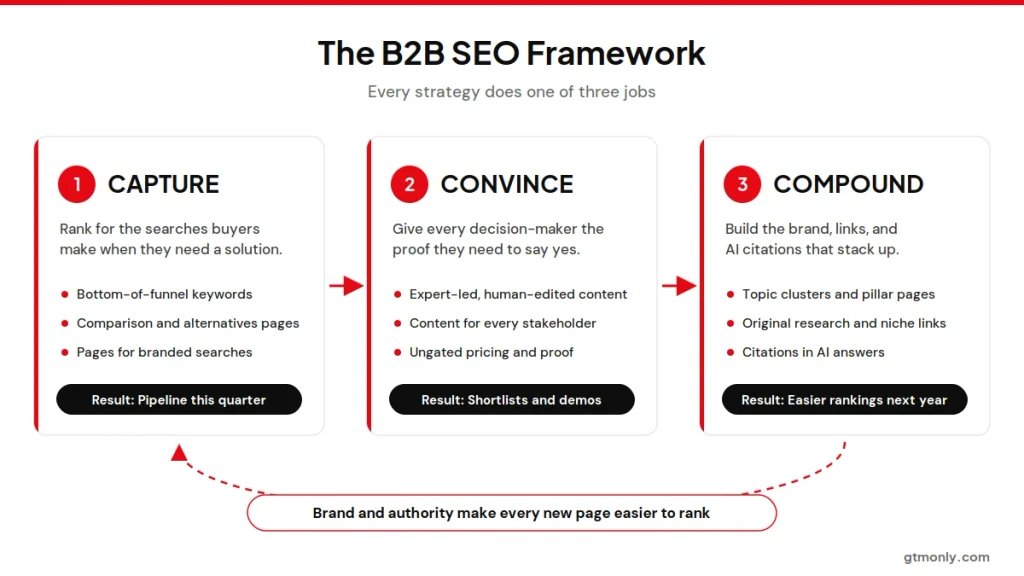
Every strategy in this guide does one of three jobs:
- Capture: rank for the searches people make when they need a solution like yours.
- Convince: give each decision-maker the proof they need to say yes.
- Compound: build the brand, links, and AI citations that make every future page easier to rank.
B2B marketers argue about one thing here.
One side says content can’t create buying intent, so spend everything on high-intent keywords. The other points to the 95/5 rule. Only a small slice of your market is buying at any moment, and the rest form a shortlist before they search.
My take: both are right, about different jobs. Capture produces pipeline this quarter. Compound puts you on the shortlist next year.
What doesn’t work is top-of-funnel content pretending to be a lead engine. Its real job is memory and citations, not demo requests.
Best B2B SEO Strategies for 2026
These are the 14 strategies I’d use, roughly in the order I’d tackle them.
1. Target Bottom-of-Funnel Keywords First
Start where buyers are closest to a decision. That means commercial and decision-stage keywords like “best [category] software for [industry],” “[competitor] alternatives,” and “[category] pricing.”
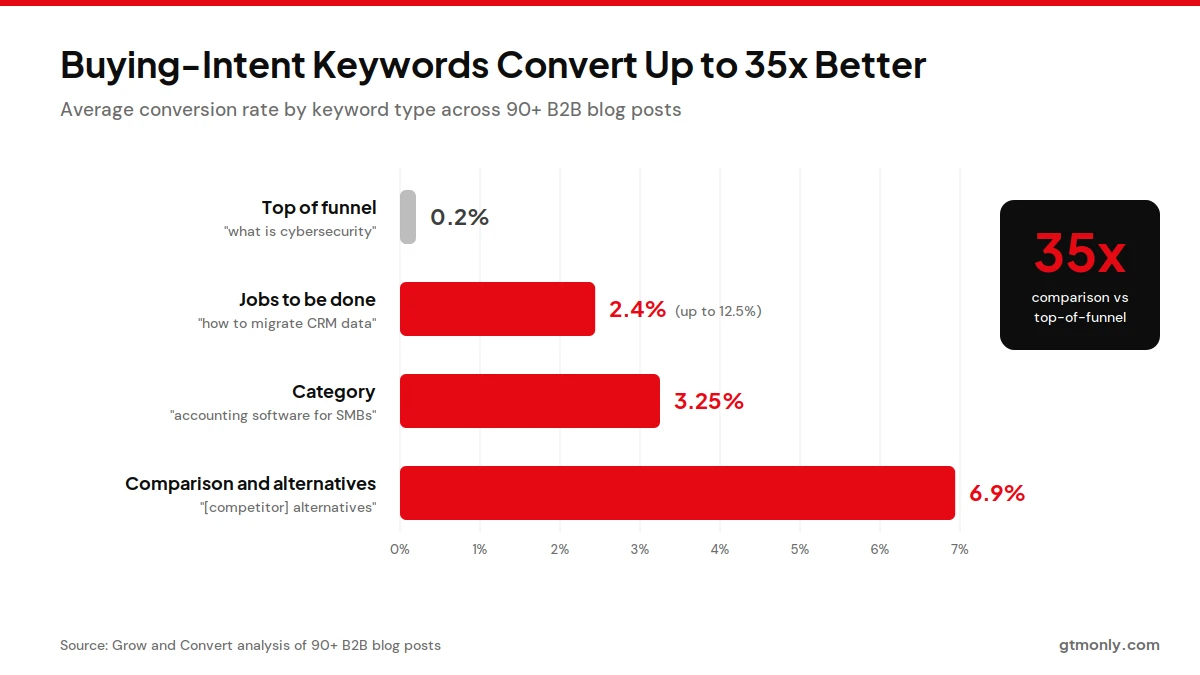
The conversion gap is huge. Grow and Convert, an agency that tracks conversions on the content it writes, analyzed over 90 B2B blog posts. These were the averages:
| Keyword type | Example | Conversion rate |
|---|---|---|
| Top of funnel | “what is cybersecurity” | About 0.2% |
| Category | “accounting software for small business” | About 3.25% |
| Comparison and alternatives | “Mailchimp alternatives” | About 6.9% |
| Jobs to be done | “how to migrate from Salesforce to HubSpot” | About 2.4% on average, up to 12.5% |
A page bringing six visits a month at 7% can beat a page bringing 500 visits at 0.2%. It’s usually easier to rank too, because fewer companies bother.
(Search volume for B2B keywords is an estimate built on thin data. A keyword showing “10” might get 60 real searches, or three. Treat it as a direction, not a fact.)
2. Pick Keywords AI Overviews Won’t Swallow
AI summaries don’t hit every query the same way, and that should shape your keyword list.
Pew Research Center analyzed the browsing data of 900 U.S. adults.
With an AI summary on the page, people clicked a traditional result on 8% of visits. Without one, they clicked on 15%.
The same study showed which searches trigger summaries. Only 8% of one- or two-word searches got one, compared with 53% of searches with 10 or more words. Searches starting with question words like “what” or “why” got a summary 60% of the time.
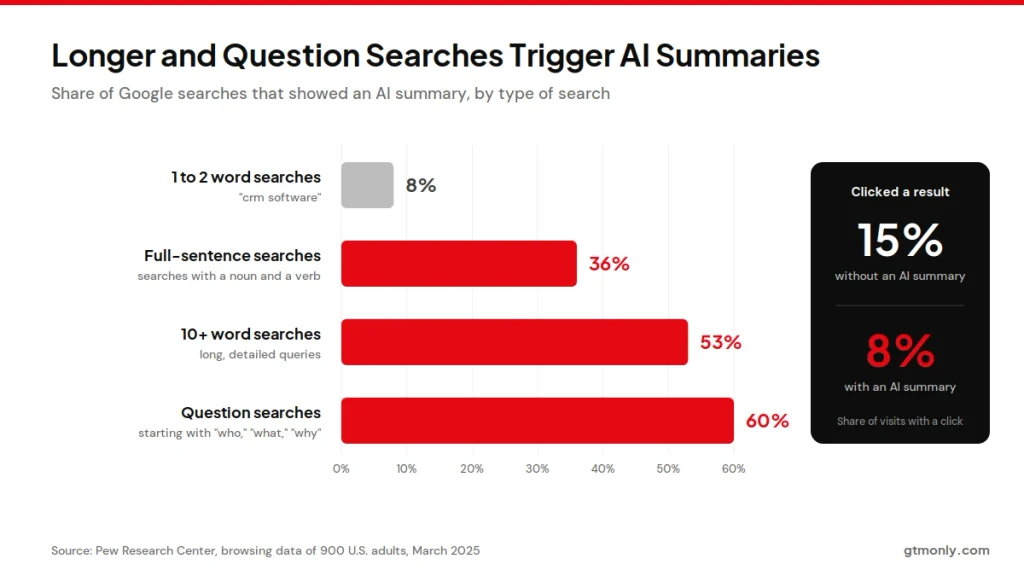
That lines up neatly with strategy one:
- Long, question-style informational keywords are the most likely to get an AI summary, and they convert worst anyway. Write these to be cited, and don’t count on the clicks.
- Short commercial keywords trigger summaries less often. They still send clicks, and those clicks are closer to a purchase.
3. Mine Sales Calls for Keywords Tools Miss
Proper keyword research still matters. But the best B2B keywords usually come from people, not tools.
- Sales calls: the words prospects use to describe their problem are often exact searches.
- Lost deals: a loss to a named competitor tells you which comparison page to build next.
- Support tickets: setup and integration questions become high-intent how-to content.
- The results page: the search intent behind a query shows whether Google wants a guide, comparison, or product page.
For category keywords, pair your topic with commercial modifiers. Good ones include software, platform, tool, services, pricing, and “for [industry].”
What to do: Ask your sales team what prospects say on discovery calls, which competitors come up most, and which objections repeat. Turn each answer into a keyword before you open a single tool.
4. Build Comparison and Alternatives Pages
If you don’t have a page comparing yourself to your top competitors, someone else does. It’s probably the competitor.
Comparison and alternatives pages sit at the top of that conversion table for a reason. The searcher already knows the category and is choosing between options.
Two things make these pages work. Be fair about where the competitor is stronger, because buyers can tell when a comparison is rigged. And spend most of the page showing how your product handles the job, with specifics and screenshots.
5. Create Pages for Your Own Brand Searches
This is the page type almost nobody plans for.
After a first sales call, prospects go back to Google and search your name. They type your brand plus words like pricing, reviews, security, implementation, or a competitor’s name.
If you don’t have a page for each, a review site or a competitor answers for you. These searches have tiny volume and some of the highest value on your site. The searcher is already in your pipeline.
6. Build Topic Clusters Around Pillar Pages
Pick four to six core topics where you have real expertise, and build a topic cluster around each. A cluster is one pillar page covering the broad topic, supported by detailed pages on each subtopic.
Link every supporting page to its pillar, and link related supporting pages to each other. This helps search engines understand what you’re an authority on, and it helps readers find the next useful page.
Stay inside your lane. Publishing far outside your expertise to chase traffic blurs what you’re known for, to search engines and buyers alike. If old off-topic posts are dragging on the site, consolidate or remove them.
7. Write Expert-Led, Human-Edited Content
B2B readers usually know their job better than the writer does. That’s why so much B2B content reads like a school report: a writer rephrasing the top five results.
The fix is slow but simple. Interview someone inside the company who does the work, like a salesperson, a product lead, or a customer success manager. Ask what buyers get wrong, which questions come up most, and how the product solves the problem.
AI can help with outlines and first drafts. Raw, unedited AI content is a different story. It repeats what’s already ranking, and it has nothing a buyer or an AI assistant would want to quote.
On bottom-of-funnel pages, sell. Someone searching “[category] for [industry]” wants to know if you can help, so show them how.
8. Create Content for Every Stakeholder
B2B purchases aren’t made by one person. Forrester’s State of Business Buying 2026 found that a typical buying decision includes 13 internal stakeholders and nine external influencers. It also found that genAI searches are where business buyers now start.
Each of those people searches for something different. A rough map for a finance software company:
| Role in the deal | What they search for | Page that answers it |
|---|---|---|
| Champion | How to fix the problem, how peers solved it | Jobs-to-be-done guides, use-case pages |
| Economic buyer | Cost, payback, risk | Pricing page, ROI content, case studies |
| Technical evaluator | Integrations, security, data handling | Integration pages, security page |
| End users | Ease of use, daily workflow | Product tours, how-to content |
| Procurement | Terms, vendor stability | Pricing details, trust and company pages |
If you’ve defined your ideal customer profile, this table mostly fills itself in. Knowing your ICP vs buyer persona tells you which companies to target and which people to write for.
9. Ungate Your Best Proof
B2B companies love forms. Pricing, case studies, security documents, and the one good research report all sit behind one.
Search engines can’t read gated content, so it can’t rank. AI assistants can’t read it either, so when a buyer asks what your category costs, the answer comes from someone else.
Publish a real pricing page, even if it’s “starts at” pricing. Publish a security page. Put an ungated summary of every report on your site, and gate only the full download.
10. Build a Strong Technical Foundation
B2B sites rarely have enterprise-scale technical problems. They have the same few, over and over:
- Crawl and index issues: broken links, redirect chains, and important pages missing from the sitemap.
- Slow pages: chat widgets, trackers, and form scripts piling up on every page.
- Scattered subdomains: docs and help centers that never get internal links.
- Orphaned pages: old campaign pages with nothing linking to them.
- Blocked AI crawlers: aggressive bot protection or robots.txt rules that keep AI tools out.
Add structured data where it fits. Use Organization schema on the homepage, Article schema on posts, and Product or SoftwareApplication schema on product pages. It won’t lift rankings on its own, but it helps search engines understand exactly what each page is.
Then cover the on-page SEO basics on every commercial page. That means a clear title, headings that match the query, and internal links from related content.
11. Optimize for AI Search and LLMs
There’s a lot of noise about AEO and GEO. Google’s guidance on AI features and your website says AI Overviews and AI Mode have no additional requirements. Normal SEO best practices apply.
I’ve argued for a while that generative engine optimization is mostly SEO done well. The habits that get your pages into AI answers also make them useful to people:
- Answer first. Open each section with a direct, self-contained answer in plain language.
- Be specific. Numbers, definitions, and named steps get quoted. Vague claims get skipped.
- Keep facts consistent. Pricing, features, and positioning should match across your site, review profiles, and partner listings.
- Get discussed elsewhere. Reviews, comparisons, communities, and expert roundups shape what assistants say about you.
- Keep pages current. An outdated pricing page can get quoted as if it were today’s.
Brand makes a real difference here. Seer Interactive’s 2026 update on AI Overviews and click-through rates looked at citations. Throughout 2025, being cited delivered two to five times the organic CTR of not being cited.
Seer is careful about cause and effect. Stronger brands may simply get cited more often. For B2B, that’s exactly the point: brand strength and AI visibility feed each other.
12. Earn Niche Backlinks and Brand Mentions
B2B link building works best when it mirrors how buyers already form opinions. Relevance beats volume every time.
- Original research: benchmarks and survey data get cited by journalists, analysts, and other companies.
- Industry podcasts: guest spots earn links and put your name in front of the exact audience you want.
- Partner and integration listings: partners’ directories are relevant, trusted links.
- Joint case studies: a customer story published on both companies’ sites earns links from both.
- Expert commentary: answering journalist requests builds links and familiarity together.
Unlinked brand mentions count too, at least for AI visibility. An assistant summarizing your category draws on what the web says about you, link or no link.
13. Refresh and Consolidate Before Publishing More
Once you have a few dozen pages, improving the right ones usually beats writing new ones.
Rank your pages by business value, not traffic. Then work down the list, updating each page until it ranks near the top and converts. A page sitting on page two for a buying-intent keyword is often one strong update away from producing leads.
Merge pages that compete for the same keyword. Two thin pages splitting the same search rarely beat one strong page.
14. Measure Pipeline, Not Traffic
If AI answers take clicks, traffic can fall while your influence grows. Track both sides:
| Metric | What it tells you |
|---|---|
| Rankings for buying-intent keywords | Whether commercial pages are being found |
| Branded search volume | Whether more people know and look for you |
| Organic demo and trial requests | Whether visits turn into conversations |
| Organic-sourced pipeline | Opportunity value that started with search |
| Self-reported attribution | Prospects who found you through AI answers or word of mouth |
| AI answer presence | Whether assistants mention you for your key category questions |
Add a free-text “How did you hear about us?” field to your demo form. People who found you through an AI assistant or a colleague won’t show up as organic in analytics. They’ll often tell you directly, though.
Every organic demo request should land in your CRM with its source. From there, it moves through the same MQL vs SQL handoff as every other lead. You’ll see which pages produce real opportunities.
How Long B2B SEO Takes
Longer than anyone selling it wants to admit.
Updates to existing pages can move within weeks. New pages for competitive keywords usually take several months to rank. Pipeline lags rankings, because B2B sales cycles add their own weeks or months on top.
The compounding part takes years. Brand familiarity, links, and citations build slowly, then start pulling every new page up faster. That’s the part worth being patient for.
B2B SaaS SEO: What Changes
B2B SaaS SEO uses the same strategies, with a few twists from how software gets bought:
- Signups count as conversions. With free trials or freemium, many pages aim for a signup, not a demo.
- Integration pages pull real weight. People search for your category plus the tools they already use.
- Docs are an SEO asset. Help documentation answers specific, high-intent questions.
- Activation beats signups. In product-led growth, organic signups that activate and upgrade are the number that matters.
Common B2B SEO Mistakes
- Chasing volume. High-volume informational keywords bring readers, and AI summaries are taking many of those clicks anyway.
- Skipping comparison pages. Competitors will rank for them instead.
- Ignoring your own brand searches. Prospects in your pipeline search for your pricing and reviews.
- Writing for one persona. Several stakeholders need different answers.
- Publishing unedited AI content. It adds nothing new, so nothing ranks or gets cited.
- Gating everything. Search engines and AI assistants can’t cite what they can’t read.
- Measuring traffic only. Traffic without pipeline is how SEO budgets get cut.
The Long Game Is the Whole Game
A B2B SEO strategy rewards the companies willing to be useful for a long time before it pays them back.
Capture the people already searching. Convince every decision-maker with proof they can read without filling out a form. Then keep compounding: the brand, the links, the citations.
Do that, and when AI search changes again (it will), you won’t have to start over. You’ll be the name the answers keep pointing to.
Frequently Asked Questions
What is B2B SEO?
B2B SEO improves a business-to-business company’s visibility in search engines and AI answers for the queries its buyers use. It focuses on reaching decision-makers, earning their trust with useful content, and turning organic visits into pipeline.
What is the best B2B SEO strategy?
The best B2B SEO strategy targets bottom-of-funnel keywords first, like category, comparison, and alternatives searches. It then builds topic clusters around core expertise, uses expert-led content, and earns authority through research, links, and brand mentions.
How is SEO for B2B different from SEO for B2C?
B2B SEO targets several decision-makers instead of one buyer, lower-volume keywords, and longer sales cycles. Conversions are usually demo requests or trials, not purchases. Brand trust plays a bigger role, and success is measured in pipeline.
Do AI Overviews hurt B2B SEO?
They reduce clicks on many informational searches, especially long, question-style ones. Short commercial searches are affected less. Being cited in AI answers helps offset the loss, which makes clear, specific content from a trusted brand more valuable.
Are low-volume keywords worth targeting in B2B?
Often, yes. Buying-intent keywords frequently show small search volumes but convert far better than broad informational terms. One customer from a low-volume keyword can be worth more than thousands of visits from a popular one.
How long does B2B SEO take to work?
Updates to existing pages can show results within weeks. New content for competitive keywords usually takes several months to rank, and pipeline follows later because of long sales cycles. Brand and authority gains compound over years.