What Is Product-Led Growth? A No-Hype Definition for B2B
If you spend more than five minutes on LinkedIn, you have likely seen the pitch.
“Just launch a freemium tier, fire your sales reps, and let the software sell itself.”
This is the myth of Product-Led Growth (PLG). It sounds incredible. It is also entirely wrong. Building a product-led business is not a marketing gimmick or a simple pricing hack. It is a fundamental rewiring of how a company operates, builds, and goes to market.
Product-Led Growth is a business methodology where the product itself is the primary driver of customer acquisition, retention, and expansion.
Instead of forcing buyers to talk to a human to understand your software, you let them experience the value firsthand. You remove the friction. Value comes first, payment comes second.
But doing this correctly is brutal. It requires ruthless engineering, flawless design, and a complete alignment of your revenue teams.
In this guide, I am tearing down the buzzwords. I will cover what product-led growth actually means, how it ruins legacy sales models, the PLG metrics you absolutely must track, and how to build a self-serve revenue engine that actually works.
What Exactly Is Product-Led Growth? (The Non-Jargon Definition)
To understand what is product-led growth in B2B SaaS, you have to understand the modern software buyer.
They do not want to read a gated whitepaper. They do not want to sit through a mandatory 45-minute discovery call just to see a dashboard. They want to solve a problem right now.
In a traditional enterprise setup, the product is locked behind a paywall and a sales gatekeeper. The buyer has to trust the salesperson that the product works as advertised.
In a product-led setup, the product sits front and center. The user signs up, pokes around, connects their actual data, and sees the results. The software acts as its own best salesperson.
But this means the product has to be exceptional. If your user interface is clunky, or if it takes three days and a developer to configure a basic dashboard, a product-led model will destroy your conversion rates. The user will simply close the tab, bounce to a competitor, and never return.
It Is an Organization-Wide Operating Model
A common mistake I see founders make is assuming PLG is just a pricing tier managed by marketing. It is neither. Transitioning to a product-led strategy requires every department to change how they operate:
- Engineering and Product: Must build intuitive, self-serve user onboarding flows that require zero human hand-holding.
- Marketing: Shifts focus from generating basic leads to driving highly targeted traffic straight into the free trial or freemium product.
- Sales: Transitions from aggressive cold outreach to consulting highly engaged users who already understand the software.
- Customer Success: Moves away from basic technical support to focus on driving deep feature adoption and enterprise account expansion.
Product-Led Growth vs. Sales-Led Growth (SLG): Which B2B Model Wins?
To see why PLG has taken over the SaaS world, I always look at the system it is rapidly replacing.
The Old Way: Sales-Led Growth (SLG)
For decades, the B2B sales process was highly restricted.
Marketing generated leads. Sales qualified those leads. Account executives (AEs) closed the deals. Customer success (CS) trained the users.
This model relies entirely on human headcount. If you want to double your revenue, you usually have to hire twice as many sales reps. That is incredibly expensive. It also creates a massive disconnect: the person buying the software (the executive holding the budget) is rarely the person actually using the software (the daily practitioner).
The result? High customer acquisition costs, grueling sales cycles, and low user adoption because the end-users hate the clunky tool their boss bought for them.
The New Way: Product-Led Growth
Product-Led Growth flips the traditional sales funnel upside down. It focuses entirely on the end-user first.
A designer, developer, or marketer signs up for a free trial. They use the tool to make their specific job easier. They love it, so they invite their coworkers. Suddenly, ten people in a single department are using the software every day.
At this point, the product hits a predefined usage limit. Only then does the platform prompt an automatic upgrade, or a sales rep reaches out to a decision-maker to consolidate those ten rogue free users into a secure, paid enterprise plan.
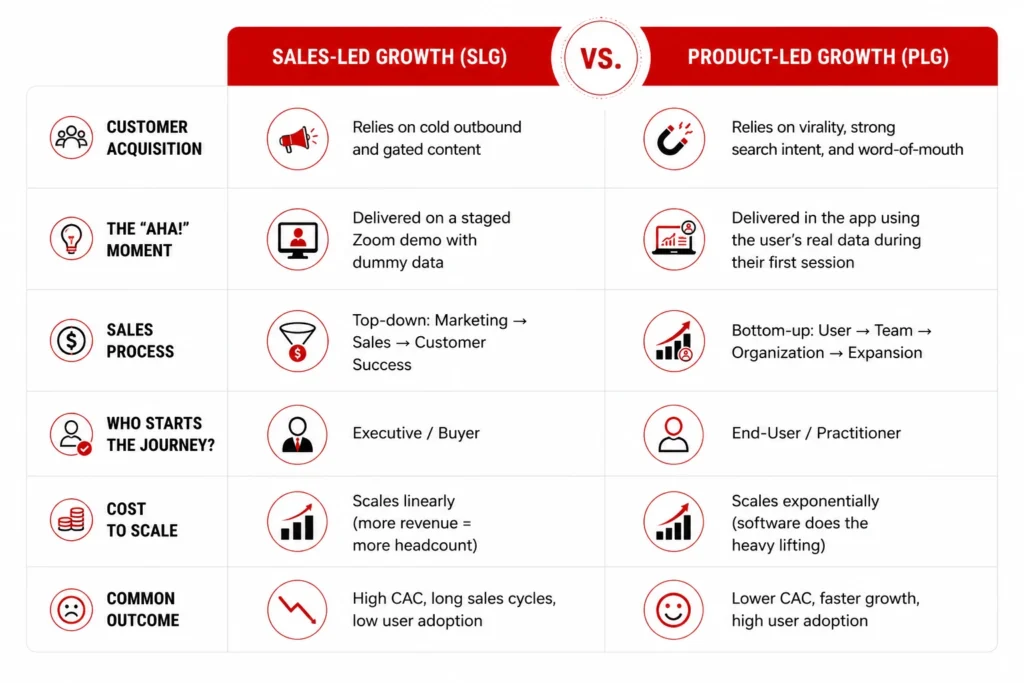
Here is how the two growth models stack up:
- Customer Acquisition: Sales-led relies heavily on cold outbound and gated content. Product-led relies on virality, strong search intent, and word-of-mouth.
- The “Aha!” Moment: Sales-led delivers the “Aha!” moment on a staged Zoom demo using dummy data. Product-led delivers it directly in the app using the user’s real data during their first session.
- Cost to Scale: Sales-led scales linearly (more revenue requires more headcount). Product-led scales exponentially (the software architecture does the heavy lifting).
The Hidden Reality: PLG Does Not Mean “Fire Your Sales Team”
(Sales reps, you can stop hyperventilating. You are not out of a job.)
Let me kill the biggest myth right now. Product-led growth companies still have massive sales teams.
Look at Slack, Figma, Zoom, or Canva. They are the poster children for PLG, yet they employ thousands of high-performing enterprise sales reps.
The difference is how those reps spend their time. In a traditional model, reps spend hours cold calling people who have never heard of the company. In a product-led model, reps only talk to people who are already actively using the software.
This hybrid approach is called Product-Led Sales (PLS).
Instead of chasing a cold sales qualified lead who accidentally downloaded an eBook, reps look at backend product data. They might see that 40 employees at Microsoft are actively using the free tier of their app on personal accounts. The sales rep then contacts the VP of IT at Microsoft.
They do not pitch the software. They offer a solution: “Your team already loves this tool; let’s put them on a secure, company-wide enterprise license with proper admin controls.”
The conversation changes from “Please buy my tool” to “Let me help you manage the tool your team has already adopted.” This requires a completely different approach to B2B sales, shifting the rep from a high-pressure persuader to a strategic consultant.
How to Build a Product-Led Growth Strategy: 5 Core Pillars
You cannot just strip the “Request a Demo” button off your website, offer a free trial, and expect revenue to pour in. A functional product-led engine requires deliberate, precise engineering.
If you want users to convert themselves, you must build these five core pillars into your foundation.
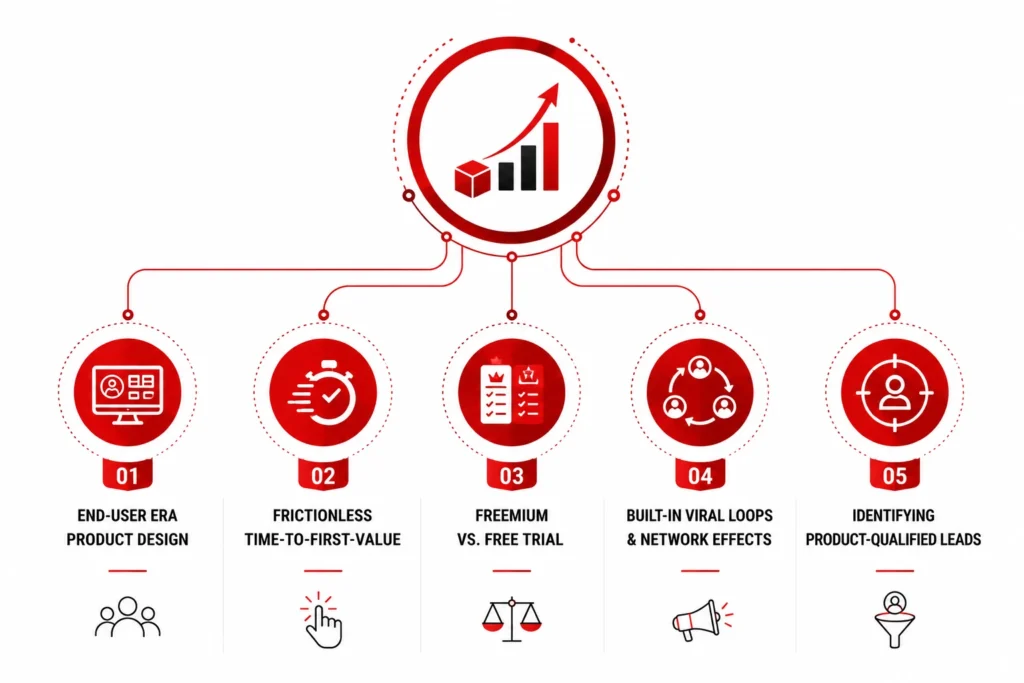
1. End-User Era Product Design
You are no longer building software to impress the CIO. You are building it for the daily practitioner.
If you want an individual contributor to adopt your tool without a mandate from their boss, the software must be as intuitive as a consumer app. Think about Spotify, Netflix, or Airbnb. Nobody needs a training manual to use them. Your B2B software must meet that exact same standard of usability.
Before you write a single line of code, you must deeply understand your ideal customer profile. You need to know their daily frustrations, their technical limitations, and design a workflow that eliminates their pain instantly.
2. Frictionless Time-to-First-Value (TTFV)
Time-to-First-Value is the single most critical metric in a PLG business. It measures the exact amount of time it takes for a new user to experience a meaningful win.
If a user signs up for your analytics tool, how long does it take for them to see their first chart? If they have to talk to a developer, install complex tracking scripts, and wait 24 hours for data to populate, your TTFV is broken. They will abandon the product.
To drastically shorten TTFV, you must relentlessly remove friction:
- Allow signups via Google, GitHub, or Microsoft single sign-on (SSO).
- Do not ask for a credit card upfront if you can financially model around it.
- Pre-populate dashboards with dummy data so the user can immediately see what the end result looks like before they do any heavy lifting.
- Delay asking non-essential profile questions until after the user has experienced value.
3. The SaaS Pricing Dilemma: Freemium vs. Free Trial
How do you let users into the product? You generally have two choices, and picking the wrong one can stall your growth for years.
The Freemium SaaS Model: Users get access to a stripped-down version of your product forever, at no cost. You monetize by gating advanced features (like custom branding, advanced integrations, or admin permissions). Freemium is brilliant for building massive brand awareness, but it requires a massive total addressable market (TAM). Free users cost money to host and support. If you cannot convert enough of them, the server costs will literally bankrupt you.
The Free Trial Model: Users get full access to your premium product, but only for a limited time (usually 7, 14, or 30 days). This creates intense psychological urgency. Free trials work best when your product requires a bit more effort to set up, or when the value is so obvious that users will happily pay once the trial expires to avoid losing their customized workspace.
4. Built-In Viral Loops and Network Effects
The absolute best product-led companies do not spend fortunes on paid Google Ads. They build marketing directly into the product.
A viral loop happens when a user naturally invites another user simply by using the product as intended.
Think of Calendly. When you send a Calendly link to a prospect to book a meeting, you are forcing them to interact with the Calendly product. They experience the smooth booking process and think, “I need this for my own business.” The product markets itself simply by functioning.
If your software is single-player (meaning only one person benefits from using it), PLG is incredibly difficult. You must find a way to make it multiplayer. Add collaboration features, easy sharing links, or team workspaces.
5. Identifying Product-Qualified Leads (PQLs)
Marketing Qualified Leads (MQLs) are fundamentally flawed in the modern era. Just because someone downloaded an eBook on marketing strategy does not mean they are ready to buy a $10,000 software package.
PLG companies track Product-Qualified Leads (PQLs). A PQL is a user who has experienced meaningful value inside your product and triggered a behavioral threshold that indicates high buying intent.
Examples of a strong PQL trigger:
- A user logs into the app five days in a row.
- A user invites three colleagues to their workspace.
- A user attempts to click a feature that is deliberately locked behind a paywall.
Because PQLs already know how your software works and have integrated it into their workflow, they close at drastically higher rates than traditional marketing leads.
Essential Product-Led Growth Metrics You Must Track
You cannot manage what you do not measure. Because product-led growth relies on high volumes of users navigating a self-serve system, your analytics must be razor-sharp. You cannot rely on gut feeling.
Here are the critical PLG metrics that dictate the health of a self-serve revenue engine.
1. User Acquisition Metrics
- Website Visitor to Sign-up Rate: What percentage of your traffic actually creates an account? If this is below 3-5%, your value proposition is unclear, or your signup form is too intimidating.
- Customer Acquisition Cost (CAC): PLG should dramatically lower your CAC because the product is acquiring users organically. If your CAC is rising in a PLG model, your viral loops are failing.
2. User Activation Metrics
- Activation Rate: The percentage of new signups who successfully reach the “Aha!” moment. You must rigorously define what activation looks like for your specific tool. If you run an email marketing platform, activation might be defined as “importing a list and sending the first broadcast.” Tracking your activation rate tells you what percentage of signups are actually making it past the front door.
- Time-to-First-Value (TTFV): Measured in minutes or hours. How fast does a user reach activation? Every extra step in your user onboarding process bleeds users.
3. SaaS Monetization Metrics
- Free-to-Paid Conversion Rate: The holy grail metric of PLG. What percentage of your free users eventually pull out their credit card? For freemium models, a healthy benchmark is 2-5%. For gated free trials, you should aim for a 15-25% conversion rate.
- Average Revenue Per User (ARPU): Because PLG often starts at lower price points (e.g., $12/month per seat), you need to closely track how this grows as teams expand their usage over time.
4. Retention & Account Expansion Metrics
- Net Revenue Retention (NRR): This measures how much revenue you retain from your existing customer base over a given period, including upgrades, seat expansions, and churn. Best-in-class PLG companies have an NRR of 120% or higher. This means their existing customers are spending 20% more money with them every year, without the company having to acquire a single new logo.
- Viral Coefficient (K-Factor): How many new users does each existing user bring in? If your K-Factor is greater than 1, your product is growing exponentially without any marketing spend.
The Ultimate Product-Led Growth Tech Stack
You cannot execute a product-led go-to-market strategy using legacy tools built for cold calling.
When the product is the primary revenue driver, your tech stack must bridge the gap between engineering, marketing, and sales data. Here is the modern go-to-market tools infrastructure needed to make PLG work:
- Product Analytics (e.g., Amplitude, Mixpanel, PostHog): This is the foundational layer. You need event-based tracking to see exactly which buttons users click, where they drop off in the onboarding flow, and which features correlate with long-term retention.
- Product-Led Sales Platforms (e.g., Pocus, Endgame, Correlated): These tools sit on top of your product analytics and score users based on behavior. They alert your sales team when a free user suddenly exhibits buying intent (like inviting a manager to the workspace). This is modern sales intelligence.
- Customer Data Platform (CDP) & Reverse ETL (e.g., Segment, Hightouch): You need a way to pipe product usage data back into your CRM (like Salesforce or HubSpot) so your marketing and sales teams have real-time visibility into user behavior.
- Self-Serve Billing & Subscription Management (e.g., Stripe, Chargebee): Frictionless payments are critical. Users need to be able to upgrade their plans, add seats, and enter credit card information without talking to a billing department.
Real-World Product-Led Growth Examples and Case Studies
Looking at the pioneers of this model reveals exactly how these mechanics work in the wild. I study these companies relentlessly because they prove that PLG is about behavioral psychology as much as it is about software engineering.
Slack: The Bottom-Up Revolution
Slack did not invent instant messaging. But they made team collaboration entirely frictionless. Anyone could spin up a workspace in two minutes without an IT department’s permission.
The absolute brilliance of Slack’s model was its invisible paywall. They gave you unlimited users and core features for free. But they limited your message history search to the most recent 10,000 messages. By the time a team hit that limit, they were completely dependent on Slack. The pain of losing their company chat history forced a paid upgrade. The users quite literally sold themselves.
Figma: Multiplayer Virality in Design
Before Figma, design software like Sketch or Adobe Illustrator lived locally on a hard drive. It was single-player. Figma moved design to the browser and made it multiplayer.
They allowed designers to share a simple URL with a copywriter, a product manager, or a frontend developer. Suddenly, non-designers were inside the design file, leaving comments and copying CSS code. By breaking down the silos between departments, Figma naturally expanded across entire organizations. The core product design intrinsically fueled the growth.
Zoom: Flawless Time-to-Value
Zoom dominated a saturated video conferencing market through pure engineering superiority and a ruthless focus on TTFV.
Competitors required users to create accounts, download heavy desktop clients, and add contacts before a call could even start. Zoom simply gave you a web link. You clicked the link, and you were in the meeting. The free tier capped meetings at 40 minutes. This was just long enough to prove the video quality was flawless, but short enough to be highly annoying for serious business meetings, logically forcing the host to upgrade.
Common Reasons Why Product-Led Growth Fails
It is crucial to note that PLG is not a magic bullet. I have seen many B2B companies attempt the pivot and fail miserably. Usually, they fall into one of these traps:
- Forcing PLG onto a Top-Down Product: If your software requires massive behavioral change across a whole company (like a giant ERP system), a bottom-up user cannot force that change alone. You still need traditional top-down enterprise sales.
- Ignoring the “Empty State”: A user logs in for the first time, and the screen is completely blank. Without dummy data or a clear checklist, the user is overwhelmed and bounces.
- The “Frankenstein” Tech Stack: Marketing uses HubSpot, Sales uses Salesforce, and Product uses Mixpanel, but none of the systems talk to each other. Sales reps end up cold-calling active power users, making the company look disorganized.
- Over-gating the Free Tier: If you lock all the truly valuable features behind the paywall, the free user never experiences the “Aha!” moment. They assume your product is useless and leave.
How to Transition to a Product-Led Business Model (A Phased Approach)
If you are currently running a legacy sales motion, do not panic. You do not have to rewrite your entire codebase tomorrow. The transition from SLG to PLG should be strategic and phased.
Step 1: Instrument Your Data Perfectly
Before you open the doors to thousands of free users, you must have perfect analytical visibility. Implement product analytics tools. You need to know exactly what users click, where they drop off, and which features drive retention. If your data is messy, PLG is impossible.
Step 2: Build a Self-Serve Onboarding Flow
Stop forcing new users into a sandbox environment that requires human setup. Rebuild your initial user journey. Create templates, dummy data, and contextual tooltips. The singular goal is to allow a user to achieve one micro-win without talking to a human.
Step 3: Align Revenue Operations (RevOps)
In a PLG environment, silos are fatal. If marketing drives free signups, but the product fails to convert them, and sales has no visibility into user behavior, the system breaks. This is why revenue operations is non-negotiable. RevOps connects the data across the entire customer lifecycle, ensuring that when a user hits a PQL threshold, an alert is instantly sent to the CRM.
Step 4: Launch a Hybrid Motion
Do not fire your sales team. Introduce a transparent pricing tier (even if it is just a 14-day trial) alongside your traditional “Contact Sales” button. Let your sales team monitor the trial users. Train your reps to transition from pitching to consulting.
Step 5: Re-align Your Funnel Metrics
Stop compensating marketing purely on raw lead volume. Stop compensating sales purely on closed-won revenue from cold outbound. The entire GTM funnel must be re-calibrated. Marketing should be measured on active product signups. Sales should be measured on expanding active accounts.
Why Product-Led Companies Still Need Demand Generation and SEO
A major misconception is that product-led companies do not need marketing.
If you have a free product, your marketing team is no longer tasked with generating “leads for sales.” Their job is to get targeted, high-intent traffic directly into the product.
Modern demand generation in a PLG environment focuses on reducing the barrier to entry. Instead of gating a template behind an email form, you make the template a free, interactive tool on your website. When the user finishes playing with the template, they click one button to save it into a free account. Demand generation becomes product adoption.
Furthermore, when buyers do not have a sales rep to guide them, your organic content must step in. If a user gets stuck on a Friday night, they will Google their problem. If your SEO team has not created an article solving that exact issue, you lose the user.
The Future of B2B: AI, PLG, and the Hybrid Go-To-Market Strategy
The next evolution of product-led growth is already here, and it is being driven heavily by artificial intelligence.
The integration of AI in GTM is solving the biggest bottlenecks in the self-serve model. Historically, if a user got confused during onboarding, they churned. Today, embedded AI copilots can analyze user behavior in real-time, realize the user is stuck on a specific feature, and dynamically generate a customized tutorial inside the app.
Pricing models are also evolving. Instead of static paywalls, AI allows for dynamic, usage-based friction. The system learns when a specific user is deriving the maximum amount of value and triggers personalized upgrade prompts based on their exact workflow.
Stop Focusing on the Label
People get too caught up in the terminology. Product-Led Growth, Sales-Led Growth, Product-Led Sales—at the end of the day, these are just labels.
The real shift is about buyer control.
B2B buyers are tired of friction. They are tired of gated information and defensive sales tactics. They want to experience your product on their own terms, at their own speed.
If your software is genuinely excellent, the best thing you can do for your revenue is to get out of its way. Stop hiding your product behind contact forms. Stop forcing excited users to wait three days for a basic demo.
Build a frictionless path to value, track the users who actually succeed, and empower your revenue teams to help those users scale. That is the true reality of product-led growth.