
What Is Revenue Operations (RevOps)? The Secret Behind Elite GTM Teams
TL;DR
- Revenue Operations (RevOps) is an operating model, not a job title. It unifies marketing, sales, and customer success under one shared process, one data model, and one set of goals.
- It is the infrastructure layer that makes your go-to-market strategy executable. Without it, even the best GTM strategy falls apart in execution.
- The four pillars are Process, Data, Technology, and People — always in that order.
- The single biggest structural mistake is putting RevOps under the VP of Sales.
- RevOps is a management discipline, not a one-time implementation project.
You built the RevOps function. You hired someone with the right title. You have a CRM, a dashboard, and a pipeline review every Friday.
And yet marketing and sales still argue about what counts as a qualified lead. Customer success finds out about churn after it already happened. The forecast is wrong at the end of every quarter.
The problem is not your team. It is not your tools either. It is that most companies build RevOps on top of a broken foundation and expect the structure to hold on its own.
This guide breaks down what revenue operations actually is, why the version most B2B companies build does not work, and what it takes to build one that does.
What Revenue Operations Actually Means
Revenue operations, or RevOps, is the function that unifies marketing, sales, customer success, and finance around one shared process, one data model, and one set of goals across the entire customer lifecycle.
Read that definition carefully. Note what it does not say.
It does not say RevOps is a CRM admin with a better title. It does not say RevOps is sales ops with a broader scope. And it definitely does not say RevOps is a reporting project.
RevOps is an operating model.
Think of it as the operating system running underneath your entire GTM function. Marketing, sales, and customer success are the applications. RevOps is the OS that lets them run on shared infrastructure, communicate in a common language, and produce outputs that actually connect to each other.
Without that OS, each team runs on its own local settings. Different definitions for the same words. Different tools tracking different versions of the same customer. Different dashboards showing different versions of the same pipeline.
A mature RevOps function has four components working together: standardized processes, a clean unified data layer, an integrated tech stack, and people aligned across shared revenue outcomes. When one component is weak, the others produce unreliable outputs.
Most companies get two right and leave the other two unresolved. That gap is why so many RevOps functions exist on the org chart but do not actually solve the problem they were hired to fix.
The Problem RevOps Was Built to Solve
Here is what the problem looks like at most B2B companies.
Marketing generates leads and calls it pipeline. Sales qualifies those leads and calls them something different. Customer success tracks health scores that have no connection to either number. Everyone has their own version of the truth. Nobody is lying. But nobody is looking at the same reality.
Revenue leaks in the gaps between teams.
A high-intent lead goes cold because the handoff from marketing to sales took three days and nobody owned the handoff process. An expansion opportunity sits inside an existing account because the CSM who spotted it had no way to route it to the right sales rep in time. A customer churns in month five because no early warning signal was connected to a renewal risk flag.
This is not a communication problem. More meetings will not fix it. Better Slack etiquette will not fix it either.
What fixes it is a shared operating model that removes the gaps instead of asking people to manage around them. That is what RevOps was built to do.
Why Silos Form in the First Place
Nobody sets out to build disconnected teams. Silos form naturally as companies scale.
When a startup has five people, everyone knows everything. When that same company hits 50 people across three departments, knowledge fragments. Each team develops its own tools, its own definitions, and its own metrics. What gets measured in each department shapes what each team optimizes for.
Marketing optimizes for lead volume. Sales optimizes for closed deals. Customer success optimizes for retention. Each goal makes sense in isolation. The problem is that optimizing independently produces locally good results and globally broken ones.
A company that hits its MQL target, its quota, and its retention rate while still missing overall revenue goals is a company with a coordination failure. RevOps is the answer to that failure.
Revenue Operations vs. Sales Operations: What Is the Difference?
Sales operations has been around for decades. RevOps is newer. A lot of companies assume they’re interchangeable terms for the same function.
They are not.
| Sales Operations | Revenue Operations | |
| Scope | Sales team only | Marketing, Sales, CS, Finance |
| Reporting line | VP of Sales | CRO or executive leadership |
| Core question | How do reps close more deals? | Where is revenue leaking across the full journey? |
| Data focus | Sales pipeline | Full-funnel, unified data model |
| Primary goal | Sales team efficiency | Cross-functional revenue predictability |
Sales ops lives inside the sales organization. Its job is to make salespeople more effective: CRM hygiene, territory design, quota modeling, pipeline reporting. It reports to sales leadership and stays inside that lane.
RevOps sits above that. It is the horizontal layer that connects sales ops, marketing ops, and customer success ops under one unified framework.
As companies mature, sales ops typically becomes the sales-specific execution arm inside the broader RevOps structure. The two are not in competition. One operates at the function level. The other operates at the system level.
Here is the distinction that matters most in practice: sales ops asks “how do we help reps close more deals?” RevOps asks “where is revenue leaking across the entire buyer journey and how do we fix it?”
One more thing worth saying plainly. When RevOps reports into the VP of Sales, it optimizes for sales and calls it RevOps. Marketing stays a black box. Customer success keeps running on intuition. The company gets sales ops with a fancier title and no actual alignment to show for it.
RevOps needs its own reporting line to the Chief Revenue Officer or directly to the executive team. It cannot serve the full revenue cycle if it is owned by one part of it.
The Four Core Pillars of Revenue Operations
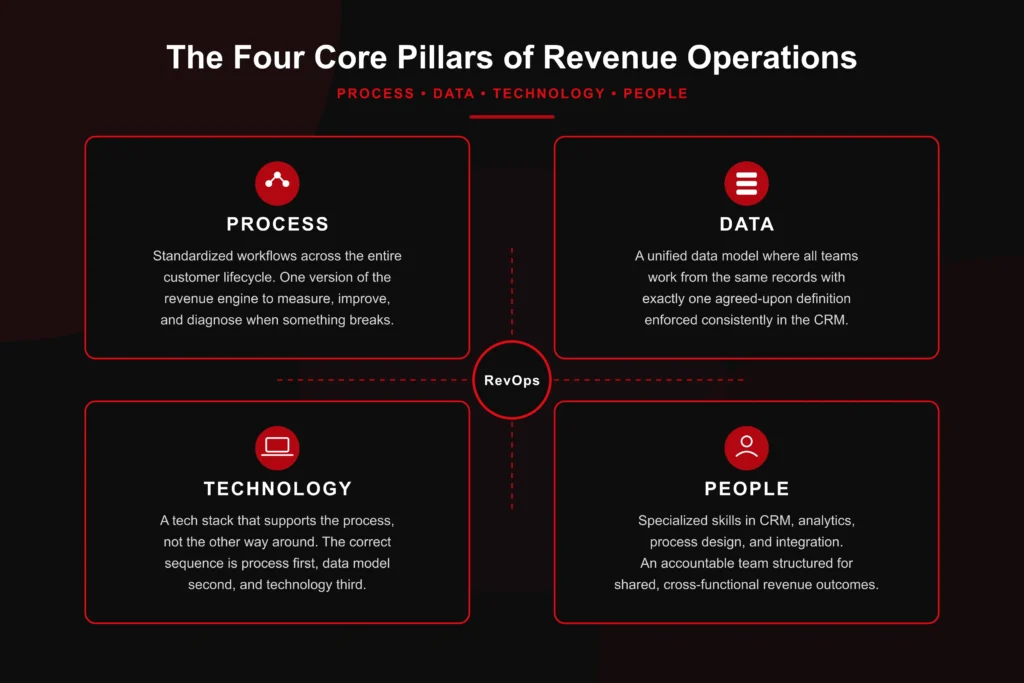
Four things. That is what RevOps runs on. Not a software platform. Not an org chart. Four foundational elements that have to work together.
Process
Standardized workflows across the entire customer lifecycle. From lead scoring criteria to handoff rules to renewal triggers, every step in the buyer journey needs a defined process that all teams follow.
This is not bureaucracy. It is about creating one version of how the revenue engine runs so you can measure it, improve it, and diagnose it when something breaks.
Without standardized processes, every team improvises. Improvisation produces inconsistency. Inconsistency makes data meaningless. Meaningless data makes everything downstream unreliable.
Process is the foundation. Everything else depends on it.
Data
A unified data model where marketing, sales, and customer success work from the same records with the same field definitions.
“Qualified lead” means one thing. Not one thing to marketing and another thing to sales. One thing, written down, agreed on, enforced in the CRM.
“Churned customer” has one definition. “Expansion opportunity” has one definition. Every term that drives a decision in your revenue org has exactly one definition.
Data governance is where most RevOps initiatives die quietly. Teams skip it because it is unglamorous work. Nobody wants to spend three weeks arguing over field definitions. But without that work, no tool in your stack will give you a version of the truth you can act on.
Clean, consistent data is not a technical problem. It is a coordination problem. And fixing it is RevOps at its most fundamental.
Technology
A tech stack that supports the process, not the other way around.
The most common RevOps mistake is buying technology before designing the operating model. Teams invest in a new analytics platform, a new pipeline tool, a new forecasting system, and then discover that the data feeding all of these tools is inconsistent across teams.
Expensive dashboards built on bad data do not help anyone. They just make the confusion look more polished.
The right sequence is process first, data model second, technology third. Every time. The tools serve the model. They do not create it.
People
RevOps draws from at least four distinct skill sets: CRM administration, data analytics, process design, and systems integration. That combination rarely lives in one person.
Mature RevOps teams build for specialization while keeping everyone accountable to the same revenue outcomes. A CRM specialist and a data analyst and a process architect, each doing what they are best at, all pointing toward the same goal.
Trying to cover all four with a single generalist hire creates gaps. Distributing the work across four people who each own one piece without anyone coordinating the whole also creates gaps.
The RevOps team structure question is not just about headcount. It is about designing the function so all four skill areas are covered and someone is accountable for the whole.
Why Your GTM Strategy Depends on RevOps to Work
A go-to-market strategy without RevOps underneath it is a race plan without fuel management.
You know where you want to finish. You have the map. You have the drivers. But you have no system ensuring every team is running on the same data, the same definitions, and the same version of the plan.
GTM strategy answers three questions: who you sell to, how you reach them, and what you offer them. RevOps is the operating model that makes those answers consistent across every team that touches the customer.
Without RevOps, GTM strategy lives in a slide deck and dies in execution.
The ICP Drift Problem
Here is a specific pattern that kills GTM momentum at B2B companies.
Marketing defines the ideal customer profile one way. Sales qualifies against a slightly different version. Customer success onboards based on a third interpretation nobody officially approved. Six months in, the three teams are targeting different types of customers, measuring different outcomes, and wondering why the GTM motion feels broken.
Nobody changed the strategy. The strategy changed in execution because there was no shared operating model to enforce it consistently.
RevOps fixes ICP drift by ensuring the same definition lives in every tool, every process, and every team’s daily workflow. One profile. One standard. Applied the same way across the full revenue cycle.
The ABM Example
Account-based marketing programs fail for a predictable reason. Marketing identifies a list of target accounts. Sales doubts the list because they built their own. Customer success has no visibility into which existing customers are in the ABM program. The program runs for six months and nobody can attribute a single deal to it because there is no shared attribution model.
RevOps makes ABM work by ensuring every team starts from the same account list, operates with the same contact data, and measures results against the same attribution framework. The program becomes something the whole revenue team runs together, not something marketing runs alone while everyone else ignores it.
The Forecasting Connection
GTM planning requires a reliable forecast. A reliable forecast requires clean pipeline data. Clean pipeline data requires standardized processes and unified definitions across every team that touches the CRM.
Every step in that chain is a RevOps problem. When the chain is broken, GTM planning becomes guesswork. Headcount decisions, budget allocations, channel investments, and territory design all get made on intuition instead of data.
RevOps turns GTM planning from a quarterly guessing exercise into a decision-making process grounded in something real.
5 Signs Your Company Needs Revenue Operations
RevOps is not the right investment at every stage. A 10-person company does not need a dedicated RevOps function. But a lot of companies wait too long and pay for it in revenue loss they cannot trace back to a single cause.
Here are the signals that tell you it is time:
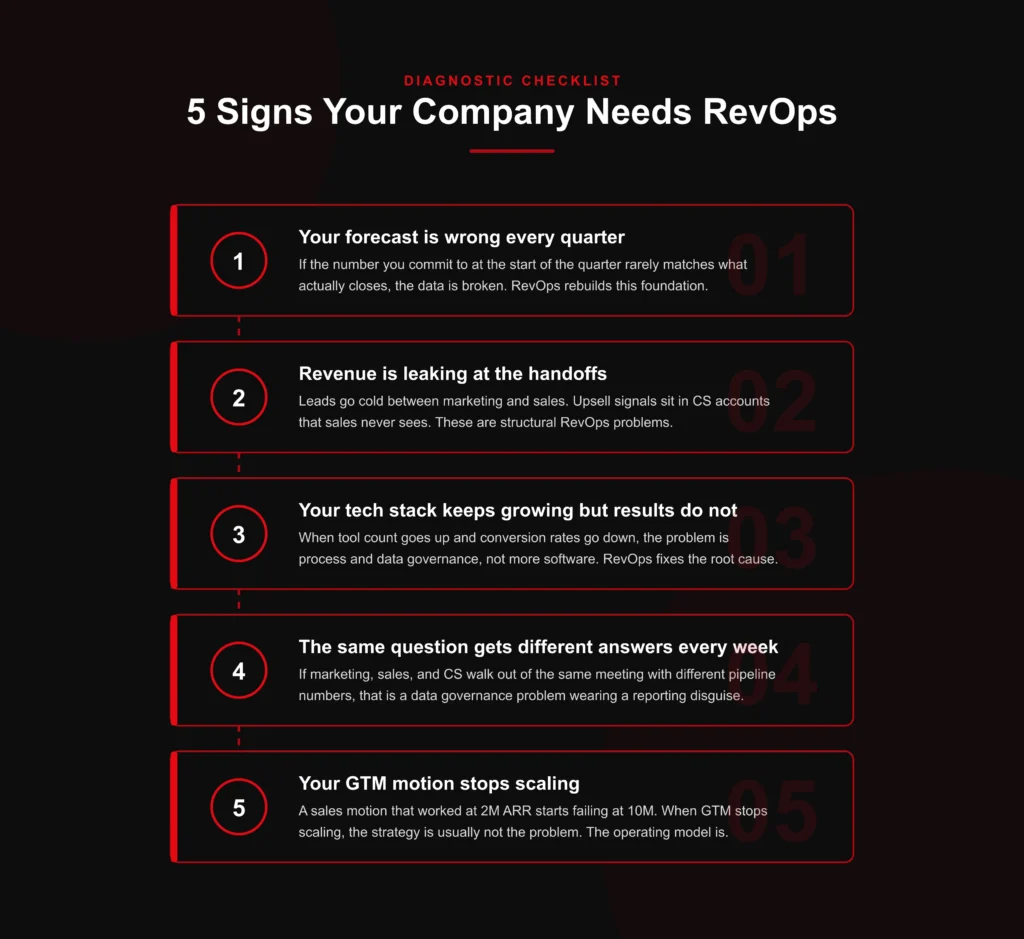
- Your forecast is wrong every quarter. If the number you commit to at the start of the quarter rarely matches what actually closes, the data underneath the forecast is broken. RevOps rebuilds the foundation that forecast accuracy depends on.
- Revenue is leaking at the handoffs. Leads go cold between marketing and sales. Upsell signals sit in CS accounts that sales never sees. Expansion opportunities expire before anyone acts on them. These are all RevOps problems.
- Your tech stack keeps growing but results do not. When tool count goes up and conversion rates go down, the problem is process and data governance, not more software. RevOps addresses the root cause.
- The same question gets different answers every week. If marketing, sales, and CS walk out of the same meeting with different pipeline or churn numbers, that is a data governance problem wearing a reporting problem disguise.
- Your GTM motion stops scaling. A sales motion that worked at 2M ARR starts failing at 10M. An ICP that closed deals at Series A stops converting at Series B. When GTM stops scaling, the strategy is usually not the problem. The operating model underneath it is.
How to Build a Revenue Operations Function
You do not need a large team or a long timeline to start. You need the right sequence. Skipping steps to save time is exactly what creates the RevOps debt that teams spend years trying to clean up.
Start With the Process, Not the Tools
Before touching a single tool, document what actually happens from first touch to renewal. Where are the handoffs? What data passes with a lead at each stage? What gets lost and where?
You cannot fix a system you have not mapped. The mapping exercise alone will surface more problems than any software audit.
Standardize Definitions Before Anything Else
Get marketing, sales, and customer success in the same room and define the terms everyone uses daily. MQL. SQL. Opportunity. Closed Won. Churned.
One definition per term. Written down. Officially shared across the organization.
This single step eliminates more cross-functional confusion than almost any tool implementation you could make. It sounds simple. It is rarely done properly. Do it first and do it thoroughly.
Audit the Tech Stack Before Adding to It
List every tool each team currently uses. Find where data is duplicated, where it is siloed, and where two tools are doing the same job that one tool should do.
Consolidate before adding anything new. More tools on a broken data foundation is just a more expensive version of the same problem.
Build Toward One Source of Truth
Every metric that matters should eventually pull from one agreed-upon source. Marketing’s pipeline number, sales’ pipeline number, and CS’s pipeline number should be the same number coming from the same place.
You will not get there on day one. But every infrastructure decision you make should move you toward it. If a new tool or process decision creates another silo, it is the wrong decision regardless of what problem it claims to solve.
Hire for the Structure, Not Just the Title
When you bring in your first RevOps hire or build out the function, be specific about which of the four skill domains you are filling and which ones still have gaps.
A RevOps leader who is strong in process design but weak in data analytics will build a clean process on dirty data. A team that covers all four domains but has no clear ownership of the overall function will build in circles.
Define the structure first. Hire into it intentionally.
Revenue Operations Metrics That Actually Matter
RevOps does not track departmental scorecards. It tracks metrics that cut across the entire revenue journey. That distinction is the whole point.
Marketing celebrating lead volume while conversion rates drop tells you nothing useful in isolation. RevOps gives those numbers context by connecting them to what happens downstream.
Here are the metrics a mature RevOps function owns:
- Pipeline Velocity – Combines deal volume, average deal value, win rate, and sales cycle length into a single metric. When velocity drops, RevOps identifies the cause: fewer deals, lower deal values, declining win rates, or longer sales cycles.
- Forecast Accuracy – Measures the gap between committed revenue and actual closed revenue. Strong forecast accuracy builds executive trust and highlights data quality issues when forecasts consistently miss.
- Win Rate by Segment – Analyzes performance across ICP tiers, deal sources, industries, and market segments. Segment-level visibility reveals where the GTM motion performs best and where resources are being wasted.
- Net Revenue Retention (NRR) – Tracks how revenue from existing customers changes over time. High NRR indicates healthy expansion revenue and customer retention, while low NRR signals underlying product or customer success challenges.
- CAC Payback Period – Measures how long it takes to recover customer acquisition costs. RevOps uses this metric to guide marketing investment, sales hiring, and overall growth planning.
- Pipeline Coverage Ratio – Calculates qualified pipeline against revenue targets. The common benchmark is 3x coverage. Falling below that threshold means revenue goals become increasingly dependent on luck rather than execution.
Track these at the full-funnel level, not by department. That is the point of RevOps. The metrics should reflect the whole system, not individual parts of it.
Common RevOps Mistakes That Kill the Function Early
RevOps implementations fail. They fail in patterns. Understanding those patterns before you build is more useful than learning them after you have already made the mistakes.
Putting RevOps under the VP of Sales
The most common structural mistake, and the most damaging one. When RevOps reports into sales leadership, the function optimizes for sales. Marketing stays a black box. Customer success keeps running on gut feel. The company gets a sales ops rebranding and zero actual alignment.
Fix the reporting line first. RevOps cannot serve the full revenue cycle if it is owned by one part of it.
Buying technology before building governance
Teams invest in a new analytics platform before agreeing on what the metrics should measure. The result is expensive dashboards full of unreliable data. No visualization tool fixes a broken data model. The governance work has to happen first.
Treating RevOps as a one-time project
RevOps is not an implementation. It is a management discipline.
Your segments shift. Your team grows. Your market changes. The initial setup is not the finish line. Companies that treat it that way end up rebuilding from scratch 18 months later and wondering what went wrong.
Build processes and documentation that can support the next stage of scale, not just the current one.
Automating a broken process
Automating a bad handoff does not fix it. It makes the bad handoff happen faster and at higher volume. Start with the process logic. Define what good looks like on paper. Then automate.
Skipping data governance because it is slow
Data governance is unglamorous. It involves long meetings about field definitions, CRM cleanup work nobody wants to do, and decisions that feel trivial until the reports are wrong.
Skip it and nothing downstream works properly. Every tool, every dashboard, every forecast, every GTM decision rests on the quality of the underlying data. The unglamorous work is the most important work.
Conclusion
Revenue operations is not a trend. It is not a title. It is not a software category.
It is the answer to a real, structural problem that scales with your company. The more teams you add, the more handoffs you create. The more handoffs you create, the more places revenue can leak. RevOps is what keeps the system whole.
The companies that build it well treat it as an architectural decision, not a hiring decision. They start with process. They fix the data. They choose tools that serve the model instead of the other way around. And they build a team structure that covers all four skill domains, not just the one that is easiest to hire for.
Build it right once. It compounds.
Frequently Asked Questions About Revenue Operations
What does a RevOps team actually do day to day?
Day-to-day work includes CRM administration, pipeline reporting, process documentation, cross-functional alignment meetings, data governance, and systems integration. The strategic layer sits on top of that: forecasting models, attribution frameworks, territory planning, and GTM capacity modeling. Most RevOps teams spend a majority of their time maintaining operational infrastructure and the rest on strategic projects. Both sides are equally necessary.
When should a company hire its first RevOps person?
The signal is revenue leakage at the handoffs, not headcount or ARR. When you are consistently losing deals at the transition between marketing and sales, when you cannot trust your forecast, or when three teams are working from three versions of the same data, it is time. For most B2B companies, that moment arrives somewhere between 25 and 100 employees or when the GTM motion starts visibly breaking under scale.
Is RevOps just a rebranding of sales operations?
No, and the distinction matters. Sales ops lives inside the sales team and optimizes for sales performance. RevOps sits above all revenue-generating functions and optimizes for the full customer journey. The scope, reporting line, data ownership, and primary metrics are all different. Calling sales ops “RevOps” without changing any of those things is one of the most common mistakes B2B companies make.
How is RevOps different from the CRO role?
The Chief Revenue Officer sets revenue strategy and owns business outcomes. RevOps is the operational function that makes the strategy executable. The CRO decides where the business needs to go. RevOps builds the systems, processes, and data infrastructure that get every team there in the same direction. One sets the destination. The other builds the vehicle.
Does RevOps only apply to SaaS companies?
No. The RevOps model applies to any B2B company where multiple teams share responsibility for the revenue cycle. In services, manufacturing, or distribution businesses, the data inputs look different, but the principle is the same: one process, one data model, shared accountability from first contact to renewal or repurchase.
What is the difference between RevOps and marketing operations?
Marketing ops lives inside the marketing team and manages campaign execution, marketing automation, attribution, and the marketing tech stack. RevOps sits above it, coordinating marketing ops, sales ops, and CS ops under one unified framework. Marketing ops is a component inside a mature RevOps function, not a substitute for one.
How long does it take to build a working RevOps function?
Three to six months to build a solid foundation: definitions standardized, data model cleaned up, processes documented, tech stack audited. Another six to twelve months before the function reaches genuine maturity. Companies that rush the foundation almost always end up rebuilding it within 18 months. The groundwork is not a phase you can skip.
How do you measure whether RevOps is working?
The clearest signals are improvements in forecast accuracy, win rate consistency across segments, shorter sales cycles, and higher net revenue retention. If your forecast is getting more accurate each quarter, if your handoffs are losing fewer leads, and if the same pipeline number comes out of every team’s reports, RevOps is working. If none of those things are improving, the infrastructure work is not done yet.