ABM vs Demand Generation: What’s the Difference (and How to Run Both)
ABM vs demand generation comes down to one thing: who you’re talking to. ABM talks to a short list of exact companies. Demand generation talks to a whole market at once.
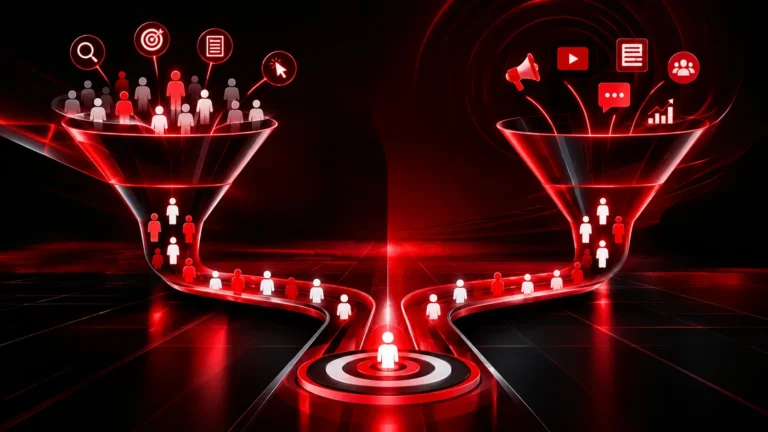
Demand generation creates interest where none existed before. It runs wide. Think content, ads, SEO, and webinars. The goal is to reach a whole group of buyers, and most of them don’t know you exist yet. ABM does the opposite. You already know exactly who you want. You build one custom path for each company.
Both work. Neither is a smaller version of the other. The confusion starts in one place. Teams treat them like two options fighting for the same budget. They’re not. They’re two different tools for two different jobs.
What Is ABM?
Account-based marketing targets a defined, named list of high-value accounts and coordinates marketing and sales around winning them. How custom that gets, one account at a time or a cluster at once, depends on which type of ABM fits your deal size. You pick the companies first, then build everything, content, ads, outreach, around that specific list, and the same logic keeps running past the close into what’s now called account-based experience.
What Is Demand Generation?
Demand generation builds awareness and interest across a broader market, then earns the right to more direct engagement as people show interest. It’s not lead generation with a rebrand. Lead gen just wants the contact info. Demand gen wants someone to actually want what you sell before you ask for anything.
Also read: ABM vs ABX: what’s the difference
ABM vs Demand Generation: The Comparison
| ABM | Demand Generation | |
|---|---|---|
| Targets | A named list of specific accounts | A broad market or segment |
| Funnel shape | Starts narrow, stays narrow | Starts wide, narrows over time |
| Personalization | Deep, account by account | Broad, message by segment |
| Owned by | Marketing and sales together | Mostly marketing |
| Content | Custom per account or cluster | Scalable, reused across the audience |
| Primary metrics | Account engagement, pipeline by account, deal size | Lead volume, cost per lead, conversion rate |
| Sales cycle fit | Long, complex, multiple stakeholders | Shorter, simpler, fewer decision-makers |
| Best for | Small TAM, high ACV | Large TAM, lower ACV |
The Differences That Actually Matter
Five things explain almost everything else on that table.
Who Gets Targeted
ABM starts with a list. Fifty accounts, a hundred, whatever fits the team. Every one of those companies was chosen on purpose. Demand generation starts with a category of buyer and casts toward all of it, most of whom will never become a customer, and that’s fine, because the game is volume and conversion rate, not precision.
The Funnel Runs Backward
A normal demand gen funnel narrows. Thousands see an ad, hundreds click, a handful convert. An ABM funnel is already narrow on day one and stays that way. You’re not filtering a crowd down to buyers. You’re deepening a relationship with a list you already committed to.
Content Gets Built Differently
Demand gen content answers a broad question well: a blog post, a webinar, a guide that helps an entire category of buyer. ABM content answers a specific account’s exact situation: their tech stack, their competitor, their recent funding round. One scales. The other doesn’t, and isn’t trying to.
The Team Structure Changes
Demand gen mostly lives in marketing, with leads handed to sales once they cross a score threshold. ABM doesn’t work that way. Marketing and sales share the account list from day one, because sales needs to see movement on a specific account in real time, not after a lead score trips a wire.
The Numbers You Watch Are Different
Demand gen tracks volume: leads generated, cost per lead, conversion rate, pipeline from a wide top of funnel. ABM tracks depth instead: how much of a target account’s buying committee is engaged, how fast a specific account is moving, whether the deal size on that account justifies the custom effort.
Where They Actually Overlap
The differences get all the attention. The overlap matters just as much.
- Both exist to build pipeline and revenue, not just activity.
- Both need a real ideal customer profile, or you’re just guessing with better production values.
- Both get dramatically better with real signal. Knowing who’s actually in-market beats guessing, whether you’re running one play or a thousand.
- Both fail without sales buy-in. Demand gen fails quietly when sales ignores the leads. ABM fails loudly when sales and marketing aren’t working the same list.
If your demand gen program already tracks account-level data, not just individual leads, you’re closer to ABM than you think.
The Mistake That Wastes Budget on Both
Nearly every serious source on this topic agrees ABM and demand gen aren’t rivals. Fewer say what actually goes wrong when a team tries to run both at once, and that’s the part most comparisons skip because it’s less satisfying than “they’re different, use both.” The usual failure isn’t picking the wrong strategy. It’s picking both, then spreading one team across two jobs that need different skills, different content, and different timelines, and watching both underperform because neither got enough of anything.
A marketer writing broad category content in the morning and building a custom microsite for one account in the afternoon isn’t running two strategies. They’re running one strategy badly, twice. Demand gen needs volume and consistency. ABM needs depth and patience. Ask one person or one small team to deliver both at full strength on the same day and you get a program that’s technically doing everything and genuinely excelling at nothing.
The fix isn’t choosing one. It’s giving each motion its own lane, its own content calendar, and ideally its own owner, even if that owner is the same person on different days of the week. Blur the two together without that separation and you’ll spend the budget of both and get the return of neither.
How to Actually Run Both Together
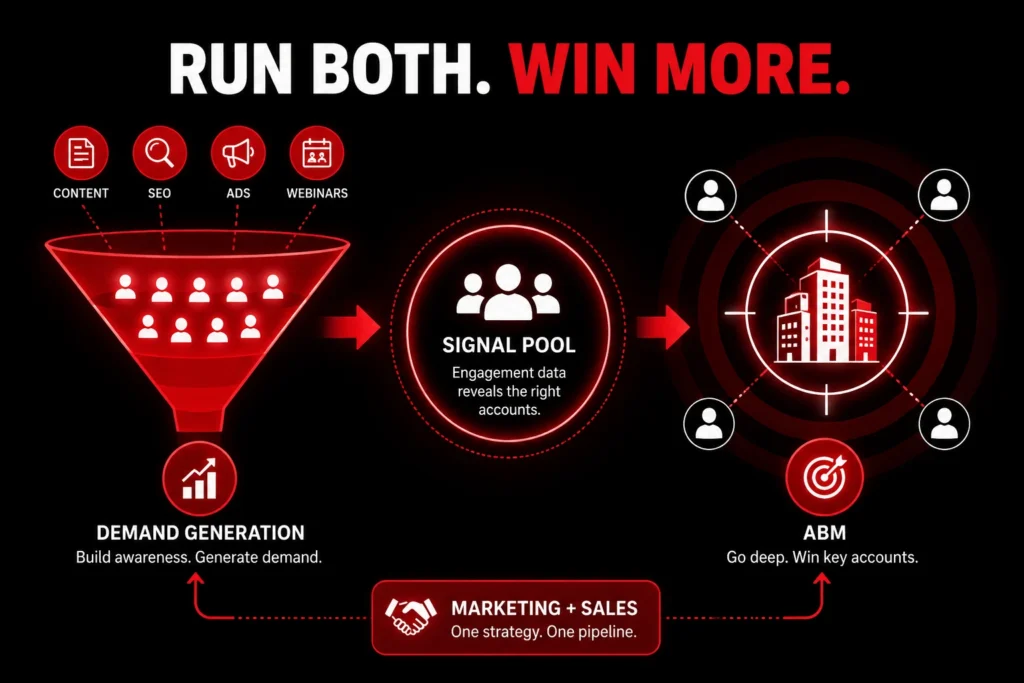
Most B2B companies past a certain size need both eventually, and the two connect in a specific way once you stop treating them as competitors for the same budget.
Demand generation runs first and wide. It builds category awareness, fills the pipeline with inbound interest, and, just as importantly, generates the exhaust data, who’s engaging, who’s researching, who fits your ICP, that makes account selection smarter. You’re not choosing target accounts blind. You’re choosing them from a pool that already showed you something.
ABM then goes deep on the accounts that pool surfaces as genuinely worth the investment. An account that’s been quietly engaging with demand gen content, visiting the pricing page, downloading a comparison guide, is a much better ABM candidate than one picked off a firmographic list with zero signal behind it.
Practically, that looks like: demand gen owns the wide top, building awareness and collecting signal across the whole market. Marketing and sales jointly own a short list pulled from that pool, the accounts showing real fit and real intent. That list is where the actual campaign starts, built on the ABM strategy work that decided who’s on it in the first place.
Which One Should You Run First?
If you’re choosing where to start, not how to blend, the deciding factors are your market size and your deal size.
Start with demand generation if:
- Your total addressable market is large.
- Deals are smaller and the sales cycle is short.
- You don’t yet have enough data to know who your best-fit accounts even are.
Start with ABM if:
- Your market is narrow, a few hundred companies could realistically buy from you.
- Average deal size is high enough to justify custom, high-touch work.
- Sales cycles are long and involve multiple stakeholders who all need to say yes.
Most companies don’t stay in one lane forever. A startup with a huge addressable market often starts in demand gen, then layers in ABM once revenue concentrates around a smaller set of high-value accounts. An enterprise seller with a narrow market often runs ABM from day one and never needs much demand gen at all.
The Bottom Line
ABM and demand generation aren’t competing for the same job. One wins specific accounts. The other builds the market those accounts eventually come from. Treating them as rivals for the same budget line is how both end up underfunded and neither performs.
Pick your starting lane based on market size and deal size, not fashion. Then, once you’re running both, keep them separate enough that each gets what it actually needs: volume and consistency for demand gen, depth and patience for ABM. Let demand gen’s signal tell you which accounts deserve the ABM treatment, and let ABM’s coordinated push close the accounts that matter most.
Run them as one system with two different jobs, not two teams fighting over the same slice of budget.
Frequently Asked Questions
What is the difference between ABM and demand generation?
ABM targets a defined, named list of high-value accounts with deep personalization, coordinated by marketing and sales together. Demand generation builds awareness and interest across a broader market to create pipeline volume. ABM optimizes for account depth and deal size; demand generation optimizes for reach and lead volume.
Is ABM better than demand generation?
Neither is better in general, they fit different situations. ABM works best with a narrow market and high deal sizes, where custom effort per account pays off. Demand generation works best with a large addressable market and shorter sales cycles, where volume and efficiency matter more than depth on any single account.
Can you run ABM and demand generation at the same time?
Yes, and most B2B companies past a certain size eventually run both. The common failure is blending them without a clear split, letting one team try to do both jobs at once. The better approach gives demand gen its own lane to build the market and generate signal, then feeds the accounts showing real fit into a separate, focused ABM motion.
Which metrics matter for ABM vs demand generation?
Demand generation tracks lead volume, cost per lead, and conversion rate, volume-based numbers that reflect a wide funnel. ABM tracks account engagement, pipeline by account, and deal size, depth-based numbers that reflect a narrow, high-touch list. Applying one strategy’s metrics to the other’s program is a common source of confused reporting.
Does demand generation feed ABM?
Often, yes. Demand generation activity generates signal, who’s engaging with your content, who fits your ideal customer profile, who’s showing real interest, that makes ABM account selection sharper than picking names off a firmographic list with no evidence behind them. Many mature GTM motions use demand gen as the top of the funnel that surfaces ABM’s best targets.
Should a small company start with ABM or demand generation?
It depends on market size more than company size. A small company selling into a narrow, high-value market, only a few hundred realistic buyers, often does better starting with ABM despite the higher effort per account. A small company selling into a large market with lower price points usually gets more return from demand generation first, since ABM’s cost per account doesn’t make sense at that deal size yet.
What tools help run ABM and demand generation together?
Most setups need overlapping infrastructure: intent and account data to know who’s engaging, a CRM that both motions can see, and something that handles account-level targeting once a company graduates from the demand gen pool into an ABM list. The best ABM software roundup covers the platforms built specifically for that account-based side of the stack.