Cold Email Templates That Actually Get Replies (2026)
TL;DR
- 12 B2B cold email templates organized by use case: first touch, trigger-based, follow-ups, and breakup.
- Each template has a subject line, email body, reason it works, and reply rate benchmark.
- Trigger-based templates (funding round, hiring signal) consistently outperform generic first-touch templates.
- Breakup templates have some of the highest reply rates in any cold email sequence.
- Includes a side-by-side comparison of a B2B cold email template that gets ignored vs one that gets replies.
Looking for cold email templates that actually get replies? You’re in the right place.
This guide has 12 B2B cold email templates organized by use case. First touch, trigger-based, follow-ups, and breakup emails. Every template includes a subject line, email body, and a short note on why it works.
I put these together after going through dozens of templates that were either too generic to get replies or too complicated to personalise at scale. The ones here are the ones that hold up in real outreach.
Pick the template that fits your situation, fill the brackets, and send.
12 Cold Email Templates for B2B Outreach
1. The Cold Introduction Template
Use when you have no prior context and no trigger event. Lead with value. Keep it short.
Template 1 | Cold Introduction
Quick question, [First name]
Hi [First name],
I help [job title]s at [company type] get [specific result] without [common frustration].
[Company] came up on my radar because [specific reason — a LinkedIn post, recent growth, a product launch].
Is this something you are working on right now?
[Your name]
Why it works: The cold email subject line feels personal, not salesy. The first line delivers value before naming yourself. The specific reason tells the reader this is not a mass blast.
Typical reply rate: 2 to 4%
2. The Pain Point B2B Cold Email Template
Use when you know a specific problem common in their industry and can back it with a result.
Template 2 | Pain Point
[Problem] at [Company]?
Hi [First name],
Most [job title]s I speak to at [company type] are dealing with [specific pain point]. It costs them [consequence].
[Your company] solved this for [similar company]. They went from [before] to [after] in [timeframe].
Worth a quick look?
[Your name]
Why it works: The subject line mirrors a question the prospect is already asking themselves. The case study does the selling without a pitch.
Typical reply rate: 4 to 6%
3. The Social Proof Cold Email Template
Use when you have a strong case study and no trigger event. Let the proof open the door.
Template 3 | Social Proof
How [Similar company] got [specific result]
Hi [First name],
[Similar company] had a problem you might recognize: [specific pain].
Here is what they did: [one-sentence description of the solution].
They hit [result] in [timeframe].
Would that kind of outcome be useful for [Company]?
[Your name]
Why it works: Opening with a third-party story removes the pitch feeling entirely. The reader either sees their own situation in the story or they do not. If they do, they reply.
Typical reply rate: 5 to 7%
4. The Value-First Cold Email Template
Use with senior buyers who get pitched constantly. Give something useful before asking for anything.
Template 4 | Value First
Thought this might be useful, [First name]
Hi [First name],
Put together a [report / checklist / playbook] on [topic relevant to their role].
Given what [Company] is doing in [space], figured it might be worth your time.
No strings. Want me to send it over?
[Your name]
Why it works: This email gives before it asks. Senior buyers respond differently to an email that leads with something useful. The follow-up does the selling, not the first touch.
Typical reply rate: 6 to 9% across the full sequence
5. The Competitor Name-Drop Cold Email Template
Use when a direct competitor of your prospect is already a customer. Do not name the competitor unless the result is public.
Template 5 | Competitor Name-Drop
[Competitor] uses us. Thought you’d want to know.
Hi [First name],
[Competitor] is one of our customers. They use [your product] for [use case] and saw [result].
Given what [Company] is doing in [space], I thought it was worth a conversation.
Interested in seeing how they did it?
[Your name]
Why it works: Nobody wants to fall behind a direct competitor. The CTA is a question, not a demand. That keeps the pressure low.
Typical reply rate: 4 to 6%
6. The Wrong Person Redirect Template
Use when you are not sure if you are emailing the right contact. Honest uncertainty is disarming.
Template 6 | Wrong Person Redirect
Not sure if you’re the right person, [First name]
Hi [First name],
I want to make sure I am talking to the right person at [Company].
We help [role] teams [specific outcome]. Is that something you handle, or is there someone better placed I should reach out to?
Either way, happy to make it quick.
[Your name]
Why it works: Most people either confirm they are the right person and engage, or redirect you to someone who is. Both outcomes are useful. The honest framing earns goodwill.
Typical reply rate: 3 to 5% — but nearly every reply is actionable
Trigger-Based B2B Cold Email Templates
These templates are built around a specific event at the prospect’s company. Trigger-based cold emails consistently outperform generic first-touch templates because the timing is relevant. The same email sent without a trigger event gets a fraction of the replies.
Surprising fact: Cold emails built around timelines and clear outcomes outperform traditional problem-based pitches by a huge margin. Timeline-focused hooks generate 10.01% reply rates, more than 2x higher than generic “Are you struggling with X?” emails.
7. The Funding Round Cold Email Template
Send within 14 days of a funding announcement. After that, the window starts to close.
Template 7 | Funding Round Trigger
Congrats on the [Series X], [First name]
Hi [First name],
Saw [Company] closed [round]. Congrats.
Growing fast usually means [relevant challenge — scaling outbound, onboarding faster, managing more pipeline]. That is where teams often hit a wall.
We helped [similar company] handle exactly that after their [similar round]. [One-line result].
Is this on your radar right now?
[Your name]
Why it works: The congratulations open is not flattery — it signals you did your homework. The follow-up connects the funding event to a specific challenge they are about to face, which makes the timing feel right rather than random.
Typical reply rate: 8 to 12%
My take: I tracked funding announcements for a set of target accounts and found the same cold email sent within 7 days of a round gets roughly 3x the replies of the same email sent a month later. Set a Google Alert for your top 50 accounts and check it every Monday.
8. The Hiring Signal Cold Email Template
When a company posts a job for a role your product replaces or supports, that is a live buying signal. They are about to spend money in this area.
Template 8 | Hiring Signal Trigger
Saw you’re hiring a [Role], [First name]
Hi [First name],
Noticed [Company] is hiring a [Role]. That usually means [related challenge or growth goal].
Before you commit to headcount, worth knowing: [similar company] achieved [result] using [your solution] instead of hiring for that role.
Happy to share the details if useful.
[Your name]
Why it works: Job postings are public, real-time intent signals. This cold email reframes the cost of hiring against your solution without being dismissive of their thinking.
Typical reply rate: 6 to 10%
9. The LinkedIn to Email Cold Email Template
Use when you have had a LinkedIn interaction with a prospect but no email conversation yet. This warms a cold email before it lands.
Template 9 | LinkedIn Crossover
Following up from LinkedIn, [First name]
Hi [First name],
We connected on LinkedIn [recently / after you commented on [post]]. I did not want to pitch you there.
I help [role]s at [company type] with [specific outcome]. Based on your background in [area], thought it might be relevant.
Would a short conversation be worth it?
[Your name]
Why it works: Referencing a real LinkedIn interaction makes this cold email warm rather than cold. Acknowledging that you did not pitch on LinkedIn shows you respect the channel.
Typical reply rate: 5 to 8%
Cold Email Follow-Up Templates
According to Instantly’s 2026 Benchmark Report, 42% of replies in a cold email sequence come from follow-ups, not the first send. Most salespeople stop after one email and miss nearly half of their potential responses.
10. The Day-3 Follow-Up Cold Email Template
Send three days after your first cold email. Add something new — do not just bump the thread.
Template 10 | Day-3 Follow-Up
Re: [original subject line]
Hi [First name],
Following up on my email from [Monday / Tuesday].
One thing I did not mention: [new angle, stat, or case study not in the first email].
Still happy to send that over if useful.
[Your name]
Why it works: A follow-up that just says ‘bumping this up’ gives the reader no new reason to respond. A new angle or fact treats their time with respect and often reaches people who simply missed the first send.
Typical reply rate: 4 to 6%
11. The Day-7 Reframe Cold Email Template
Send seven days after the first cold email. Switch the angle entirely. If the first led with pain, this one leads with opportunity.
Template 11 | Day-7 Reframe
Different angle, [First name]
Hi [First name],
Had another thought on [original topic].
[Reframe the offer completely — ROI instead of pain, a different use case, or a new piece of social proof]
Would this version be a better fit for where [Company] is right now?
[Your name]
Why it works: Switching the frame gives prospects who were not sold on angle one a fresh reason to engage. The closing question keeps the tone light and leaves the door open.
Typical reply rate: 3 to 5%
12. The Breakup Cold Email Template
Send this as the final cold email in your sequence. Breakup emails have some of the highest reply rates of any touch in a sequence because they create finality.
Template 12 | Breakup Email
Closing the loop, [First name]
Hi [First name],
I have reached out a few times about [topic]. Since I have not heard back, I will assume the timing is not right.
I will not follow up again after this. If things change and [relevant goal or pain] becomes a priority, my details are below.
Wishing [Company] a strong [quarter / year].
[Your name]
Why it works: The phrase ‘I will not follow up again’ often triggers a reply from prospects who were interested but had not found the right moment. It removes pressure and earns goodwill at the same time.
Typical reply rate: 8 to 12%
Having a template is only half the job. Here is what separates a B2B cold email template that gets ignored from one that earns a reply.
Bad B2B Cold Email Template vs One That Gets Replies
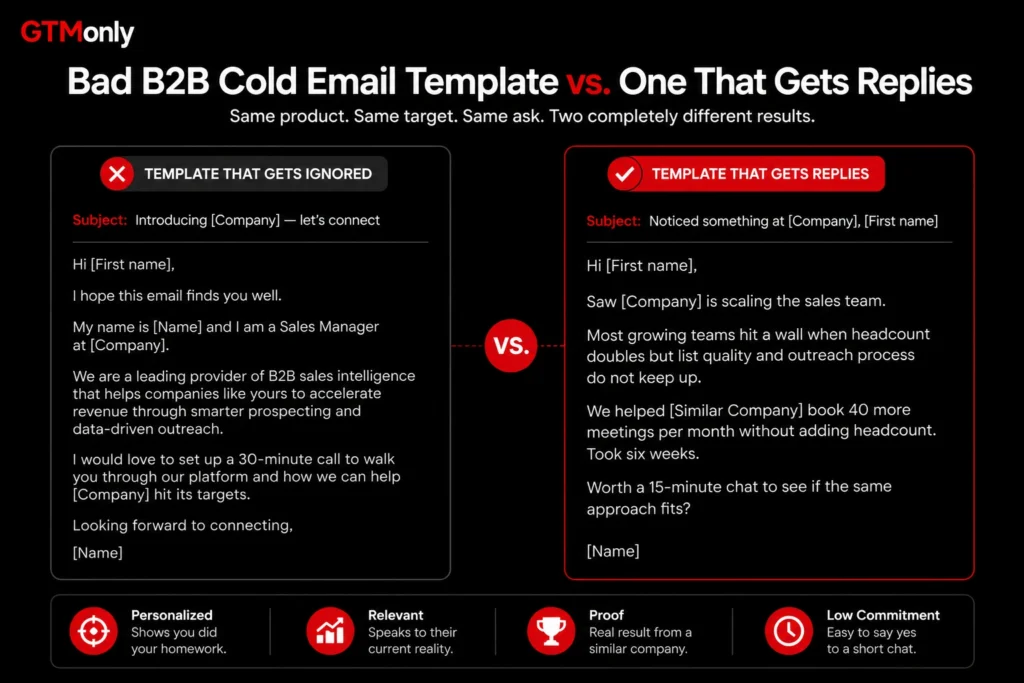
The first template talks about the sender for four lines before making an ask. The second opens with the prospect’s situation, delivers one proof point, and gets out.
The product is the same. The ask is nearly the same. But one reads as noise and the other reads as relevant.
My take: The first B2B cold email template I ever used looked exactly like the bad example above. Four paragraphs about myself. Zero replies. The shift that changed things for me was simple: I stopped writing about what I do and started writing about what the prospect is probably already thinking about.
Final Thought
A good cold email template gives you the structure. What makes it work is how you fill it in.
Every template here is a starting point. Swap the brackets with real research, pick the right template for your situation, and build a sequence of at least three touches before writing off a prospect.
If you want to go deeper on the craft of writing cold emails from scratch, our guide on how to write a cold email covers subject lines, opening lines, CTAs, and follow-up timing.
Frequently Asked Questions
What is a B2B cold email template?
A B2B cold email template is a reusable framework for reaching out to business prospects you have no prior relationship with. It includes a subject line, opening hook, value statement, and a call to action. Templates are starting points — you fill in the specifics before sending. The best ones are built around the prospect’s situation, not the sender’s product.
What is the best cold email template for B2B?
The best B2B cold email template depends on what you know about the prospect. If you have a trigger event, use template 7 (funding round) or template 8 (hiring signal) from this guide. If you have a strong case study and no context, template 3 (social proof) performs consistently well. Generic introduction templates with no specific hook perform worst.
Should I use the same cold email template for every prospect?
No. A template to a VP of Sales should look different from one to a CMO or a Head of RevOps. The pain point, proof, and ask all need to match the role. Using one template for every prospect is the fastest way to underperform. At minimum, build a different version for each buyer persona you target regularly.
Can I use these templates in cold email software?
Yes. All 12 templates in this guide work inside tools like Instantly, Smartlead, Lemlist, and Salesloft. Use the platform’s merge field syntax to auto-fill the personalisation variables at scale. If you are still choosing a tool, our cold email software guide covers the best options.
How long should a cold email template be?
Under 125 words. Shorter templates get higher reply rates in B2B outreach. If you cannot say what you need to say in 125 words, you are pitching too early. The goal of a cold email is to start a conversation, not close a deal.