
Buying Committee Mapping: How to Find Every Decision-Maker Before Your Deal Stalls
Buying committee mapping is how you find every person who will shape a deal, before one of them quietly ends it.
Skip it, and you sell to whoever replies to your emails. Then someone you’ve never met raises one concern in a meeting you’re not invited to.
The deal goes quiet. Your champion stops answering.
This happens far more often than sellers admit. Forrester’s State of Business Buying research found that 86% of B2B purchases stall during the buying process. A good map shows you who can stall yours, while you still have time to act.
What Is a Buying Committee?
A buying committee is the group of people inside a company who evaluate, influence, and approve a B2B purchase. Its members use the product, fund it, judge its risk, and sign the contract.
Committees form around one specific purchase. Once the contract is signed, the group breaks up, and the next purchase pulls together a different mix of people.
You’ll also hear the term buying group. The two overlap heavily, though a B2B buying group often counts outside advisors like consultants and peers as well.
What Is Buying Committee Mapping?
Buying committee mapping is the process of identifying every member of a buying committee and recording what matters about each one. A finished map shows each person’s role, influence, stance on your deal, and main concern.
It also records how you know each fact. And it shows the approval path, meaning the reviews and sign-offs the deal must clear after the committee agrees.
People often confuse a map with an org chart. The two do different jobs:
| Org chart | Buying committee map | |
|---|---|---|
| Shows | Who reports to whom | Who shapes this purchase |
| Covers | Everyone in the company | Only people tied to this deal, including outside advisors |
| Tracks stance | No | Yes, from champion to blocker |
| Changes | At re-orgs | Every few weeks during a live deal |
Use the org chart as raw material. The map is what you build from it.
Why Buying Committee Mapping Matters
Four shifts in B2B buying make mapping hard to skip.
1. Committees Are Bigger Than Your CRM Shows
Forrester’s research puts the average buying decision at 13 people, with 89% of purchases involving two or more departments. Tech purchases go further: Foundry’s Role & Influence research counts an average of 32 influencers in technology purchases.
Deal size pushes the number up, too. A LeanData roundup of buying group statistics reports that deals over $250,000 need an average of 19 stakeholders to close.
Now count the contacts attached to your biggest open deal.
2. Purchases Stall Where You Have No Contact
With 86% of purchases stalling at some point, the real question is where yours will stall. Stalls tend to start with people you haven’t met. Think of a finance lead nobody briefed, or a security reviewer who found a gap.
A map shows you where that risk sits while there’s still time to address it.
3. One Departure Can Sink a Single-Threaded Deal
The same LeanData roundup reports that more than 80% of sellers say deals stalled or were lost after a key stakeholder left. When your only contact changes jobs, a single-threaded deal goes with them.
A deal with four engaged contacts survives one departure. A deal with one contact rarely does.
4. Forecasts Need Evidence Behind Them
A deal that rests on one friendly contact is a hope with a close date. Mapping forces you to show who has confirmed what, which makes your sales pipeline reviews far more honest.
How B2B Buying Committees Make Decisions
Committees rarely move in a straight line. Members research alone, loop back, and join at different points, yet six stages show up in nearly every purchase.
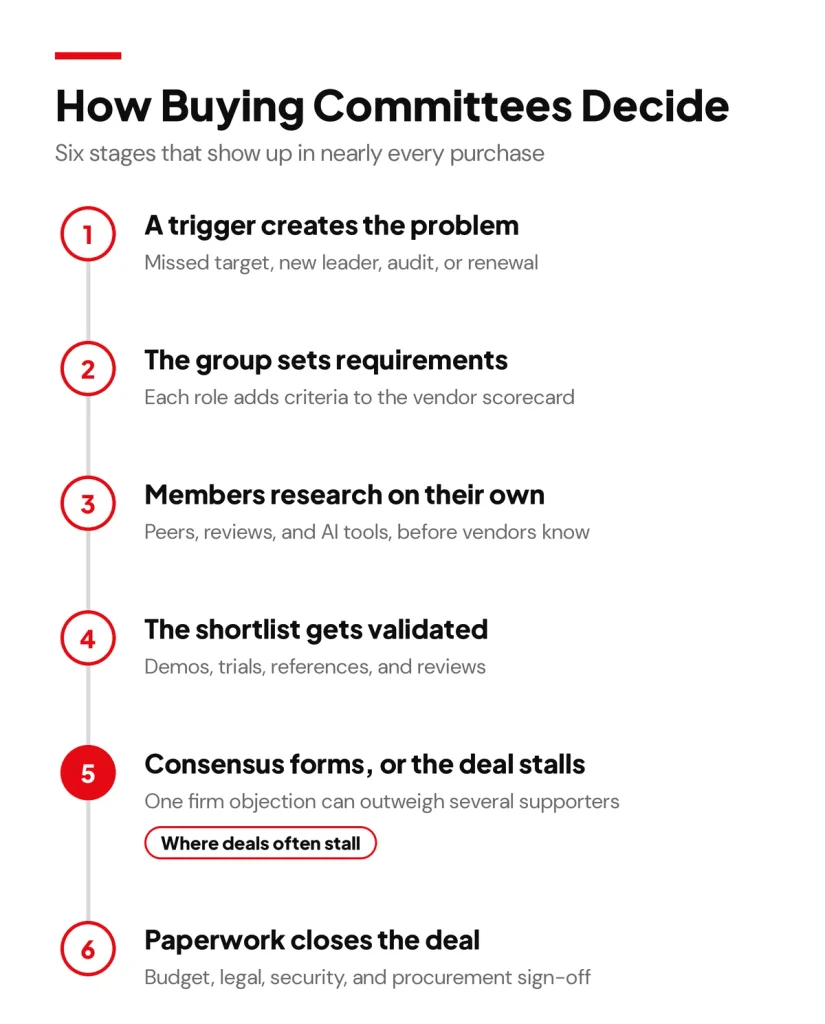
1. A Trigger Creates the Problem
Something forces the issue: a missed target, a new leader, a failed audit, or a contract renewal. The person who feels that pain first often becomes your champion.
2. The Group Sets Requirements
The champion pulls in the people who will be affected. IT wants integration, finance wants budget fit, and security wants data controls.
Requirements set at this stage become the scorecard every vendor gets judged against. Arriving after the scorecard is written puts you at a disadvantage.
3. Members Research on Their Own
Committee members rarely research together. Each one reads, asks peers, and increasingly asks AI tools, often before any vendor hears about the project.
Forrester found that almost 95% of buyers expected to use genAI in their purchase process within a year. That shift is changing how B2B buyers use AI to build shortlists before a seller ever calls.
4. The Shortlist Gets Validated
Members test vendors against their requirements through demos, trials, references, and reviews. Brand familiarity carries real weight here.
Foundry found that 80% of tech decision-makers say the internal sell gets easier when every stakeholder already knows the brand.
5. Consensus Forms, or the Deal Stalls
This is where committees break. Your champion needs a business case that survives questions from people with competing goals. Foundry found 79% of tech buyers work with vendors to build it.
Committees also rarely decide by vote. One firm objection from security or finance can outweigh several quiet supporters.
6. Paperwork Closes the Deal
After a yes in principle, the deal moves through budget approval, legal review, security review, and procurement. Each step adds people and time, and each one can reopen the decision.
Decision-Maker Roles in Enterprise B2B Buying Committees
Job titles vary by company, but these eight roles show up in nearly every enterprise deal. One person can hold more than one role, especially at smaller companies.
| Role | Typical titles | What they decide | How to spot them |
|---|---|---|---|
| Champion | Director or manager who owns the problem | Whether the deal moves forward internally | Introduces you to others and asks for material to share |
| Economic buyer | VP, CFO, or business unit head | Budget and final approval | Approved past purchases of this size |
| Technical evaluator | IT director, architect, or engineering lead | Fit with current systems | Asks integration and security questions in demos |
| End users | Team leads and practitioners | Whether adoption will work | Join trials and demos, rarely contract talks |
| Procurement | Procurement or vendor manager | Terms, pricing structure, and vendor risk | Sends vendor forms and onboarding steps |
| Legal and security | Counsel, CISO, or compliance lead | Contract and data risk | Sends questionnaires and contract redlines |
| Finance | Controller or financial planning lead | Budget timing and cash flow | Asks about payment terms and budget cycles |
| Outside advisors | Consultants, analysts, or peers | Shortlist credibility | Mentioned by your champion as someone they trust |
Watch for the blocker, too. That’s anyone with a reason to keep things as they are, such as the owner of the tool you’d replace.
Blockers rarely announce themselves. Ask your champion directly who might resist the change.
How Roles Expand in Enterprise Deals
Larger deals spread each role across more people. In a mid-market deal, one controller might cover finance and procurement.
An enterprise deal can involve a procurement team, a separate legal team, and a security review board. Map the roles first, then expect several names per role at large accounts.
How to Map a Buying Committee in 7 Steps
Run these steps in order the first time. After that, steps 3, 4, and 7 repeat for as long as the deal stays open.
Step 1: Define the Roles This Deal Needs
Decide which roles a deal like this needs before you research a single name. Pull 10 to 15 recent closed-won deals. List everyone who joined a call, filled out a form, or got copied on the contract.
The roles that repeat become your template. Build two or three templates by deal size:
| Deal type | Roles to map |
|---|---|
| Small add-on or upgrade | Champion, budget owner, one end user |
| Mid-size team purchase | Champion, economic buyer, technical evaluator, end users, procurement |
| Enterprise platform | All of the above, plus finance, legal, security, and outside advisors |
Step 2: Research the Account Before First Contact
Start with what’s public. Company pages, leadership bios, job posts, and press releases will put likely names next to most roles.
Pay extra attention to recent hires in the function you sell to. A new leader often reviews the tools they inherit, and they may sit on the committee without your contact mentioning it.
Engagement shows you who’s already looking. Watch for buying signals like several people from one account visiting your pricing or security pages within a few weeks.
Tag every name from this step as inferred. You haven’t confirmed anything yet.
Step 3: Ask Your Champion to Fill the Gaps
Your champion knows the internal politics better than any database. Use your next discovery call to ask:
- “Who else will weigh in before this gets approved?”
- “Who signed off on the last purchase this size?”
- “Which team would feel this change the most?”
- “Who usually raises concerns about new vendors?”
- “What happens after you say yes, step by step?”
Names your champion gives you move from inferred to told. A name only becomes confirmed when that person tells you their role or concern directly.
Step 4: Record Role, Influence, Stance, and Evidence
Give every person on the map the same six fields. This template works in a CRM or a shared sheet:
| Field | What to record | Options |
|---|---|---|
| Name and title | Who they are | Free text |
| Role | Their part in this purchase | Champion, economic buyer, technical evaluator, end user, procurement, legal or security, finance, outside advisor |
| Influence | How much their view moves the decision | High (can approve or block), medium (shapes it), low (gives input) |
| Stance | Where they stand on your deal | Champion, supporter, neutral, skeptic, blocker, unknown |
| Main concern | The one thing they need answered | Free text, one sentence |
| Evidence | How you know all of the above | Confirmed, told, inferred |
The evidence field is the easiest to skip and the most useful to keep. A guess typed into a CRM looks exactly like a fact, and forecasts get built on both.
Step 5: Map the Approval Path
People are only half the map. The other half is the path the deal travels after the committee says yes.
Write down each approval step, who owns it, and what they need from you:
- Budget sign-off: Find out who approves spend at this size and when their budget cycle resets.
- Security review: Ask whether there’s a questionnaire, who reviews it, and how long it usually takes.
- Legal review: Learn whether they redline vendor paper or insist on their own contract.
- Procurement: Get the vendor onboarding steps, required forms, and any preferred-supplier rules.
If you run a qualification framework like MEDDPICC, this step covers its decision process and paper process, written down with names attached.
Step 6: Plot Influence Against Stance
Now turn the list into a plan. Place every person in one of four boxes:
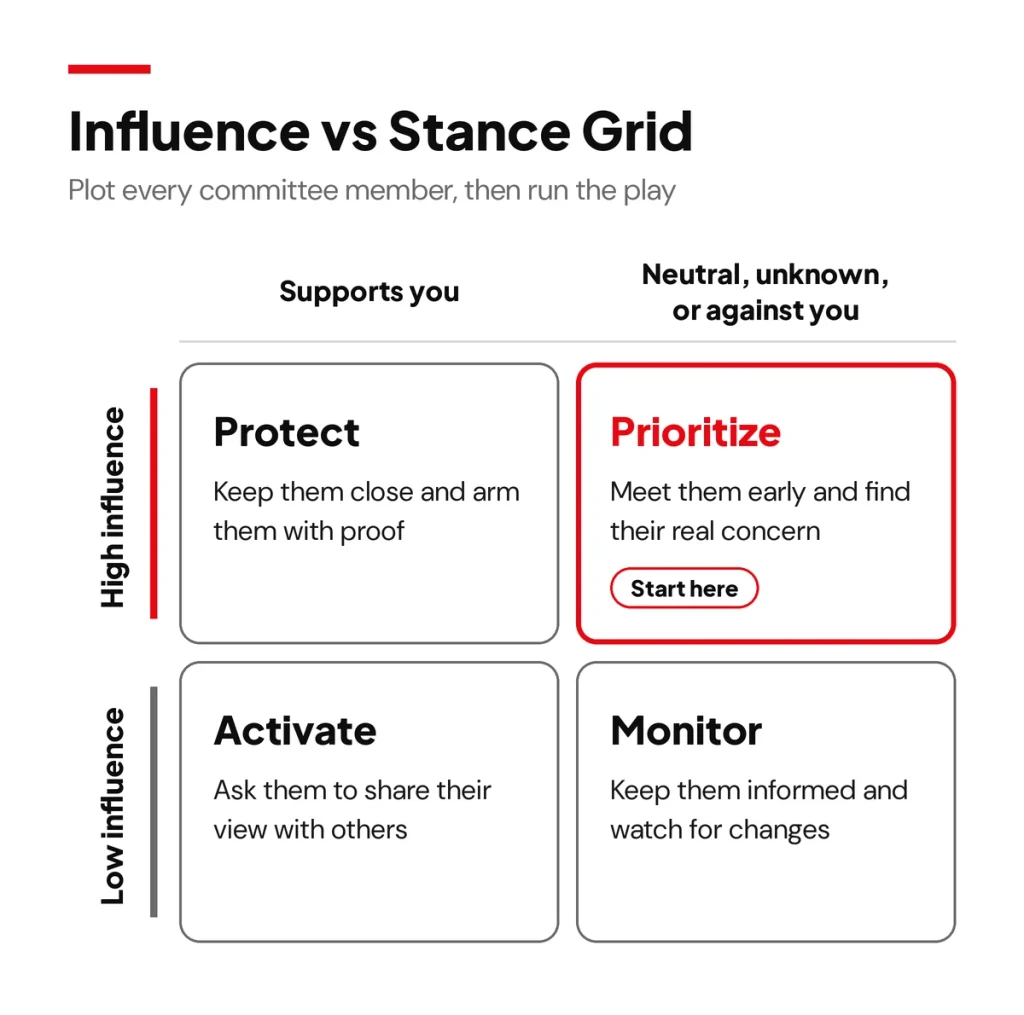
Start with the high-influence box on the right. A powerful skeptic you’ve never met is the single biggest risk on any map.
What to do: For each person in that box, write one sentence on what worries them. Then name who on your side will address it this week.
Step 7: Keep the Map Current
A map is only useful while it’s true. Update it whenever one of these happens:
- The deal moves to a new stage.
- Someone on the committee changes jobs, or a new leader joins.
- The account goes through a re-org or a budget reset.
- A new name shows up on an email thread or meeting invite.
- Two weeks pass with no reply from someone who used to answer fast.
People move faster than you’d think. B2B contact data decays at about 22.5% a year, so a map from last quarter has already drifted.
Buying Committee Map Example
This example is fictional, but the pattern is common. A 600-person logistics company is evaluating an analytics platform, and the rep has worked mostly with one operations manager.
| Person | Role | Influence | Stance | Main concern | Evidence |
|---|---|---|---|---|---|
| Operations manager | Champion | Medium | Champion | Faster weekly reporting | Confirmed |
| VP of operations | Economic buyer | High | Neutral | Payback within a year | Told |
| IT director | Technical evaluator | High | Skeptic | Integration workload for a small team | Inferred |
| Two shift leads | End users | Low | Supporter | Fewer manual spreadsheets | Confirmed |
| Procurement lead | Procurement | Medium | Unknown | Standard terms and vendor risk | Inferred |
| Finance controller | Finance | Medium | Unknown | Spend isn’t budgeted until next quarter | Told |
On paper, the rep has a happy champion and keen users. The map tells a different story.
Only two of the six entries are confirmed. The IT director holds high influence, leans skeptical, and has never spoken to the rep. That seat is the likeliest place for the deal to stall.
What to do: Ask the champion to set up a technical session with the IT director. Send the security pack before procurement asks, then ask the VP of operations whether next quarter’s budget changes the start date.
Buying Committee Marketing
Buying committee marketing means planning campaigns around every role in a purchase instead of single leads. It builds on account-based marketing by adding a people layer to the account list.
Marketing’s job here is reach. Sales can only meet so many people, so marketing builds trust with the rest of the committee.
1. Build Content for Each Role
Finance wants payback math. IT wants architecture details, and end users want proof the tool will save them time.
Foundry found tech buyers download more than eight pieces of content on average during a purchase. One generic asset won’t carry a whole committee.
2. Arm the Champion for the Internal Sell
Your champion presents your case in rooms you’ll never enter. Give them a short business case, a cost-of-waiting summary, and answers to the objections each role is likely to raise.
3. Reach the Roles Sales Hasn’t Met
Use the map to target the roles that are still empty. Role-specific ads, peer proof, and third-party reviews reach people who will never fill out a form.
Intent data helps with timing. It shows which accounts are researching your category right now.
4. Measure the Group Instead of the Lead
Lead scoring counts individuals, so a committee forming at one account looks like several lukewarm leads. Track engagement by account and role instead.
Judge readiness by how many required roles are active. That tells you far more than one lead crossing an MQL threshold.
The Evolution of Buying Committees
B2B buying didn’t become a group activity overnight. The shift happened in stages, and each stage changed how sellers work.
| Era | How B2B buying worked | How sellers responded |
|---|---|---|
| Single decision-maker | One budget holder made most purchase calls | Sold to the person with authority and qualified on budget and timing |
| Buying center | Academic research described several roles behind each purchase | Mapped key roles on large, complex deals |
| Account-based | Marketing targeted whole companies instead of individuals | Built account lists and coordinated sales and marketing |
| Buying group | A dozen or more people across several departments decide together | Shifted to group scoring, role-based content, and multithreading |
| AI-assisted | Members research alone with AI tools before contacting vendors | Started optimizing for visibility in AI answers |
Committees grew for practical reasons. Software now touches more teams, data and security risks pull in more reviewers, and tighter budgets mean more people check the math.
AI is the newest shift. Foundry reports that nearly all IT decision-makers say AI has influenced their purchase process. Each committee member can now research alone, so early visibility with every role matters.
Common Buying Committee Mapping Mistakes
Even a carefully built map can mislead you. Watch for these:
- Copying the org chart. Reporting lines tell you who manages whom, not who shapes this purchase.
- Treating titles as roles. A director with a strong track record can carry more weight than a VP who’s new to the company.
- Skipping the evidence field. Without it, an inferred name and a confirmed one look identical in your forecast.
- Mapping once at kickoff. Committees change mid-deal, and a frozen map hides those changes.
- Keeping it in one rep’s notes. Marketing, sales development, and customer success all need the map to reach the right people.
- Forgetting outside advisors. Consultants and peers at other companies shape shortlists, even though they never sign anything.
FAQs About Buying Committee Mapping
What is a buying committee in B2B sales?
A buying committee is the group of people inside a company who evaluate, influence, and approve a B2B purchase. Members usually come from several departments, including the team that will use the product, finance, IT, legal, and procurement. The committee forms around one purchase and breaks up once the contract is signed.
Who is your buying committee, and why should you care?
Your buying committee is everyone at the customer’s company who can push your deal forward or stop it. That includes people you’ve never spoken to, like finance, security, and procurement. You should care because purchases often stall around these unseen members, and a single contact can’t answer every concern alone.
What is buying committee mapping?
Buying committee mapping is the process of identifying everyone involved in a B2B purchase. You record each person’s role, influence, stance, and main concern. A good map also tracks how each fact was confirmed and which approval steps the deal must pass.
How many people are on a B2B buying committee?
Forrester’s research puts the average at 13 people per buying decision, with most purchases spanning two or more departments. Technology purchases often involve more, and Foundry counts an average of 32 influencers in tech buying. Larger deals tend to involve more stakeholders than smaller ones.
What is the difference between a buying committee map and an org chart?
An org chart shows reporting lines for the whole company. A buying committee map shows only the people involved in one purchase, including outside advisors. It also records each person’s influence, stance, and concerns, which an org chart never captures.
How often should you update a buying committee map?
Update it at every deal stage change and whenever someone on the committee changes jobs. Re-orgs, budget resets, and new names on email threads are also triggers. During an active deal, review the map at least once a month, even if nothing seems to have changed.
What is buying committee marketing?
Buying committee marketing plans campaigns around every role in a purchase rather than single leads. It uses role-based content, champion support, and account-level targeting to reach people sales may never meet. Success is measured by how many required roles are engaged at each account.
Start With Your Biggest Open Deal
Every deal has more people in it than your CRM shows. A buying committee map is where you admit that and plan around it.
The work itself is plain. Names, roles, and a few honest labels about what you know and what you’re guessing.
What to do this week: Pick your largest open deal. Fill in the template, mark every entry’s evidence level, and book one meeting with the highest-influence person you haven’t met yet.