
The Types of ABM Just Changed (Here’s What Actually Counts Now)
TL;DR
- For two decades, ABM had three types: Strategic (1:1), ABM Lite (1:Few), and Programmatic (1:Many). That’s still the model most people teach.
- In 2025, Bev Burgess, the person who coined the term ABM in 2003, updated the framework to five types in her book. The five are Strategic, Scenario, Segment, Programmatic, and Pursuit Marketing.
- The change wasn’t academic. It split the old “1:1” into two real motions and added a deal-specific play that practitioners were already running.
- You don’t pick one and stop. You run a portfolio, matching the type to what each account is worth.
- The biggest mistake isn’t choosing the wrong type. It’s spreading your best accounts too thin and your weak accounts too rich.
If you search “types of ABM,” you’ll get the same three answers on every page: one-to-one, one-to-few, one-to-many. Clean little pyramid, done.
Here’s what those pages won’t tell you. The person who invented account-based marketing quietly rewrote that model, and the three-type pyramid is now out of date.
I’ll walk you through both. The classic three, because you still need to know them, and the five that the field’s actual founder published in 2025. Then I’ll tell you which one to start with, because honestly, that’s the part people get wrong.
Where the Three Types Came From
Quick history, because it matters for what comes next.
Bev Burgess coined the term “account-based marketing” back in 2003 while running the ABM practice at ITSMA. She gave the world the framework everyone still uses: three tiers, sorted by how personalized you get and how many accounts you cover.
Strategic ABM, also called one-to-one, is fully custom work for a tiny handful of your biggest accounts. ABM Lite, or one-to-few, groups a small cluster of similar accounts and lightly personalizes for the group. Programmatic ABM, one-to-many, uses automation to run account-based plays across hundreds of companies at once.
That’s the pyramid. It held up for twenty years. And for most teams, it’s still a perfectly good way to think about the work. But it had a problem that practitioners kept running into.
Why Three Wasn’t Enough Anymore
The trouble was that “one-to-one” was doing too much work.
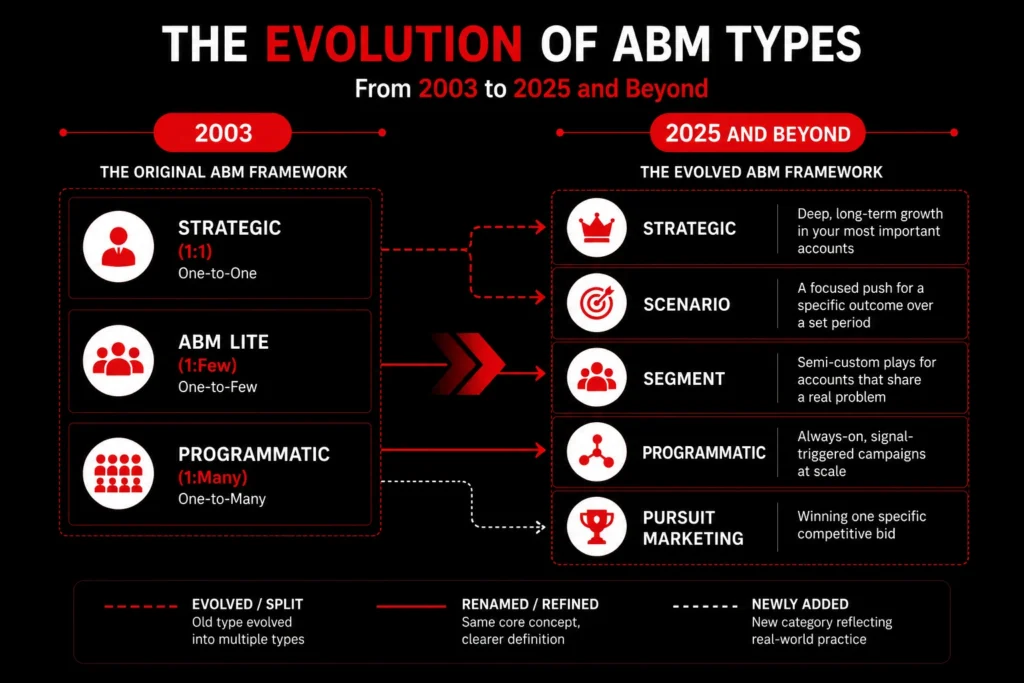
In practice, “fully custom ABM for a single account” turned out to mean two completely different things depending on the situation. Sometimes it meant a years-long, deeply resourced program for a top account, the kind of thing where a marketer is basically embedded in the account team. Other times it meant a sharp, short burst of activity aimed at one specific moment, like winning a renewal or breaking into a stalled deal.
Those aren’t the same motion. One is a marriage. The other is a sprint. Cramming both into “1:1” left teams guessing about how much to invest and for how long.
So when Burgess released her updated book in 2025, Account-Based Marketing: The Definitive Handbook for B2B Marketers, she split the old model into five types that map to how teams actually work today. Philip Kotler, the man most people call the father of modern marketing, wrote the foreword. So this isn’t some random agency reframing the wheel for clicks. It’s the source updating her own framework.
Here are the five.
The 5 Types of ABM in 2026
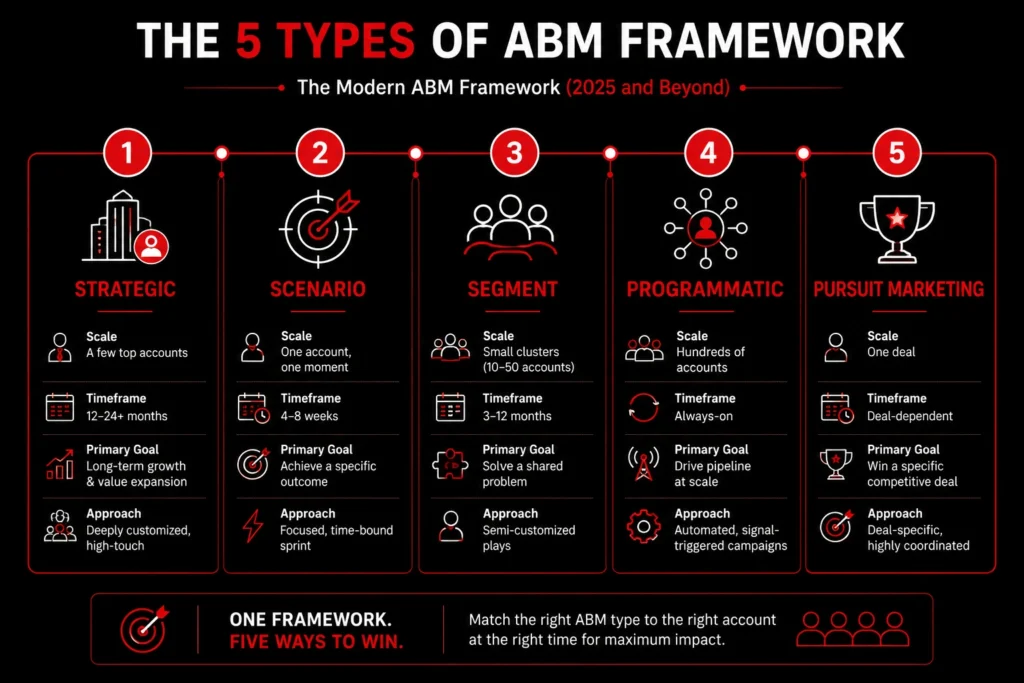
You can understand the 5 types of ABM by looking at the above image or the below table.
| Type | What it replaces | Scale | The job it does |
|---|---|---|---|
| Strategic | The “marriage” half of old 1:1 | A few top accounts | Deep, long-term growth in your most important clients |
| Scenario | The “sprint” half of old 1:1 | One account, one moment | A focused push for a specific outcome over a set period |
| Segment | Old 1:Few / ABM Lite | Small clusters | Semi-custom plays for accounts that share a real problem |
| Programmatic | Old 1:Many | Hundreds | Always-on, signal-triggered campaigns at scale |
| Pursuit Marketing | New, formalized | A single deal | Winning one specific competitive bid |
Notice what happened. The old three didn’t get thrown out. Two of them, 1:Few and 1:Many, just got cleaner names (Segment and Programmatic). The real change is at the top, where the overloaded “1:1” finally split into Strategic and Scenario, and where Pursuit Marketing got named as its own thing.
Let me make each one concrete.
Strategic ABM
This is the original, and it’s still the deep end of the pool.
You take one of your most important accounts and build an entire marketing program around it. Custom research into their business. Content written for their exact situation. Messaging tailored to each person on the buying committee. Burgess describes the people who run these as operating like a “CMO of the account,” and that’s the right mental picture. It’s that involved.
You reserve this for the handful of accounts that move your whole number. ITSMA’s own research pegged the median Strategic ABM program at around 13 accounts, with serious spend behind each one. If a single client represents a chunk of your revenue, your churn risk, and your expansion upside all at once, this is where they belong. Nothing lighter will do them justice.
Scenario ABM
Here’s the new one that makes the framework click.
Scenario ABM is Strategic ABM’s lighter, faster cousin. Same depth of focus on a single account, but aimed at a specific situation over a limited window instead of running forever. You’re not marrying the account. You’re solving one thing.
Think about the moments where this fits. A major renewal is coming up and you want to lock it in. A big account went quiet and you need to re-engage the buying committee. A new decision-maker just joined and you want to land well before a competitor does. Each of those deserves a custom, intense effort, but not a permanent program. That gap is exactly what Scenario ABM fills, and it’s why splitting it out from Strategic was overdue.
Segment ABM
This is the old ABM Lite, and it’s where most teams should actually live.
You take a small cluster of accounts that share something real and build one semi-custom program for the group. The trick is what you cluster on. Lazy clustering groups by industry or company size. Better clustering groups by a shared problem.
Picture a group of ten accounts all running the same competitor’s platform. You build a campaign aimed squarely at that platform’s weak spots and the pain of switching. That lands far harder than a generic “for healthcare companies” play, because everyone in the cluster feels the same specific frustration. You make the assets once, tweak them per account, and you’ve got most of the relevance of custom work at a fraction of the cost. Get your ideal customer profile sharp first, though, or your clusters won’t mean anything.
Programmatic ABM
This is one-to-many, and it’s the type that lives or dies on data.
You run account-based campaigns across hundreds of accounts using automation, with personalization driven by segment rather than by hand. The danger is obvious: spread the peanut butter too thin and it stops being ABM and becomes regular marketing with a target list.
What keeps it honest is signal. At any given moment, only a small slice of your market is actually in a buying cycle. So the smart version of Programmatic ABM doesn’t blast everyone on a calendar. It uses intent data and digital signals to push more budget toward accounts that are heating up and pull back from the ones that aren’t. Strong sales intelligence is what surfaces those signals before your competitors catch them. Done right, one person can run this across a few hundred accounts and keep your sales prospecting team fed with warm targets.
Pursuit Marketing
The fifth type is the most intense, and the rarest.
Pursuit Marketing is built around a single deal, usually a big competitive bid you’re determined to win. Marketing and sales lock arms and pour everything into one named opportunity: content that targets the incumbent’s gaps, proof from companies that already switched, an ROI case built around that specific deal.
You measure it differently, too. Not by engagement or clicks, but by one number: did you win the deal? Teams that run this set a hard timeline and treat it like the sprint it is. You’ll only pull this out for opportunities big enough to justify the effort, where your B2B sales team has real intelligence on the competitor and the buying process. But when the deal is worth it, nothing else focuses a team quite like it.
So Which One Should You Run?
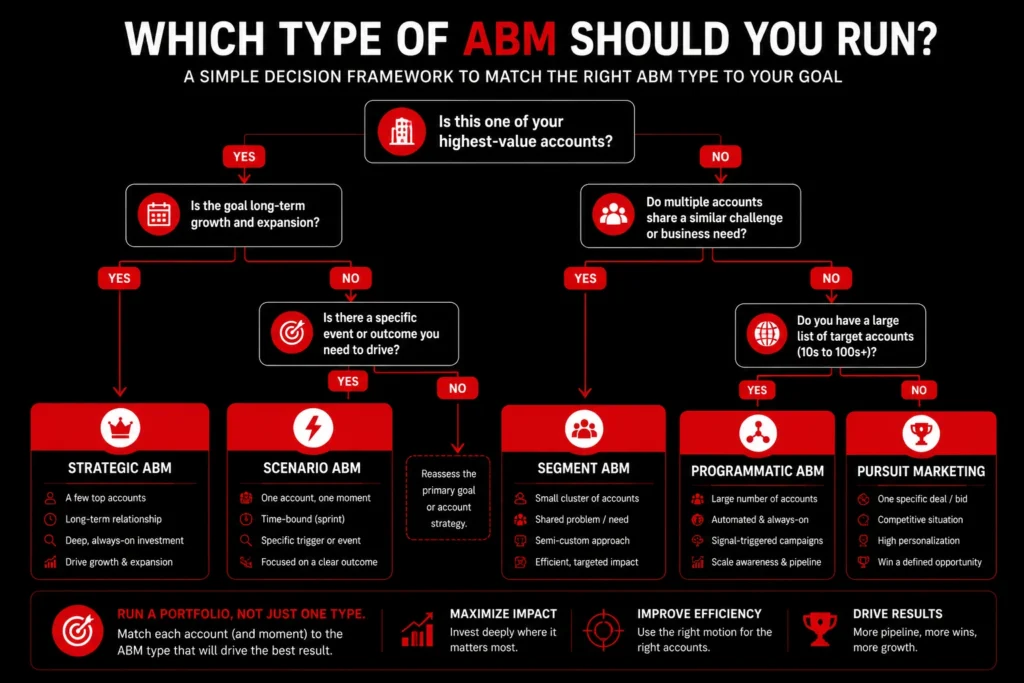
Here’s where I’ll give you the take that the vendor pages won’t.
The type matters less than the match. Almost every failed ABM program I’ve seen didn’t fail because someone chose Segment over Programmatic. It failed because the team spread their best accounts too thin and their weak accounts too rich. They ran expensive custom work on companies that would’ve closed anyway, and cheap automated plays on the whale that needed a CMO of the account.
So forget picking a favorite. Match the type to the account:
- A few accounts that move your whole number? Strategic.
- One of those accounts hitting a key moment, like a renewal? Scenario.
- A cluster of mid-tier accounts with a shared problem? Segment.
- A big list you need to cover efficiently? Programmatic.
- One competitive deal you have to win? Pursuit Marketing.
Burgess calls this a portfolio model, and that’s the right frame. You don’t choose one type. You run several at once, with each account getting the level of investment its potential actually earns. A working setup might be 13 accounts in Strategic, a Scenario push wherever a renewal looms, a handful of Segment clusters, a few hundred in Programmatic, and a Pursuit sprint whenever a deal demands it.
When you’re ready to pick tools for any of these types, the best ABM software breakdown lays out what fits where.
The Trap Underneath All of This
One last thing, because it sinks more programs than any wrong tier ever has.
Whatever type you run, it’s only ABM if sales and marketing actually move together. If your sales team learns an account is “in ABM” only after it fills out a form, you don’t have ABM. You have a list with nicer branding. The whole point, across all five types, is coordination: shared accounts, shared intelligence, a real plan for who says what to whom. Get that right and the type you picked almost picks itself. Get it wrong and no framework on earth will save you.
The Bottom Line
The three-type pyramid isn’t wrong. It’s just no longer complete. The field’s founder updated it to five for a reason: real teams needed to tell a long-term Strategic program apart from a quick Scenario push, and they needed a name for the deal-specific Pursuit plays they were already running.
But don’t lose the forest for the trees. The types are a menu, not a strategy. What actually drives results is matching the right level of investment to the right account, and getting sales and marketing to run as one unit. Nail that, and whichever type you start with will work. Miss it, and none of them will.
Pick the account that matters most. Choose the type that fits it. Start there.
Frequently Asked Questions
How many types of ABM are there?
There are three classic types, Strategic (1:1), ABM Lite (1:Few), and Programmatic (1:Many), which come from the original ITSMA framework. In 2025, ABM founder Bev Burgess updated the model to five types: Strategic, Scenario, Segment, Programmatic, and Pursuit Marketing. The five-type version reflects how teams actually run ABM today.
What is the difference between Strategic and Scenario ABM?
Strategic ABM is a deep, long-running program for one of your most important accounts, often with a dedicated marketer acting as a “CMO of the account.” Scenario ABM applies that same single-account focus to a specific situation over a limited period, like winning a renewal or re-engaging a stalled deal. Strategic is ongoing. Scenario is a focused sprint.
What is Segment ABM?
Segment ABM, previously called ABM Lite or one-to-few, builds a semi-custom program for a small cluster of accounts that share a real characteristic, like the same competitor or the same business problem. You create the assets once and adapt them lightly per account, getting much of the relevance of custom work at lower cost.
What is Pursuit Marketing?
Pursuit Marketing is a type of ABM built around a single competitive deal. Marketing and sales focus everything on winning one specific bid, using custom content, competitive positioning, and a tight timeline. Success is measured by one thing: whether you win the deal.
Do I have to choose just one type of ABM?
No. Bev Burgess describes ABM as a portfolio model. The strongest B2B teams run several types at once, matching the type to each account’s value. A few top accounts get Strategic treatment, mid-tier clusters get Segment, and a broad list gets Programmatic, all running in parallel.
Which type of ABM is best for a small team?
Start with Segment ABM if you have a clear ICP, or Programmatic if you need to cover a large list with limited people. Both give you real ABM discipline without the heavy resource demands of Strategic ABM. Add Strategic and Scenario plays as your team and budget grow.