
How to Get Recommended by ChatGPT: 8 Steps That Work
Learning how to get recommended by ChatGPT is tough.
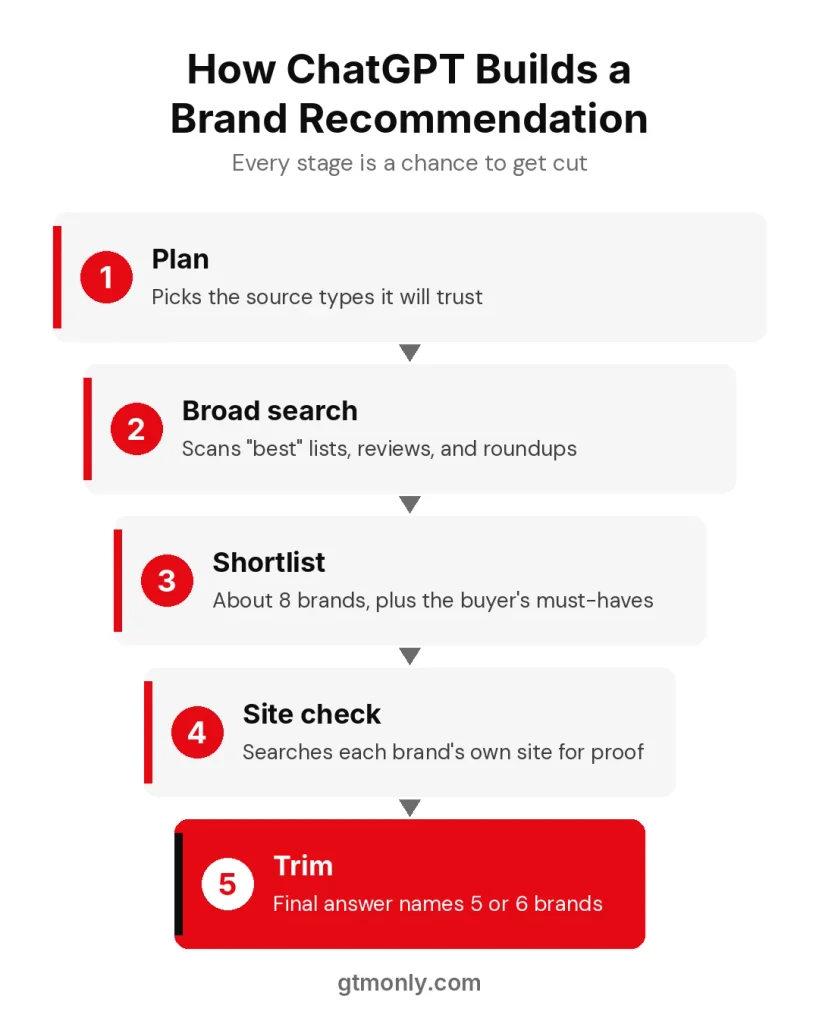
ChatGPT will typically search online and create a shortlist of around eight brands. From here, it will filter based on the key requirements, to leave you with five or six.
The problem occurs if your brand is not on any of the pages ChatGPT has looked at. Or if the must-have criteria cannot be supported by your website. In this case, you will be filtered out of the final recommendations (without knowing why).
This is important to understand. B2B buyers are using AI to create shortlists of vendors long before a salesperson is even involved.
However, all of these issues are within your control. You can simply make changes to overcome this challenge without “gaming the system.”
How Does ChatGPT Decide Which Brands to Recommend?
ChatGPT’s research begins broadly, then becomes more specific. Initial research pulls in a list of top picks and reviews.
Around eight brands are on the shortlist. From here, must-have criteria are added, research is performed on each brand’s website, and five or six recommendations are provided.
An example of this can be seen in a recent study from Seer Interactive. They sent 20 prompts from the buyer’s perspective into the OpenAI API. Then they looked at the reasoning provided in the responses (in other words, ChatGPT’s thought process).
| Stage | Process | Outcome |
|---|---|---|
| 1. Plan | Decides what kind of sources to trust | You should have trusted pages outside your site in this category |
| 2. Broad search | Searches for “best” lists, reviews, and summaries | Brands in consideration depend on third-party lists |
| 3. Shortlist | A shortlist of around eight brands is chosen based on must-have requirements | Vague positioning could keep you off the shortlist |
| 4. Targeted search | Each brand’s site is searched | Key information must be clearly stated on your site |
| 5. Trim | A list of five or six recommendations is made, and the wording is softened | Brands with weaknesses and low trust signals may be removed |
Interesting results came from this study. Before any searches had been carried out, fewer than one in 10 brands had been mentioned. However, after the first round of broad searches, 59% of brands had been mentioned.
In later rounds of searching, 75% of searches were targeted searches. This means that ChatGPT was searching each brand’s individual site. Of the 10 brands that ChatGPT said “might be trimmed,” nine did not make it to the final recommendation.
This demonstrates that the issue is with retrieval. This is great news, as you can make changes to improve it.
Mentioned, Recommended, or Cited: What You’re Aiming For
- Mention: Your brand is included in the answer. This can include indirect mentions, such as “you might also want to consider.”
- Recommendation: ChatGPT suggests the brand would be a good choice for the user’s query. These tend to be within the final five or six options.
- Citation: A source is cited in the answer. This can be either your own page or a review site.
It is possible to achieve one type of result but not the others. In a B2B study by Position Digital, 66% of brand recommendations did not include a citation to the brand’s own page.
Therefore, two out of three times, ChatGPT recommended a brand but cited a page from an external source.
In this article, I will focus on recommendations. If you want to get citations for your own pages, this is more related to answer engine optimization and content structure.
What Signals Get a Brand Recommended by ChatGPT?
The main signal is how often your brand appears on third-party pages that ChatGPT searches, especially “best of” lists for your category. Branded web mentions, Reddit threads, your own website, and your number of reviews also made a difference. In B2B, star ratings showed no positive link at all.
Position Digital looked at how each of these signals correlated with ChatGPT mentions across six software categories:
| Signal | Correlation with ChatGPT mentions |
|---|---|
| Presence on third-party “best of” lists | +0.64 |
| Branded mentions across the web | +0.58 |
| Presence in Reddit threads | +0.57 |
| Brand’s own website cited | +0.46 |
| G2 review count | +0.39 |
| G2 star rating | -0.07 |
Keep in mind this was a small study from a single point in time. I’d use these numbers as a direction to test. Even so, the gap for listicles surprised me.
Brands that appeared on 40% or more of their category’s lists averaged 20.5 ChatGPT mentions and showed up in 47% of answers. Brands that weren’t on any lists averaged only 2.6 mentions and showed up in 6% of answers.
Having lots of mentions in general isn’t enough, either. Two brands in the study had a similar web footprint. The one on 25% of category lists got seven mentions, while the one on 2% got none.
How to Get Recommended by ChatGPT in Eight Steps
Steps one to four optimize internally. Steps five to eight optimize externally.
1. Write the Prompts Your Buyers Type
Find 20 to 30 realistic prompts that users in your ideal customer profile would use. Include the following prompt types:
- Category prompts: “Best [category] for [company type].” This is where the shortlist is formed.
- Problem prompts: A prompt describing a problem (but not mentioning a category). Many people won’t know what the category is called.
- Comparison prompts: “[Competitor] vs [brand]” or “[competitor] alternatives.”
- Constraint prompts: A prompt describing constraints, for example integrations, location, budget, and compliance requirements.
Create a list of prompts for each role in your buying group. Often a CFO will ask a different question than a RevOps lead.
Run each of your prompts three or four times in a temporary chat with search turned on. Note the brands and sources ChatGPT mentions.
What to do: Create a simple spreadsheet to track the prompt, the date, brands mentioned, position in results, and cited sources. You’ll be able to reuse this data in steps five and six.
2. Let ChatGPT’s Search Crawler Into Your Site
In order to be recommended by ChatGPT, your site must be able to be crawled by OAI-SearchBot. Check your robots.txt file, and ensure it is allowed.
If OAI-SearchBot cannot crawl your site, you will not appear in ChatGPT search answers, according to OpenAI’s crawler documentation. Please note that it can take around 24 hours for changes to robots.txt to take effect.
GPTBot is also mentioned in that documentation. This is the bot used by OpenAI to train its models. If you block it, it will not impact whether you appear in search.
Also, make sure that your CDN or firewall isn’t blocking the bots. Even if your robots.txt is correct, AI crawlers may not be able to reach your site due to bot protection settings. This is a cheap fix, so do this first.
3. Put Your Must-Haves on Your Own Site
This is the most important tip to carry out if you can only do one thing this week. In the Seer study, ChatGPT searched individual brand sites to decide whether to keep each brand on the shortlist.
For example, the user might be searching for a tool with CRM integration and SOC 2 compliance. ChatGPT will search for both features on your site.
If it can’t find them, you won’t be included in the final recommendations.
Include the following in clear text on your site:
- Integrations (names, not just logos).
- Security and compliance standards (SOC 2, ISO 27001, GDPR, etc.) and their scope.
- Pricing (or your pricing model, such as “starting from” or “per seat”).
- Who the product is for and not for (one sentence each).
- Supported regions and languages (if buyers filter by them).
In the Seer study, this was the easiest exclusion reason to fix. Ensure this information is in clear text, and not within images, gated PDFs, or tabs that only show it after a click.
4. Use One Category Sentence Everywhere
ChatGPT will look at the category that your business fits into, in order to recommend it. Your homepage, LinkedIn page, and review pages might describe your category differently. If so, ChatGPT may get confused over what category you fit into.
Use the same sentence on all of your channels: “[Brand] is a [category] for [audience], with the main difference being [difference].” Include this sentence on your homepage, About page, LinkedIn page, review pages, directory listings, and press releases.
Although tedious, this will improve your chances of getting featured in ChatGPT answers for category searches.
It also fixes a common problem. You appear when people search for your brand directly, but not when they search for a category.
5. Get Onto the “Best Of” Lists ChatGPT Already Cites
Go back to your prompt sheet. Find all the listicles, comparisons, and roundups that ChatGPT cited. Rank these by how often they appear.
When getting in touch with the authors, make sure you offer something of value. Providing accurate product details, a demo account, examples of how customers have benefited, or raw data will help. Just being polite will not be enough!
Also create comparison and alternatives pages. In the Position Digital study, ChatGPT changed some prompts into searches with “vs,” “comparison,” and “alternatives.”
Be genuine. The Seer study found that ChatGPT may get suspicious of self-promotional pages. Be open about the trade-offs (including those that are negative for you).
What to do: Over time, try to be included in as many “best of” lists in your category as possible. In the B2B data, brands on 10% to 24% of lists averaged almost three times as many mentions as brands on none.
6. Show Up Where Buyers Talk
Both branded mentions and presence on Reddit had a strong correlation with ChatGPT mentions in the B2B data. This makes sense, as buyers trust these sources because they reflect real people.
Comment on the subreddits that your buyers frequent. Be honest, say who you are, and answer the question. Only mention your product if it is relevant.
Other content such as review videos, podcast appearances, and founder content on LinkedIn will also help. This means you can get your brand mentioned in ChatGPT without publishing more content on your own site.
7. Build Review Volume and Fix What Reviews Say
In the B2B study, ChatGPT mentions correlated with the number of reviews, but not with star ratings. Brands with between 50 and 499 reviews appeared in 40% of answers. Brands with no reviews only appeared in 4%.
Try to view your reviews from ChatGPT’s perspective. In the Seer study, brands with a known disadvantage were still included in answers, but with a caveat. However, if this disadvantage was something the buyer specifically wanted to avoid, the brand was excluded.
Fix the issues behind the complaints you receive, and then publish evidence of improvements. This can be release notes, test results, or updated documentation.
What to do: Ask ChatGPT what people dislike about your product. If you’re surprised by the answer, it gives you a great agenda for your next roadmap meeting.
8. Re-Test Monthly and Track Share of Answers
Don’t just take one good result to your manager! The answers change every time. To get a good picture of performance, complete the full list of prompts once a month, running each prompt a few times.
Track these four things:
- Mention rate: how often you are mentioned.
- Position: where in the results you appear (top, middle, or lower).
- Cited sources: which sources ChatGPT cites.
- Accuracy: whether ChatGPT gets your category, price, and features right.
What to do: If you have 20 or fewer prompts, use a spreadsheet. If you have more, using AI visibility tools will save you time.
Why Isn’t ChatGPT Recommending My Brand?
Most likely, it is due to one of five reasons. Either ChatGPT can’t crawl your site, not enough trustworthy sites refer to you, or it is unclear what category you are in.
Alternatively, the must-have features may not be confirmed on your site. Or a known disadvantage may match exactly what the buyer wants to avoid.
| Symptom | Likely cause | Fix |
|---|---|---|
| Missing from every answer, even when asked by name | Crawler is blocked, or the brand is too new and has little coverage | Allow OAI-SearchBot, then build third-party mentions |
| Named when asked directly, but missing on category prompts | Weak link between your brand and the category | Use one category sentence everywhere and win list placements |
| Appears in some runs, then drops out | Sitting near the bottom of the shortlist | Get onto more lists and confirm must-haves on your site |
| Named with a caveat or a warning | A known weakness repeated in reviews or threads | Fix it, then publish proof |
| Wrong category or outdated details | Different descriptions across the web | Use the same facts on every profile and listing |
A good place to start is the branded versus category test. Ask ChatGPT about your brand by name, then try a category prompt you should be winning. The difference between the two answers shows you which row of the table applies to you.
What Doesn’t Work (and Why People Keep Trying It)
These tactics might seem like a good idea, but none of them will get you recommended.
- Asking ChatGPT to remember your brand. Memory is tied to your own account, so it won’t carry over to anyone else’s chat.
- Paying for ads. OpenAI says ads run on separate systems from the chat model and can’t influence answers. Ads appear below the answer and are labeled as sponsored.
- Looking for a way to submit your brand. ChatGPT has no submission form for its organic answers. If someone offers to sell you “ChatGPT registration,” don’t buy it.
- Publishing lots of AI-written pages about yourself. According to Seer, ChatGPT tends to discount self-published, programmatic content. Fifty thin pages won’t beat one trusted list.
- Judging your progress from one screenshot. A good answer today might disappear the next time you run the prompt. Look at the trend over many runs instead.
What I’d Do First
If I only had one week, I’d focus on three things. First, make sure OAI-SearchBot can reach your site. Then put every must-have fact in plain text, run 20 buyer prompts, and save every source ChatGPT cites.
Everything after this takes more time, including list placements, reviews, Reddit threads, and the odd podcast. It’s generative engine optimization applied to one platform, and it rewards the same things good marketing always has.
I find that reassuring. You can’t pay your way into the answer, and shortcuts don’t last.
In the end, learning how to get recommended by ChatGPT means becoming the brand other people already call the right choice.
Frequently Asked Questions
Can you pay to be recommended by ChatGPT?
No. OpenAI says ads run on separate systems from the chat model, so advertisers can’t shape, rank, or change ChatGPT’s answers. Ads are shown as labeled sponsored placements, and organic recommendations are based on what ChatGPT trusts across the web.
How do I get my business listed on ChatGPT?
There’s no form to get listed in ChatGPT’s organic answers. Your business gets included when ChatGPT finds it on pages it trusts, like roundups, review sites, community threads, and your website. Allow OAI-SearchBot, describe your category clearly, and work on getting onto the lists ChatGPT already cites.
How long does it take to get recommended by ChatGPT?
Crawler fixes can start working in about a day, since OpenAI says robots.txt changes take around 24 hours. Getting onto lists and building reviews and mentions takes longer, usually weeks to months. Test your prompts every month to see which changes are improving your mention rate.
Does ChatGPT recommend the same brands to everyone?
No. Answers change between runs, and things like memory and past chats can affect what each person sees. Run each prompt several times in a temporary chat and track how often you appear overall.
Does ranking on Google help you get recommended by ChatGPT?
Yes, to some extent. In one B2B study, 58% of pages in Google’s top 10 were also cited by ChatGPT. Ranking well makes your pages easier to find, but recommendations rely more on third-party lists, mentions, and reviews.