What Is Demand Generation? B2B Teams Are Doing It Wrong
TL;DR
- Demand generation is the process of creating awareness and buying intent among your target market, long before they’re ready to talk to sales.
- It’s not lead generation with a fancier name. Lead gen captures interest that already exists. Demand gen creates interest that doesn’t exist yet.
- At any given moment, only 5% of your B2B market is actively looking to buy. Demand gen is built for the other 95%, according to research from The B2B Institute.
- The teams winning in 2026 build pipeline from future buyers. The teams losing fight over the same in-market 5% as every competitor they have.
- Demand gen is measured by pipeline influence, branded search growth, and content engagement, not cost per form fill.
Most B2B marketing teams spend the majority of their budget chasing buyers who are already ready to buy.
That’s demand capture. It’s not demand generation. And it’s why pipeline feels inconsistent, revenue forecasts miss, and sales keeps asking why the leads marketing sends don’t close.
Demand generation is what happens before the demo request, before the form fill, and before the prospect even knows they have a problem you can solve. This guide explains what it actually is, how it differs from lead generation, and what a real demand gen program looks like in 2026.
What Is Demand Generation?
Demand generation is the process of building awareness, trust, and buying intent in your target market before prospects are ready to engage with sales.
It covers every touchpoint a potential buyer has with your brand from first discovery to pipeline entry. A blog post they read while solving an unrelated problem. A LinkedIn video that made them think differently about a challenge they’ve been ignoring. A podcast episode where your founder named a pain point they recognized but couldn’t articulate.
None of those moments produce a form fill or a sales qualified lead. But they build the mental shortlist that determines which vendor gets the demo request six months later.
Demand generation is the long game in B2B revenue. It creates the market awareness and credibility that makes every downstream marketing and sales activity work better and close faster.
It sits at the heart of every well-built go-to-market strategy and makes everything downstream, from sales outreach to paid campaigns, more effective.
Here is a number worth sitting with. According to research from Bain and Co., 80 to 90% of B2B buyers have a set of preferred vendors in mind before they begin any formal research. And 90% of them will ultimately choose a vendor from that day-one shortlist.
You can’t earn a spot on that list with a paid ad the week before a buyer enters the market. You earn it through consistent, credible presence over months. That is demand generation.
Demand Generation vs Lead Generation: What’s the Real Difference?
This is the most confused distinction in B2B marketing. Both terms appear in the same conversations, the same job descriptions, and the same board decks. That confusion is expensive.
| Demand Generation | Lead Generation | |
| Goal | Create awareness and buying intent in the market | Capture and convert existing interest into leads |
| Funnel stage | Top of funnel, pre-awareness to early consideration | Middle to bottom of funnel |
| Audience | Everyone in your ICP, whether in market or not | Prospects actively researching or evaluating solutions |
| Content type | Ungated blogs, videos, podcasts, thought leadership | Gated assets, demo requests, free trials, forms |
| Primary metric | Branded search growth, pipeline influence, engagement | MQLs, SQLs, cost per lead, conversion rate |
| Timeline | Months to compound; years to dominate | Results visible in days to weeks |
The practical way to think about it: demand generation creates the want. Lead generation converts the want into a contact in your CRM.
The sales funnel is where that conversion journey plays out, stage by stage, from first awareness to closed deal.
The mistake most B2B teams make is running lead gen tactics without a demand gen foundation. That’s trying to harvest a crop you never planted. You get some yield from buyers already in market, but you never build the pipeline depth that makes revenue predictable quarter over quarter.
The 95/5 Rule: Why Most B2B Marketing Misses the Point
This is the most important data point in demand generation strategy, and most marketing teams build their programs as if it doesn’t exist.
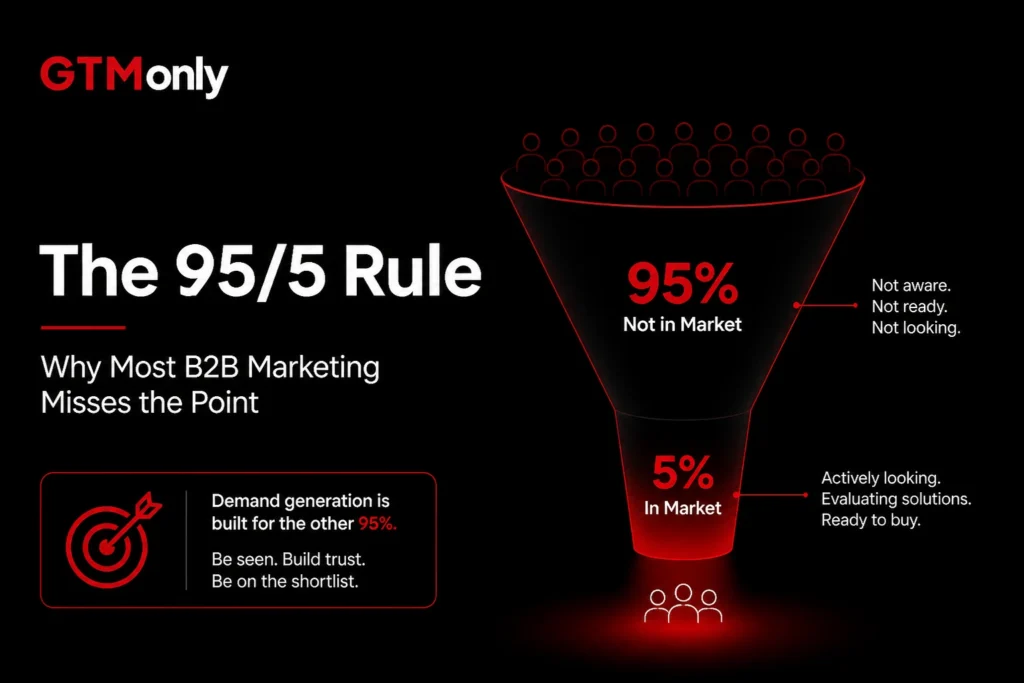
At any given moment, only about 5% of your total addressable market is actively looking for a solution like yours right now. The other 95% either aren’t aware they have the problem, aren’t in a buying cycle, or are locked into existing contracts for the next 18 months.
Most B2B marketing programs are built to capture that 5%. Everyone targets the same high-intent keywords. Everyone runs retargeting campaigns against the same in-market buyers. Everyone offers a demo to prospects who raised their hand this week.
So costs go up, conversion rates go down, and pipeline swings wildly depending on whether you happened to catch the right buyers that month.
It’s one of the fundamental challenges of B2B sales today, and it’s exactly what demand generation is designed to solve.
Demand generation is built for the other 95%.
When you build content that educates, builds trust, and keeps your brand consistently visible to future buyers, you aren’t trying to convert them today. You’re making sure that when they eventually move into that 5% buying window, your brand is already on their shortlist.
The teams that get this right don’t have a pipeline problem. They have a pipeline depth problem because they’re choosing which deals to prioritize, not scrambling to fill the funnel.
The Three Types of Demand (What Most B2B Articles Never Cover)
Not all demand is the same. This matters because the type of demand you’re working with determines which channels work, what content resonates, and how long it takes to see results.
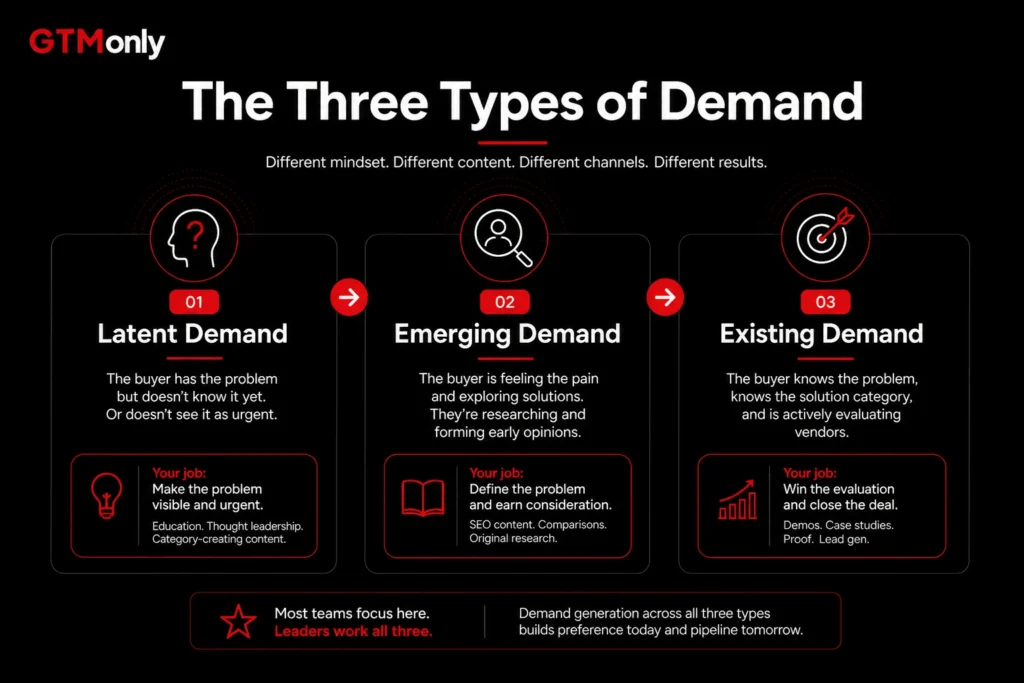
Latent Demand
The buyer has the problem but doesn’t know it yet, or doesn’t see it as urgent enough to act on. They’re running the broken process, living with the limitation, or paying the hidden cost, and they’ve accepted it as normal.
Your job here is to make the problem visible and urgent. Educational content, thought leadership, and category-creating messaging do this work. You’re not selling yet. You’re naming a pain the buyer already feels but hasn’t prioritized.
Emerging Demand
The buyer is starting to feel the pain and has loosely recognized that a solution category exists. They’re searching, reading, and forming early opinions about which vendors seem credible.
Content that defines the problem sharply and positions you as the expert earns a spot on their consideration list. This is where SEO-driven content, comparison articles, and original research compound. They find you, not the other way around.
Existing Demand
The buyer knows the problem, knows the solution category, and is actively evaluating vendors. They’re requesting demos, comparing pricing pages, and talking to references.
This is where lead gen tactics pay off. But it’s important to know: if you only invest here, you’re competing on the same terms as every other vendor chasing the same in-market buyers. Demand gen gives you an unfair advantage at this stage because buyers already know who you are.
Most B2B teams put 80% of their effort into existing demand. The ones that build durable pipeline leadership work all three types at the same time.
The Dark Funnel: Where Demand Generation Actually Happens
Here is an uncomfortable truth about B2B marketing measurement.
Most of the moments that actually shape a buying decision are not tracked anywhere in your CRM or marketing automation platform.
A buyer reads your blog post at 10pm and doesn’t click anything. They mention your brand in a Slack thread with their team. They watch a LinkedIn video during a commute and don’t comment. They see your CEO’s name come up in a Reddit discussion about the problem category. A colleague recommends you in a private message.
None of that shows up as a trackable touchpoint. This is the dark funnel, and it’s where the majority of demand generation influence actually lives.
The practical implication is structural. If you measure your demand gen program with the same cost-per-lead logic you use for a paid search campaign, you will always underinvest in it. The ROI looks invisible because you’re measuring it with the wrong instrument.
The right proxy metrics are branded search volume growth over time, direct traffic increases, and pipeline influence. Pipeline influence tracks deals where the contact engaged with your demand gen content at some point before entering the pipeline. It’s not perfect attribution, but it’s honest.
Teams that demand perfect attribution from demand gen programs defund them before they compound. That’s how competitors earn the shortlist while you’re still debating the spreadsheet.
Core Demand Generation Channels for B2B Teams
The right channels depend on your ICP’s behavior and your team’s strengths. That said, the following channels consistently show up in the highest-performing B2B demand gen programs in 2026.
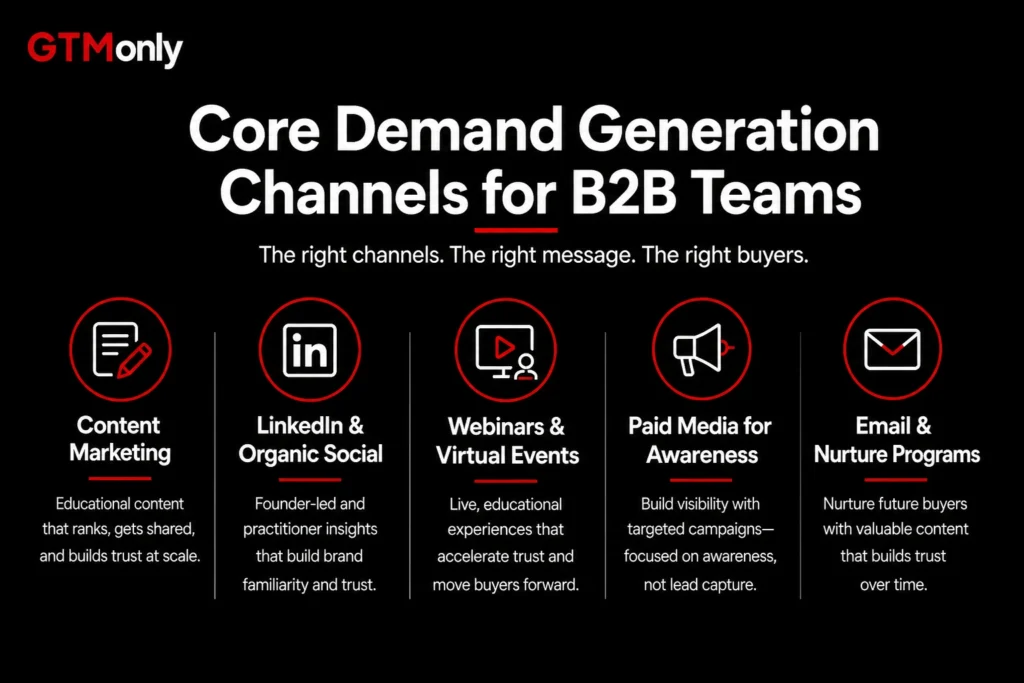
Content Marketing
This is the backbone of most B2B demand gen programs. Long-form educational content that ranks in search, gets shared in communities, and gets cited by AI tools when buyers ask questions about your problem space.
The goal is not lead capture. The goal is becoming the trusted resource buyers think of first when the pain becomes urgent. Content Marketing Institute reports that 83% of B2B teams use content marketing as their primary demand gen channel. The ones winning use it to answer questions their buyers are genuinely asking, not to produce keyword-stuffed filler nobody reads past the second paragraph.
LinkedIn and Organic Social
LinkedIn is the highest-signal B2B demand gen channel available right now. Founder-led content and practitioner insights consistently outperform branded company content because people trust people, not logos.
Your ICP is scrolling LinkedIn every morning. The question is whether the content they see is yours or your competitor’s. A consistent posting cadence from your founders and team members, focused on real insights and honest takes, builds brand familiarity at scale without a paid budget.
Webinars and Virtual Events
72% of B2B marketers report that prospects close faster after attending a webinar. Events create a focused live moment that no other channel replicates.
The best demand gen webinars are education-led, not product-led. They teach something genuinely useful to your ICP. The product mention comes last, if at all. When you teach first and sell second, you attract the buyers worth having.
Paid Media for Awareness, Not Lead Capture
Paid media in demand gen serves a different purpose than in lead gen. The goal is brand visibility, not form fills. LinkedIn Thought Leader Ads, YouTube content retargeting, and display campaigns against in-market audiences all build presence without asking for anything in return.
This is a hard shift for teams used to measuring paid channels by cost per lead. Awareness-focused paid media shows up in branded search growth and pipeline influence, not in the lead count column. Accept that before you run it, or the program will be cancelled after six weeks.
If you’re still building your demand gen tech stack, the go-to-market tools guide covers the most-used platforms by channel and funnel stage.
Why Gating Your Content Is Quietly Killing Your Demand Gen
The dominant B2B content model for the past decade has been: create valuable content, put it behind a form, and count the form fills as leads.
Modern B2B buyers know exactly what a gated asset is. They have a throwaway email address ready for it. They download the PDF, never open the email sequence, and never hear from you again. Your MQL count looks respectable. Your pipeline doesn’t reflect it.
The shift happening right now is called ungating. B2B companies like Cognism, Refine Labs, and Metadata moved major content assets to free access because they found that ungated content creates more pipeline influence, more qualified inbound, and stronger brand recognition than gated content ever produced.
The logic is counterintuitive but solid. When your best content is freely available, it spreads. It gets shared. It gets cited. It builds credibility before a sales conversation ever happens. You lose the form fill. You gain the brand familiarity that makes closing faster and easier.
Gating every piece of content is a lead gen reflex. Ungating your best thinking is a demand gen commitment. Know which game you’re playing before you decide what goes behind a form.
How to Measure Demand Generation the Right Way
Demand gen doesn’t map cleanly to a cost-per-lead report. That gap is what causes most organizations to underfund it relative to its actual contribution to pipeline and revenue.
| Metric | What It Measures | Why It Matters |
| Branded search volume | Month-over-month growth in branded keyword searches | The clearest signal that demand gen is building recognition |
| Pipeline influence | Deals where a contact engaged with demand gen content before entering pipeline | Shows actual revenue contribution without requiring perfect attribution |
| Direct traffic growth | Visitors who type your URL directly or arrive with no tracked source | Strong proxy for brand awareness that isn’t captured by referral or paid |
| Content engagement rate | Time on page, scroll depth, shares, saves across demand gen content | Shows whether content resonates with the audience you’re trying to reach |
| Share of voice | Your brand mentions vs. competitor mentions in target communities | Tracks whether your brand is part of the conversations buyers are having |
| Sales cycle velocity | Average days from SQL to closed-won over time | When demand gen works, buyers already know you, which shortens close times |
The most important measurement shift: move from activity metrics to influence metrics. Counting blog posts published tells you how busy the team is. Counting pipeline from contacts who read those posts tells you whether it’s working.
How AI Is Changing Demand Generation in 2026
AI hasn’t replaced demand generation. It has fundamentally changed what’s possible for B2B teams that don’t have large headcounts or large budgets.
Intent data platforms like 6sense, Bombora, and Apollo can now identify accounts showing buying signals before they ever visit your website. That tells you which segment of the 95% is starting to move toward the in-market buying window so you can concentrate the right content and outreach at the right moment.
Teams pairing intent data with AI lead generation tools are finding and qualifying pipeline before competitors even know the buyer is in market.
AI also enables content personalization at a scale that was not possible three years ago. Different messaging for different industries, different personas, and different problem awareness stages, all running from the same core content program without needing a full editorial team to manage it.
The risk is straightforward. Using AI to produce more content faster without improving quality is a trap. The 2026 B2B content environment is more competitive than it has ever been. Buyers are more skeptical, search is more crowded, and LLMs answer basic questions before a buyer clicks any link. Volume doesn’t help if the content doesn’t stand out. AI amplifies a strong point of view. It doesn’t create one.
For a full breakdown of how AI is changing B2B revenue motions across every GTM function, see the guide to AI in GTM.
How Long Does Demand Generation Actually Take to Show Results?
This is the question every team asks and almost nobody in the industry answers honestly. So here it is.
Expect 6 to 12 months before demand gen content starts producing measurable pipeline influence. Organic content compounds slowly. Branded search grows gradually. Community presence builds on reputation accumulated over dozens of interactions, not one campaign.
The teams that cancel their demand gen programs after one quarter and pivot back to paid lead gen are making a rational short-term decision that creates a structural long-term problem. You’ll always be buying pipeline. You’ll never build one.
The honest framing: demand gen is an investment with a delayed and compounding return. Lead gen is an expense with an immediate and linear return. You need both running in parallel. Use lead gen to hit this quarter’s number. Use demand gen to make next year’s number easier to hit.
The teams that figure this out early build a compound advantage that’s genuinely hard to replicate. Their brand is on every shortlist. Their content ranks for every relevant question. Their pipeline is full of buyers who already know and trust them before the first call.
Conclusion
Demand generation is not a campaign. It’s not a quarter’s budget. It’s not a fancier name for lead generation.
It’s the discipline of being present, credible, and useful to buyers who aren’t ready for you yet. So that when they are ready, you’re already the obvious choice and the only brand they want to call.
Most B2B teams figure this out the hard way, after a few quarters of flat pipeline and a lot of finger-pointing between marketing and sales. The ones that get it right from the start build a durable competitive position that paid media alone can never replicate.
Start from scratch on your demand gen foundation with the most important decision you’ll make: your ideal customer profile. Every demand gen decision, from which channels to run to what problems to write about to which communities to show up in, flows directly from knowing exactly who you’re trying to reach and what they care about.
Frequently Asked Questions
What is demand generation in simple terms?
Demand generation is the process of making potential buyers aware that they have a problem and that your product can solve it, before they’re ready to buy. It’s everything your business does to create interest, build trust, and stay visible in your target market over time. The goal is not to get a form fill today. The goal is to be the brand buyers already know and trust when they eventually enter the market.
What does a demand generation team actually do day to day?
A demand gen team manages the programs that keep your brand visible and credible to your target market over time. Day-to-day this includes producing and distributing content, running LinkedIn and paid awareness campaigns, managing webinars, tracking branded search and pipeline influence metrics, coordinating with sales on which content is resonating with buyers, and building the ICP-specific messaging that underlies all campaigns. Demand gen sits closest to marketing but works closely with sales on feedback loops between content and pipeline.
How do you measure demand generation ROI when attribution is so difficult?
The most reliable demand gen metrics are branded search volume growth, pipeline influence (deals where a contact engaged with demand gen content before becoming a lead), direct traffic growth, and sales cycle velocity. These metrics are not perfect attribution, but they’re honest proxies for whether demand gen is working. Teams that try to measure demand gen with cost-per-lead logic consistently underinvest in it because the ROI appears invisible. Shift your reporting to influence-based metrics and the investment case becomes much clearer.
How long does it take for demand generation to show results?
Realistically, 6 to 12 months before demand gen content produces measurable pipeline influence. Branded search growth is visible in 3 to 6 months with consistent publishing. Organic content takes longer to compound because it depends on domain authority, backlinks, and search algorithm recognition. The teams that cancel demand gen programs after one quarter and return to pure lead gen make a rational short-term decision that creates a structural long-term problem. The right model runs demand gen and lead gen in parallel from day one.
What is the 95/5 rule and why does it matter for demand generation?
The 95/5 rule, developed from research by The B2B Institute, states that at any given moment only about 5% of your total addressable market is actively in a buying cycle for a solution like yours. The remaining 95% are not in market right now. Most B2B marketing programs are built to capture that active 5%, which means every competitor is targeting the same small pool of buyers simultaneously. Demand generation is the strategy for building brand visibility and trust with the other 95% so that when they eventually enter the market, you’re already on their shortlist before the first touchpoint.