What Is a Go-to-Market Strategy? (And How to Build One)
TL;DR
- A go-to-market strategy is the plan between your product and your first real customers. It covers who you’re selling to, why they should buy, how you’ll reach them, and how you’ll close.
- Five core components: ICP, value proposition, pricing model, sales motion, and distribution channels. Miss one and the whole motion breaks.
- The most important decision in any GTM plan is which motion to run: product-led, sales-led, or marketing-led. Most guides skip the actual framework for choosing. We don’t.
- Most GTM strategies fail not because of bad execution. They fail because of the wrong assumptions built in before a single prospect is contacted.
- Treat your GTM strategy as a live document. Review it every quarter. The first version is never the right version.
“We spent eight months building the product. We spent about two days on the go-to-market strategy. Then we wondered why nothing was selling.”
That’s from a conversation with a Series A founder. Their product was genuinely good. Their GTM was a guess dressed up as a plan.
Most companies treat go-to-market as a launch checklist. Ship the product, write some positioning, run some ads, and hope the pipeline follows. When it doesn’t, they blame the product.
This guide is for teams who want to get it right before they go to market. Not after.
What Is a Go-to-Market Strategy?
A go-to-market (GTM) strategy is a plan for how a company brings a specific product to a specific market. It defines who the ideal customer is, what problem the product solves for them, how the company will reach them, and how it will convert their interest into revenue.
That’s the clean definition. Here’s the practical one.
Your GTM strategy is what tells your B2B sales team who to call. It tells your marketing team what to say. It tells your pricing team what signal to send to the market. Without it, every team does their own thing and points fingers when the revenue miss lands.
A strong GTM strategy answers six questions consistently across your whole organization:
- Who is your ideal customer? Not ‘B2B companies.’ Not ‘anyone who could use this.’ A specific, data-backed profile.
- What exact problem do they have? The one they’re losing sleep over, not the one you assumed they had.
- Why should they choose you over what they’re using now? Your actual competitor, not a generic market comparison.
- How will you reach them? Not ‘social media and outbound.’ Specific channels that match how your ICP actually buys.
- How will you convert interest into a signed contract? Self-serve, sales-led, or something in between.
- How will you measure whether it’s working? The three to five metrics that tell you the motion is healthy or broken.
When every person in your go-to-market organization can answer all six questions the same way, you have a real strategy. When they give different answers, you have an expensive alignment problem.
GTM Strategy vs. Marketing Strategy: They Are Not the Same Thing
This distinction costs companies real money when they miss it, so let’s be clear.
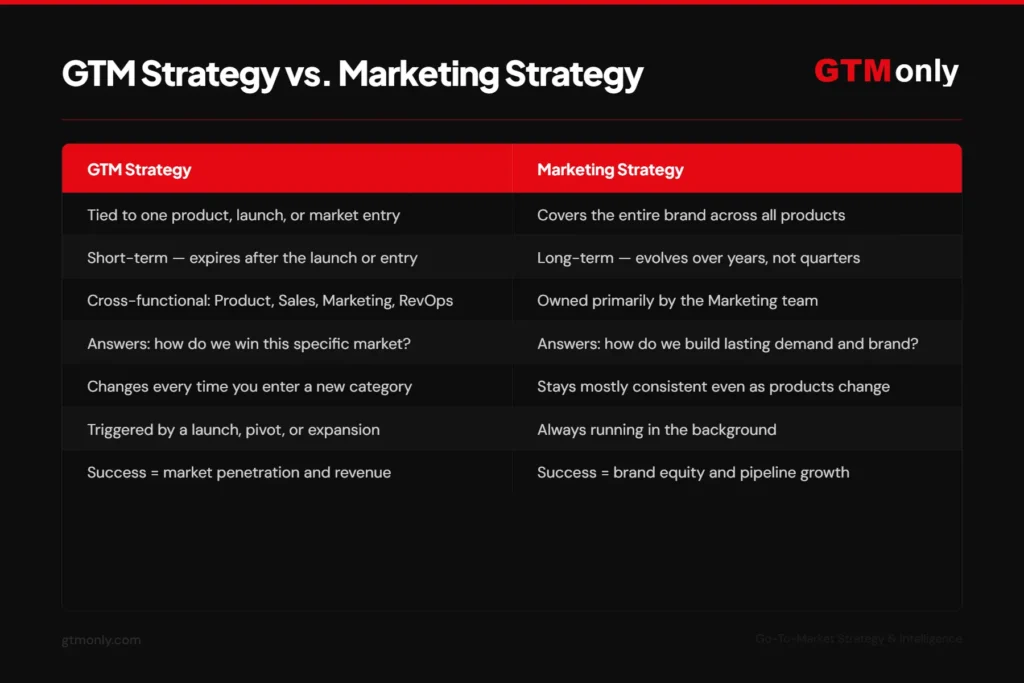
A marketing strategy is long-term. It covers brand building, demand generation, content, and audience growth. None of that is tied to a single product launch. HubSpot has had roughly the same marketing strategy for a decade. Their GTM strategy changes every time they enter a new category.
A GTM strategy is specific. It’s built for one product, one launch, or one market entry. When Slack launched in 2013, they had a clear GTM strategy: get the product into small teams through word of mouth, then convert to paid as those teams grew. That strategy expired. Their marketing strategy evolved alongside it.
The practical difference is ownership. Your marketing team owns the marketing strategy. Your GTM strategy is cross-functional. Product, Sales, Marketing, and RevOps all have a stake in it. If only one team owns the GTM strategy, it will serve only that team.
Why Most GTM Strategies Fail Before the Product Ships
Let me be direct about this.
Most GTM strategies fail not because of bad execution. They fail because of bad assumptions baked in before execution even starts. Here’s what we see when we audit a struggling GTM motion.
The ICP is built on aspiration, not data
A founder builds the ICP around the Fortune 500 logo they want on their case study page. The product actually solves a problem for 150-person SaaS companies. Everything downstream, including the sales pitch, the pricing, the channel mix, and the content strategy, gets built for the wrong buyer.
The discovery that the ICP is wrong usually happens around month six. By then, the team has hired for the wrong motion, produced content for the wrong audience, and burned pipeline budget on the wrong accounts.
The value prop is written for the product team
“AI-powered, end-to-end pipeline visibility” sounds impressive in a board deck. A VP of Sales hears “another thing I have to get my team to adopt.” The real value prop addresses their actual fear, which is usually something closer to: “We’ll show you which deals are quietly going off the rails before your CRM does.”
Good value props are written from the buyer’s perspective. Most value props are written from the builder’s perspective. That gap shows up immediately in conversion rates.
Pricing contradicts the sales motion
A company running a product-led growth motion prices at $40,000 annual contracts. Sales can’t close enterprise deals without heavy human touch. Product can’t drive self-serve adoption at that price. The motion stalls at conversion and the team blames both the product and the sales team. The real problem is a mismatch between the pricing model and the intended motion.
Sales and marketing are running different plays
Marketing is nurturing mid-market leads with educational content. Sales is calling enterprise accounts with a pitch that doesn’t match the nurture sequence. Neither team is generating the pipeline the other expects. The QBR turns into a blame session.
These are not execution problems. They’re strategy problems. Hiring another SDR doesn’t fix a strategy problem.
Not Using AI Where It Actually Changes the Outcome
Most GTM teams are either ignoring AI completely or using it for the wrong things.
They use it to write subject lines. They don’t use it to identify which accounts are in an active buying cycle right now, before a competitor does.
Using AI in GTM is not a productivity hack. When used correctly, it changes which accounts you target, when you reach out, and how you qualify pipeline. Teams still running manual prospecting processes in 2026 are starting every quarter behind.
Relying on Manual Lead Generation at Scale
Outbound built on spreadsheets and gut feel has a ceiling. Most GTM teams hit it around month four and mistake it for a market problem.
AI lead generation has changed what’s possible for B2B teams without large SDR headcounts. Intent signals, technographic filters, and automated enrichment mean you can build a targeted pipeline of accounts that are actively researching solutions like yours, without cold-calling a list of 500 people who have never heard of you.
The teams not using this are not just slower. They’re handing pipeline to competitors who are.
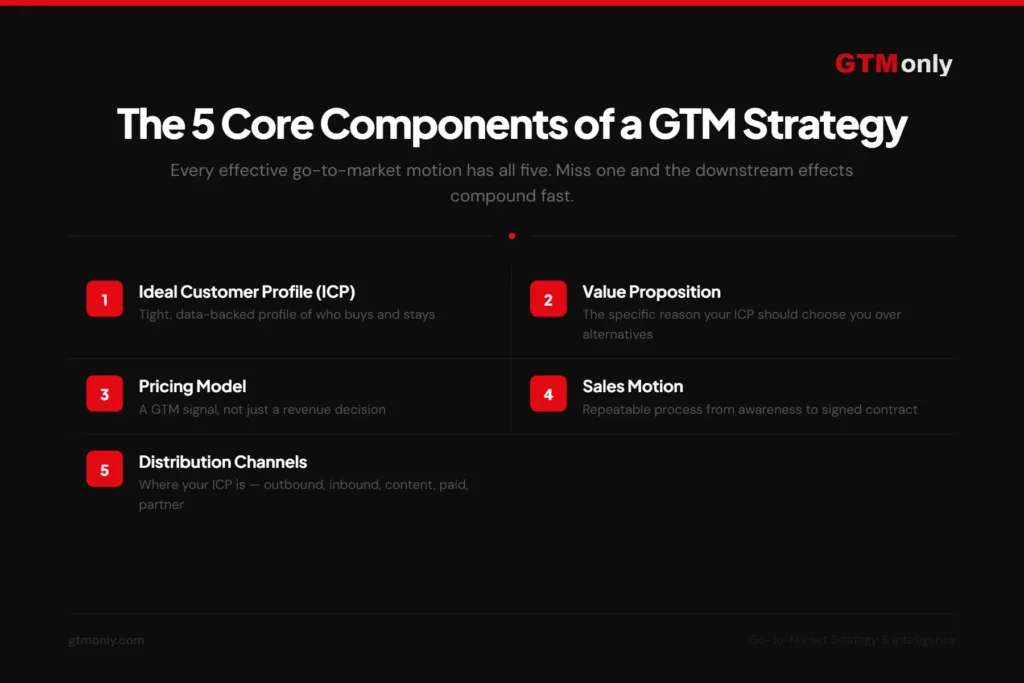
The 5 Core Components of a GTM Strategy
Right out of the gate: these are not optional. Every effective go-to-market motion has all five. Miss one and the downstream effects compound fast.
1. Ideal Customer Profile (ICP)
Your Ideal Customer Profile is a tight, data-backed profile of the customer most likely to buy, get value quickly, and stay. It’s not a buyer persona. Personas are marketing tools. An ICP is a targeting tool.
Build it from your last 15 to 20 closed-won accounts. Find the patterns: industry, company size, tech stack, team structure, what triggered the purchase. If you’re pre-revenue, run 10 discovery calls with target buyers before you finalize anything.
The test for a good ICP: hand it to an SDR on their first day and ask if they could build a prospect list from it. If the answer is no, the ICP is too vague. If it has more than five firmographic filters, it’s a wishlist, not an ICP.
2. Value Proposition
Your value prop is the specific reason your specific ICP should choose you over what they’re using now. Not a tagline. Not a category description.
The format that works in practice: “[Product] helps [ICP] achieve [specific outcome] by [mechanism], unlike [current alternative].”.
A bad one: “We help teams work better together.” A good one: “We help B2B SDRs reach more prospects by providing verified mobile numbers for over 75% of any B2B contact list, unlike data providers that mostly cover email.” The difference is specificity. A good value prop makes the reader say: that’s my problem.
3. Pricing Model
Pricing is a GTM signal, not just a revenue decision. How you price tells the market who you’re for and how they should think about buying.
Usage-based says: try it, pay as you grow, no friction. That’s a product-led signal. Seat-based SaaS says: you’re buying a recurring service for a defined team. Annual enterprise contracts say: this is a strategic investment requiring executive sign-off.
Pick the pricing model that matches your sales motion. Running a product-led motion with $40,000 annual contracts is putting a race car engine in a delivery van. It doesn’t fit.
4. Sales Motion
Your sales motion is the repeatable process for moving a buyer from awareness to signed contract. It includes who owns each stage, what signals advancement, and how long the cycle runs.
If you want someone to build the technical infrastructure behind your motion, that’s the job of a GTM engineer.
Product-led, sales-led, and marketing-led are the three primary motions. The one you choose shapes everything else. More on how to pick in the next section.
5. Distribution Channels
Channels are how you reach your ICP. Outbound SDRs, inbound content, paid acquisition, partner networks, and product virality are all channels. They have wildly different economics, timelines, and fit for different ICPs.
The mistake most teams make: picking channels based on what the team is comfortable running. The right test is simpler. Where does your ICP go when they’re actively looking for a solution to this problem? Start there.
How to Build a Go-to-Market Strategy in 7 Steps
With that foundation in place, here’s how to actually build one. Each step includes a watch-out worth knowing before you commit.
- Define your ICP from win data, not assumptions. Pull your closed-won accounts and find the patterns. If you’re pre-revenue, run 10 buyer discovery calls first. Watch-out: don’t let aspirational logos shape your ICP. The customer you want is not always the customer who buys.
- Write a value proposition that survives a real sales call. Use the format: product, ICP, outcome, mechanism, current alternative. Write three versions. Test them in real sales conversations. Pick the one that gets the fastest genuine recognition. Watch-out: if it takes more than one sentence, it’s not ready.
- Choose your GTM motion. PLG, SLG, or marketing-led. This shapes your team structure, pricing, and channel mix. The next section gives you the framework for choosing. Watch-out: don’t pick a motion because it’s what’s popular. PLG is not the right answer for every product, no matter what Twitter says.
- Set pricing to match the motion. Whatever motion you choose, price to support it. PLG needs low or no friction on entry. SLG needs pricing that justifies a full sales cycle. Misalign these and the motion stalls at conversion. Watch-out: freemium is an acquisition tactic, not a pricing model. Make sure you have a clear conversion path before you offer it.
- Build a focused channel mix. Pick two or three channels to start. Most early GTM motions succeed on one primary channel and one supporting channel. Running six channels at once means running none of them well. Watch-out: content takes 12 to 18 months to compound. If you need pipeline in 90 days, content is not your primary channel. If you’re still figuring out which tools support each channel, this list of go-to-market tools covers the most-used options by stage.
- Align Sales and Marketing on shared definitions. Before the first campaign runs, make sure both teams agree on what an ICP looks like, what counts as a qualified lead, and who owns what metric. This alignment does not happen on its own. Watch-out: if Marketing and Sales are arguing about lead quality, the root cause is almost always an ICP definition problem, not a volume problem.
- Set your metrics and review cadence. Five metrics worth tracking: win rate, average sales cycle length, pipeline coverage ratio, customer acquisition cost, and net revenue retention. Review them quarterly in a formal RevOps-led session. Watch-out: most teams track activity metrics instead of outcome metrics. Activity feels productive. Outcome metrics tell you whether the motion is actually working.
Which GTM Motion Is Right for You?
Most GTM guides describe the three motions and then say “it depends on your situation.” That is not helpful. Here’s the real framework.
Product-Led Growth (PLG)
In a PLG motion, the product itself drives acquisition, activation, and expansion. Users find the product, experience value before paying, and convert when the value justifies the cost. Figma, Notion, and Loom are the canonical B2B examples.
PLG is right for you if: your product delivers a clear value moment in the first session, your ICP can self-serve without hand-holding, and your pricing allows low-friction entry.
PLG is wrong for you if: your product requires complex configuration, your ICP is a buying committee, or your average contract value requires executive sign-off.
The honest take: a lot of companies call themselves PLG because they have a free trial. That is not PLG. PLG is when product usage is itself the growth mechanism. If your free trial converts better when sales follows up immediately, you are running a sales-led motion with a free trial. Call it what it is.
Sales-Led Growth (SLG)
In an SLG motion, human sellers drive revenue. Marketing generates awareness and qualified leads. Sales converts and expands. This is the traditional enterprise B2B motion and it still works for most high-ACV products.
SLG is right for you if: your product requires explanation or customization, your ICP’s buying decision involves multiple stakeholders, or your average contract value is above $15,000 annually.
SLG is wrong for you if: your ICP researches independently and avoids sales conversations, your ACV is too low to support a full sales cycle economically, or your product is simple enough that self-serve delivers the same outcome.
One thing that kills SLG motions repeatedly: hiring sales before validating the message. Salespeople can execute a proven motion. They cannot simultaneously invent the positioning, find the ICP, and build the playbook from scratch. That is founder work. Solve it before you hire.
Marketing-Led Growth
In a marketing-led motion, content, brand, and SEO create a pipeline of inbound demand that converts through self-serve or a light-touch sales process. HubSpot built this better than almost anyone in B2B.
Marketing-led is right for you if: your ICP actively searches for solutions, you have the patience for a 12 to 18 month compounding timeline, and you can produce content that is genuinely better than what’s already ranking.
Marketing-led is wrong for you if: you need pipeline in the next 90 days, your ICP does not self-direct their research, or you don’t have the editorial capacity to produce useful content consistently.
The devil is in the details here. Most companies underestimate how hard this motion is to build from scratch. It takes longer than you think. It costs more than you budget. And it fails completely if the content is thin, generic, or indistinguishable from what a competitor published six months ago.
GTM Strategy Mistakes We See Over and Over
These are not the obvious mistakes. These are the ones that trip up experienced, well-funded teams.
Treating the GTM strategy as a launch artifact
The most common mistake is building a GTM strategy for the launch date and filing it away once the product ships. Markets shift. Buyer behavior changes. Competitors move. The GTM strategy you wrote in January is probably wrong by April.
The teams that compound year over year run a formal quarterly GTM review. They look at win rate by ICP segment. They track which channels are still performing. They update positioning based on what they’re hearing in lost deals. That iteration is worth its weight in gold and almost nobody does it consistently.
Skipping real competitive positioning
Most GTM strategies have a competitor section. Very few have competitive positioning that actually holds up in a live sales conversation.
“We are faster and cheaper” is not competitive positioning. Real positioning is a clear, defensible reason why your specific ICP should pick you over the specific tool they’re currently using. That requires knowing what the alternative actually does wrong, from the buyer’s perspective. Most teams know what they themselves do well. Fewer know what the buyer hates about the alternative.
Confusing channel with motion
A GTM motion (PLG, SLG, marketing-led) is the structural way value gets delivered and revenue gets created. A channel (LinkedIn ads, cold email, SEO) is a tactic within a motion.
Teams that chase channels without committing to a motion end up fragmented, expensive, and unscalable. Pick the motion first. Then pick the channels that support it. Not the other way around.
Scaling before validating
You’ve shipped the product. You have a few early customers. The board wants a go-to-market plan, so you hire five SDRs, a demand gen manager, and a content writer.
Then you find out the ICP you assumed doesn’t match the buyer who actually converts. The SDRs are calling the wrong people. The content is attracting the wrong audience. You’ve spent $600,000 and the pipeline is thin.
Validate the motion with a small, scrappy team first. Then scale what’s working. Hiring ahead of validated motion is one of the most expensive mistakes in early GTM.
Start Small. Get It Right. Then Scale.
Building a go-to-market strategy is not the exciting part of launching a product. But it is the part that determines whether everything else pays off.
Start with the ICP. Get that right and the rest follows faster than you think. Pick the motion that matches your product and your buyer’s behavior. Align your team before you scale. And go back and review the whole thing every 90 days, because the first version is never the final version.
Frequently Asked Questions About GTM Strategy
What is the difference between a GTM strategy and a business plan?
A business plan covers the whole company: vision, financials, operations, and the long-term roadmap. A GTM strategy is narrower. It focuses on one product or one market entry and answers a specific set of questions: who are we selling to, how do we reach them, and how do we convert them. The scope is tighter and the timeline is shorter.
How long does it take to build a go-to-market strategy?
For most B2B teams, two to four weeks for a solid first version. That includes ICP research, value proposition work, competitive positioning, and channel selection. The teams that rush this to get to launch faster are usually the ones rebuilding the whole thing six months later when nothing is converting.
Who owns the GTM strategy?
In most B2B companies, the GTM strategy is co-owned by Marketing, Sales, and RevOps. Someone needs accountability for keeping it current and running the quarterly review. That is usually the Head of RevOps or the VP of Marketing. Product contributes ICP and positioning input. Finance validates the pricing model. No single team should own it exclusively.
When should you update a GTM strategy?
At minimum, once per quarter. More often if you see a sudden shift in win rate, a new competitor entering the market, or a change in how your buyer is behaving. The worst time to realize your GTM strategy is wrong is at the end-of-year review when pipeline is already behind.
What is the most common reason a GTM strategy fails?
An ICP built on aspiration instead of data. Everything downstream, from the sales pitch to the content to the channel mix, gets built for the wrong buyer. The discovery that the ICP is off usually happens six months in, after the team has already hired for the wrong motion and spent budget on the wrong accounts. Get the ICP right first. Everything else is fixable.