What Is Lead Generation? The Complete Beginner to Pro Guide
Imagine building the best coffee shop in town, but placing it in the middle of a dense forest with no signs. You have the best beans, the coziest chairs, and the friendliest staff.
Yet, nobody walks through the door.
That is what running a business feels like without a steady flow of potential buyers. Revenue is the fuel for your business, and lead generation is the pump that keeps it flowing.
Whether you run a solo agency or a fast-growing tech company, relying on random word-of-mouth creates a terrifying revenue rollercoaster. You need a predictable, repeatable system to attract strangers, earn their trust, and turn them into paying clients.
In this guide, you will learn what lead generation really means, how modern buyers make decisions, and the exact strategies you can use to fill your sales pipeline this year.
What Is a Lead?
Before we talk about generating leads, let us get crystal clear on what a lead actually is.
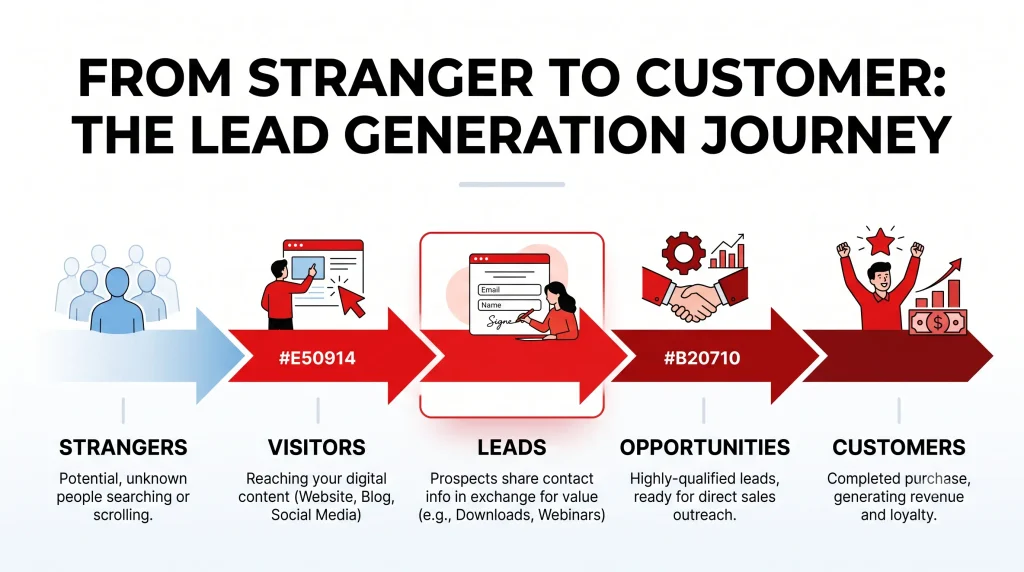
A lead is any person or business that shows interest in what you sell.
They are no longer a random stranger browsing the web. They have raised their hand, stepped out of the crowd, and shared their contact details with you—usually an email address, phone number, or company name.
Why All Leads Are Not the Same
A common mistake is treating every lead like they are ready to buy right now.
If someone downloads a free checklist, calling them five minutes later to pitch a $10,000 contract will only scare them away.
To prevent this, high-performing teams sort their prospects into four distinct buckets:
- Information Qualified Lead (IQL): A prospect at the very beginning of their research. They gave you their email for a high-level guide or cheat sheet. They know they have a problem, but they do not know what solution they need yet.
- Marketing Qualified Lead (MQL): A prospect who regularly consumes your content. They match your ideal customer profile and have taken clear actions, such as attending a live webinar or downloading a product comparison.
- Sales Qualified Lead (SQL): The highest-intent prospect. A sales qualified lead has asked for a quote, booked a demo, or filled out your contact form. They are ready to discuss pricing and timelines.
- Product Qualified Lead (PQL): Common in software companies using product-led growth. These are free trial or freemium users who have hit key usage milestones and are ready to upgrade to a paid tier.
What Is Lead Generation?
Lead generation is the process of attracting potential buyers and capturing their contact information so you can guide them toward a sale.
It sits right at the start of your B2B sales process. Instead of cold pitching people who do not care, lead generation warms people up so your outreach feels welcome, not annoying.
Inbound vs Outbound Lead Generation
Lead generation generally works through two main channels:
1. Inbound Lead Generation (Attraction)
You create helpful content, optimize for search engines, and share insights on social media.
When buyers search for help, they find your website. Inbound works because the prospect starts the conversation.
2. Outbound Lead Generation (Direct Outreach)
You identify specific companies that need your help and reach out to them directly.
This includes channels like cold email, cold calling, and targeted LinkedIn messages. When done with care and relevant research, outbound is the fastest way to start conversations with key decision-makers.
The best businesses do not pick one over the other. They combine both into a unified go-to-market strategy.
Lead Generation vs Demand Generation: What Is the Difference?
These two terms often get mixed up, but they play very different roles in your growth engine.
| Feature | Demand Generation | Lead Generation |
| Main Goal | Build brand awareness and trust | Capture contact details (Name, Email, Phone) |
| Gating | 100% free and ungated | Requires a form submission |
| Content Types | Podcasts, videos, social posts, free articles | Cheat sheets, demo requests, webinars, audits |
| Outcome | People know and trust your brand | Sales reps have qualified prospects to contact |
Think of it this way: Demand generation gets people to visit your store window. Lead generation invites them through the front door.
How Does the Lead Generation Process Work?
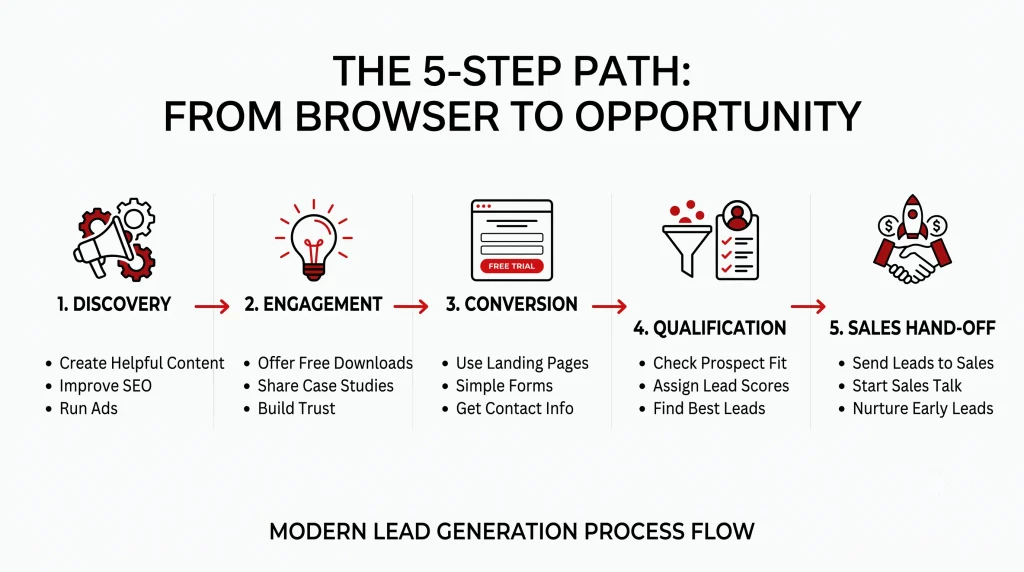
Every successful digital campaign follows a simple, five-step path to move prospects from casual browsers to sales opportunities.
1. Discovery
A buyer discovers your brand through a search result, a recommendation, a social media post, or an ad.
2. Engagement
The visitor reads your content, reviews your case studies, or checks out your product features to see if your advice helps them.
3. The Call to Action (CTA)
They see a clear, enticing offer—such as a free template, a benchmark report, or an interactive tool.
4. The Landing Page and Form
Clicking the CTA takes them to a distraction-free page with a short form. They enter their name and work email in exchange for the resource.
5. CRM Sync and Routing
Their details go straight into your database. High-intent leads get sent directly to your sales team, while early-stage leads receive helpful, automated follow-up emails.
6 High-Converting Lead Generation Strategies
Now that you know how the system works, let us look at the practical strategies you can use to bring in qualified prospects.
1. Search Engine Optimization (SEO)
SEO helps you capture buyers at the exact moment they are looking for answers.
When someone searches for a solution to a problem, they have high intent. If your guide ranks on page one, you immediately become their trusted expert.
- Find specific questions your buyers ask using deep keyword research.
- Match what searchers want by understanding search intent.
- Add custom downloadables inside your B2B content marketing articles to turn readers into subscribers.
2. Modern Cold Outreach
Cold outreach works well when you focus on relevance over volume. Blasting thousands of generic templates will only send your messages straight to the spam folder.
- Clean your prospect lists before sending to maintain high email deliverability.
- Target prospects based on buying triggers, such as new funding or leadership changes.
- Craft short, compelling messages using a proven cold email strategy.
3. Account-Based Marketing (ABM)
If you sell high-ticket services or enterprise software, you do not need thousands of leads. You only need the right fifty accounts.
Account-based marketing treats individual target companies as their own dedicated markets. Marketing and sales work together to deliver personalized content, custom landing pages, and tailored ads directly to key decision-makers.
4. AI-Powered Lead Capture
Artificial intelligence has changed how modern teams find and qualify prospects.
Using ai lead generation allows you to:
- Deploy smart chatbots that answer questions and book demos around the clock.
- Use predictive algorithms to score and prioritize leads based on website behavior.
- Uncover buying signals using modern sales intelligence tools.
5. Interactive Calculators and Tools
Static PDF downloads are losing their appeal. Interactive tools provide instant, personalized value and convert visitors at a much higher rate.
- ROI Calculators: Let prospects calculate how much time or money they can save.
- Audit Checklists: Provide a quick, automated assessment of their current setup.
- Quizzes: Offer tailored recommendations based on their specific pain points.
6. Social Selling and Communities
Buyers increasingly seek advice from peers in private Slack groups, Discord servers, and LinkedIn feeds.
Instead of posting direct sales pitches:
- Share practical breakdowns of problems you have solved for clients.
- Answer questions in industry forums without asking for anything in return.
- Build genuine relationships using proven sales prospecting methods.
Essential Tools for Your Lead Generation Stack
You cannot build a scalable system using manual spreadsheets. You need a simple, connected stack of lead generation software to automate routine tasks.
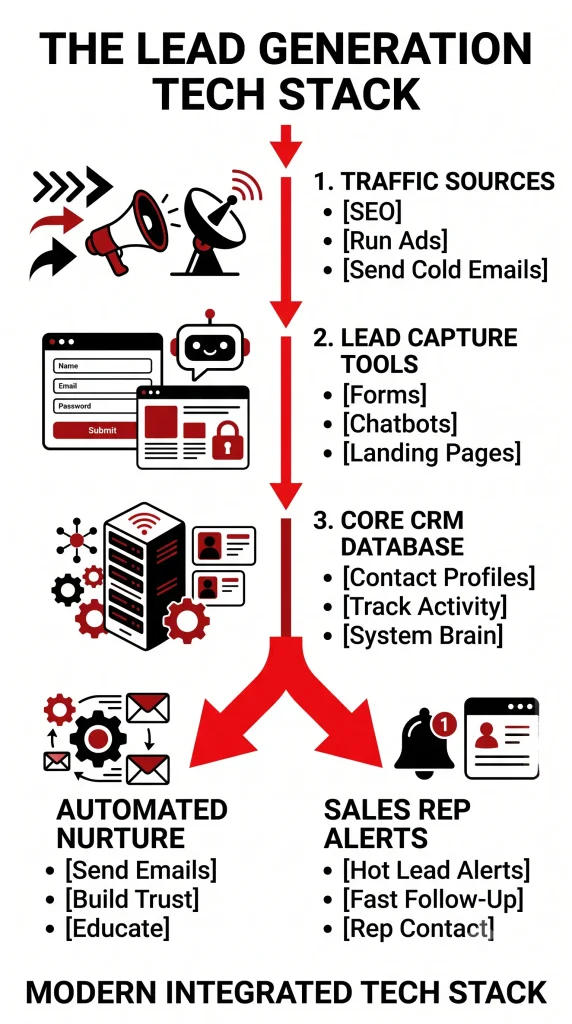
1. Customer Relationship Management (CRM)
Your CRM is the command center for your pipeline. It stores every interaction, message, and form submission so your team always has full context before reaching out.
2. Data Enrichment Tools
Long forms with ten different fields crush conversion rates. Data enrichment tools let you ask for just a work email address, then automatically fill in the prospect’s job title, company size, and industry behind the scenes.
3. Email Automation Software
Automated email tools help you send timely, relevant follow-up sequences to prospects based on the actions they take on your website.
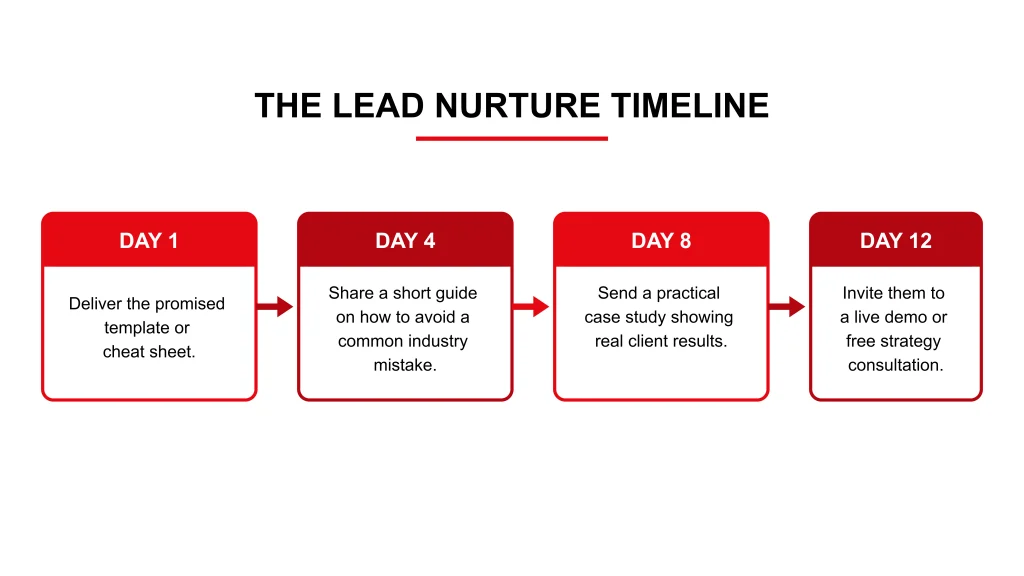
How to Nurture Leads That Are Not Ready to Buy
Most of the leads you capture will not be ready to purchase on day one. If you hand every new subscriber straight to a sales rep, you will burn through good prospects.
Lead nurturing is how you stay top of mind by offering steady, practical value until the prospect is ready to make a decision.
Simple Lead Scoring
To help your sales team focus on the best opportunities, assign point values to prospect actions:
- +1 Point: Opens a weekly newsletter.
- +5 Points: Clicks a link to read a case study.
- +15 Points: Visits your product pricing page.
- +30 Points: Fills out a demo request form.
When a prospect crosses your set threshold (such as 30 points), your CRM flags them as sales-ready so your reps can follow up immediately.
4 Metrics Every Growth Team Must Track
To ensure your campaigns generate real revenue rather than vanity numbers, monitor these four essential metrics:
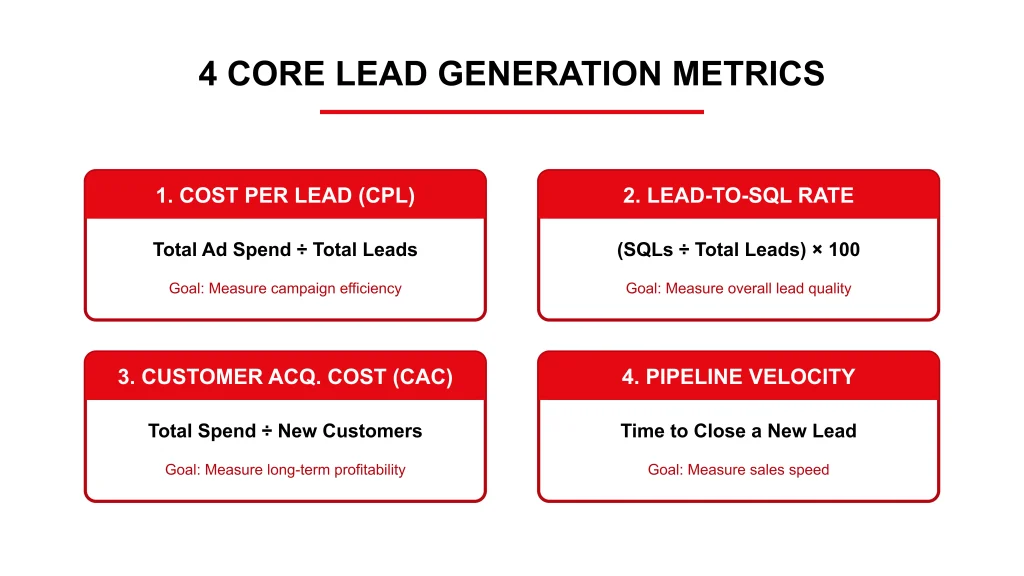
- Cost Per Lead (CPL): The marketing spend required to acquire one new lead.
- Lead-to-SQL Conversion Rate: The percentage of raw leads that turn into genuine sales conversations.
- Customer Acquisition Cost (CAC): The total investment needed to win a paying customer.
- Sales Velocity: How quickly a prospect moves from their first form submission to a closed deal.
3 Costly Lead Generation Mistakes to Avoid
Even seasoned teams make mistakes that hurt their conversion rates. Watch out for these common traps:
1. Asking for Too Much Information Upfront
Every extra field you add to a form lowers your conversion rate. Stick to essential details like first name and work email. You can always gather more information later as the relationship grows.
2. Ignoring Follow-Up Speed
Research consistently shows that following up with a high-intent lead within five minutes increases qualification rates dramatically. If you wait days to reply to a contact form, your prospect will likely reach out to a competitor.
3. Poor Sales and Marketing Alignment
When marketing targets one audience and sales pitches another, your budget goes to waste. Both teams must agree on the target profile, qualification criteria, and follow-up processes.
Conclusion: Stop Chasing and Start Attracting
Lead generation is not about finding clever ways to trick people into giving you their email addresses. It is about delivering consistent, undeniable value.
When you deeply understand the daily struggles of your target audience, marketing becomes much easier. You stop guessing and start creating the exact guides, tools, and answers they are already searching for.
Instead of pushing desperate sales pitches, you build a system that pulls buyers toward you.
Take a look at your website today. Are your forms simple? Do you offer resources that actually solve a problem? Do you follow up fast? Fix those basic foundations, focus on helping your buyers, and you will build a predictable revenue engine that fuels your business for years to come.
Frequently Asked Questions
How do you generate B2B leads without making cold calls?
You can generate high-quality B2B leads without cold calling by focusing on inbound marketing and social selling. Build comprehensive SEO articles that answer specific industry questions. Offer interactive tools, like ROI calculators, in exchange for an email address. You can also share helpful, non-promotional advice in private Slack communities and LinkedIn groups to build trust over time.
What is the exact difference between an MQL and an SQL?
A Marketing Qualified Lead (MQL) is someone who engages with your content and matches your ideal customer profile, but is not ready to buy yet. They might download a guide or attend a webinar. A Sales Qualified Lead (SQL) has taken a direct action showing buying intent, such as requesting a custom pricing quote or booking a software demo.
How can small businesses use AI tools for lead generation?
Small teams can use ai lead generation tools to automate the heavy lifting. You can install an AI chatbot on your website to answer visitor questions and book meetings 24/7. You can also use AI data enrichment tools to automatically find a prospect’s job title and company size. This allows you to keep your website forms short and immediately boost your conversion rates.
How long does it take to see results from inbound lead generation?
Inbound lead generation is a long-term play. If you rely on SEO and content marketing, it typically takes three to six months to see a steady flow of organic traffic and leads. However, if you combine inbound content with targeted paid ads or a smart cold email strategy, you can start generating qualified leads within the first few weeks.
What is a good target Cost Per Lead (CPL) for B2B SaaS companies?
A “good” Cost Per Lead depends entirely on your customer lifetime value (LTV). However, in the B2B SaaS space, the average CPL ranges between $40 and $200 depending on the industry and the target role. Targeting a CEO will always cost more than targeting a mid-level manager. The key is ensuring your total customer acquisition cost remains lower than the revenue that new customer brings in over time.