What Is Account-Based Marketing? The Full ABM Guide
TL;DR
- Account-based marketing (ABM) targets a defined list of high-value accounts instead of chasing lead volume.
- It flips the funnel. You qualify accounts first, then build demand inside them.
- There are five types: Strategic, Scenario, Segment, Programmatic, and Pursuit Marketing. Start with Segment.
- The program lives or dies on ICP quality, account selection, and sales-marketing alignment.
- Measure accounts, not leads. Pipeline, deal size, and win rate beat MQL counts every time.
Account-based marketing is the one B2B strategy where you pick your customers before they pick you.
Instead of pouring budget into channels and hoping the right companies show up, you build a list of accounts worth winning. Then you market to the people inside each one until the deal closes.
Get it right and deals get bigger while sales cycles shrink. Get it wrong and you burn a quarter’s budget personalizing content for companies that were never going to buy.
This guide covers what ABM is, how it differs from demand generation, the five ABM types, a six-step strategy build, and how to measure it all. By the end, you’ll know whether ABM fits your motion and how to launch it without the usual false starts.
What Is Account-Based Marketing?
Account-based marketing (ABM) is a B2B strategy that treats individual high-value accounts as markets of one. Marketing and sales agree on a target account list, then run personalized campaigns to engage the full buying committee inside each account until it converts to revenue.
The term dates back to 2003, when Bev Burgess at ITSMA gave a name to something enterprise sellers had done informally for years: focus the whole company on the accounts that matter.
The core difference sits in where you start. Lead generation fills a bucket with contacts and sorts them later. ABM picks the 50 or 200 companies that fit your business best and ignores everyone else.
That focus changes everything downstream. Content gets written for a named account, not a persona. Ads target a company’s buying committee, not a demographic. Sales and marketing work the same list, in the same quarter, toward the same revenue number.
One caution early: ABM is a strategy, not a software category. You can run it with a spreadsheet and a disciplined team, and plenty of good programs started that way.
That definition covers the what. The bigger shift is structural, and it happens in the funnel.
How ABM Flips the Traditional Funnel
A traditional sales funnel starts wide and narrows. You attract thousands of visitors, convert a fraction into leads, and qualify a fraction of those into opportunities. Waste is built into the model.
The ABM funnel inverts that shape. It starts narrow and expands:
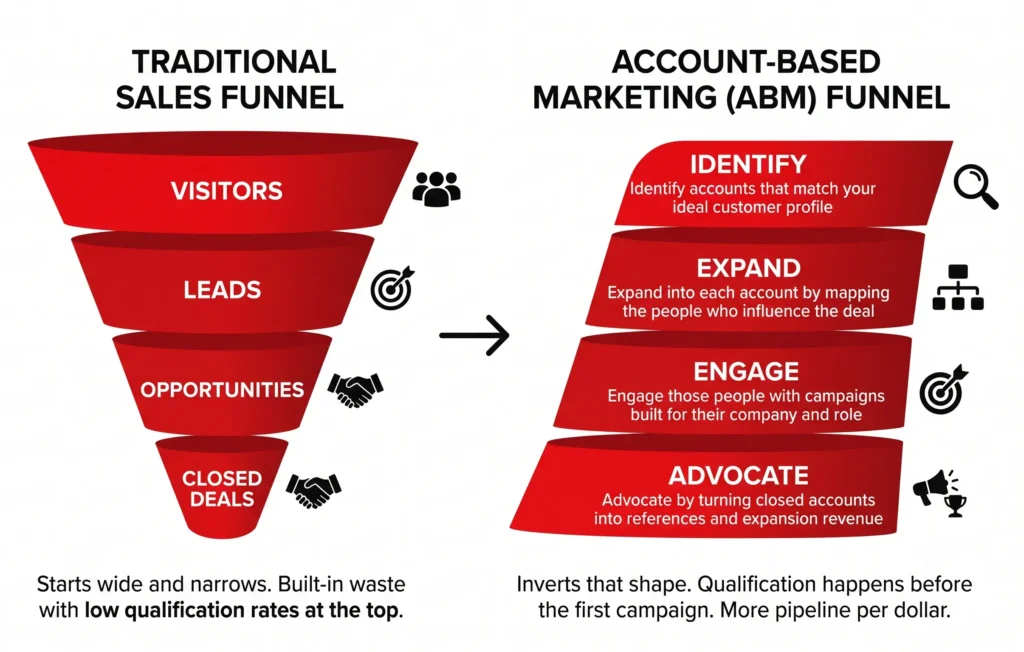
- Identify the accounts that match your ideal customer profile.
- Expand into each account by mapping the people who influence the deal.
- Engage those people with campaigns built for their company and role.
- Advocate by turning closed accounts into references and expansion revenue.
The practical consequence: qualification happens before the first campaign runs, not after. Every dollar spent touches a company that already passed the fit test.
That’s also why ABM math looks different. You’ll reach fewer people, get fewer form fills, and still produce more pipeline per dollar. Judge it by the old funnel’s metrics and it will always look like it’s failing.
If ABM inverts the demand model, the natural question is whether it replaces it.
ABM vs Demand Generation vs Inbound
ABM, demand generation, and inbound solve different problems, and the strongest GTM motions run all three as layers rather than rivals.
Demand generation builds awareness and captures interest across your whole market. ABM concentrates resources on the accounts most likely to produce revenue. Inbound is the content engine that feeds both.
The differences in one view:
| Demand Generation | Inbound | Account-Based Marketing | |
|---|---|---|---|
| Starting point | Total addressable market | Search and content demand | Named account list |
| Unit of measure | Leads and MQLs | Traffic and conversions | Accounts and pipeline |
| Personalization | By segment or persona | By topic and intent | By account and person |
| Best for | Building future pipeline | Capturing existing demand | Landing high-value deals |
| Fails when | ICP is undefined | Nobody searches for the problem | Deal sizes are too small |
The mistake I see founders make is framing ABM vs demand generation as a budget fight where one side has to lose. In practice, demand gen creates awareness inside your target accounts before the ABM play begins, which makes every personalized touch land warmer.
Once you’ve settled that ABM belongs in the mix, the next decision is which type to run.
The 5 Types of ABM
There are five types of ABM: Strategic, Scenario, Segment, Programmatic, and Pursuit Marketing. Bev Burgess, who coined the term, expanded the classic three-tier pyramid to this five-type model in 2025 to match how account-based teams work now.
| Type | Scale | The job it does |
|---|---|---|
| Strategic | A few top accounts | Deep, long-term growth programs for the clients that move your number |
| Scenario | One account, one moment | A focused push around a renewal, a stalled deal, or a new decision maker |
| Segment | Clusters of 5 to 15 accounts | Semi-custom plays for accounts that share a real problem |
| Programmatic | Hundreds of accounts | Always-on, signal-triggered campaigns at scale |
| Pursuit Marketing | A single deal | Winning one specific competitive bid |
The old pyramid you’ll still see everywhere, one-to-one, one-to-few, and one-to-many, didn’t get thrown out. Segment and Programmatic are cleaner names for one-to-few and one-to-many. The real change happened at the top, where the overloaded one-to-one tier split into Strategic for long-term account programs and Scenario for short, situation-driven sprints, with Pursuit Marketing named as its own deal-level play.
You don’t pick one type and stop. Burgess frames it as a portfolio: each account gets the level of investment its potential earns, so a mature program runs several types in parallel.
If you’re launching your first program, start with Segment. It forces real account research without demanding an enterprise budget, and it produces results fast enough to earn a bigger mandate.
The type is one decision. Whether ABM deserves the budget at all is the bigger one.
Why ABM Works (and When It Doesn’t)
ABM works because it removes the single biggest source of waste in B2B marketing: spending on companies that will never buy.
The numbers back the shift. Gartner found that technology companies with revenue above $100 million allocate 21% of their marketing budget to ABM programs. In Foundry’s ABM research, 93% of respondents rated their program a success.
In practice, the gains show up in four places:
- Bigger deals. You target companies by revenue potential, so average contract value climbs by design.
- Shorter cycles. You engage the full buying committee at once instead of waiting for one contact to route your pitch internally.
- Tighter alignment. Sales and marketing share one list and one revenue goal, which ends the argument over lead quality.
- Expansion revenue. The same playbook works on existing customers, where the trust is already built and deals close far faster than net-new.
Now the honest part. ABM is the wrong choice for a lot of companies, and it pays to know if yours is one.
Skip it if your ACV sits below roughly $10K, because personalization costs more than the deal returns. Skip it if you sell self-serve to a massive market, because the funnel already works. And skip it if sales won’t commit to working the list, because ABM without sales is just expensive advertising.
If you’ve cleared those bars, the build starts. Six steps, in order.
How to Build an ABM Strategy in 6 Steps
A working ABM strategy answers three questions: which accounts, which people, and which message. The six steps below get you there. Skip one and the program leaks.
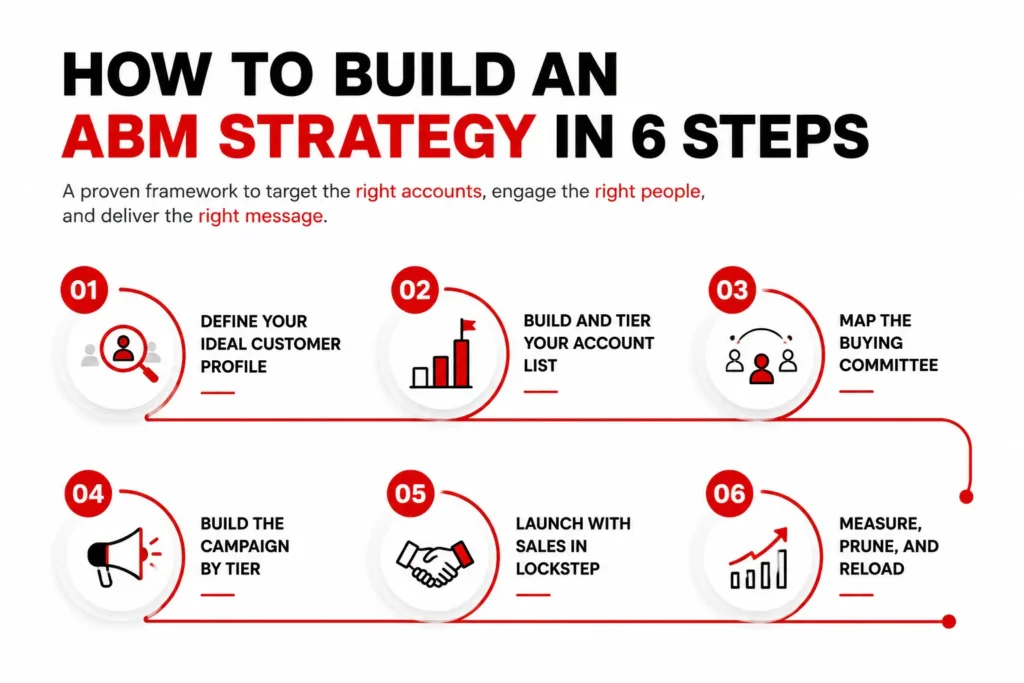
Step 1: Define Your Ideal Customer Profile
Your ideal customer profile is the filter every account must pass. Build it from your closed-won data: pull your 15 to 20 best customers and find what they share in industry, size, tech stack, and buying trigger.
The watch-out: teams build the ICP they want, not the one the data supports. If your profile describes your dream logo instead of your best current customers, start over.
Step 2: Build and Tier Your Account List
Score every account that fits the ICP, then split the list into tiers. Your top accounts get Strategic treatment, mid-tier clusters get Segment plays, and the long tail runs Programmatic.
Fit alone isn’t enough, because it tells you nothing about timing. Layer intent data on top to find which accounts are researching your category right now. An account with strong fit and active intent jumps the queue.
Step 3: Map the Buying Committee
Enterprise deals rarely have one decision maker. For each priority account, identify the champion, the economic buyer, the end users, and the people who can kill the deal from procurement or IT.
Do this before writing a single asset. The message that wins over a VP of Sales will bore a CFO, and you need both.
Step 4: Build the Campaign by Tier
Now design the ABM campaign for each tier: the offer, the content, the channels, and the sequence of touches. Strategic accounts get custom assets. Programmatic accounts get personalized templates.
Resist the urge to personalize everything. Swapping a company name into a generic email isn’t personalization, and buyers can smell it. Personalize the insight, not just the greeting.
Step 5: Launch With Sales in Lockstep
Marketing runs air cover: ads, content, events. Sales runs ground game: outreach, calls, meetings. Both work from a shared account plan with agreed timing, so a prospect sees the ad the same week the SDR calls.
Set a weekly sync on account movement. When marketing sees a spike in engagement from a target account, sales should know within a day, not at the end of the quarter.
Step 6: Measure, Prune, and Reload
Review the list quarterly. Cut accounts that showed no engagement after a full cycle of touches, promote accounts that surged, and add fresh ones that match what your closed-won data now shows.
The devil is in the details here: a stale list quietly turns an ABM program back into spray-and-pray with extra steps.
The strategy decides who you target. Tactics decide what those accounts see, and this is where budgets go to die.
ABM Tactics That Work
The ABM tactics that produce responses share one trait: they prove you did the homework on that specific company. Channel choice matters far less than that relevance.
A few that earn their budget:
- Personalized landing pages that name the account and speak to its stated priorities, built once per Strategic account or per Segment cluster.
- LinkedIn prospecting paired with targeted ads, so the buying committee sees your content before your connection request.
- Direct mail with a reason. A gift tied to something the account said publicly beats an expensive gift with a generic note.
- Small-format events. A dinner for eight people from three target accounts outperforms a booth that 500 strangers walk past.
- Tailored webinars built around one cluster’s shared problem, with follow-up mapped to each attendee’s role.
One rule governs all of them. If the tactic would work just as well with a different company name swapped in, it isn’t an ABM tactic yet.
Tactics generate activity. Whether that activity means anything is a measurement question, and measurement trips up more ABM programs than execution does.
How to Measure ABM: Metrics That Matter
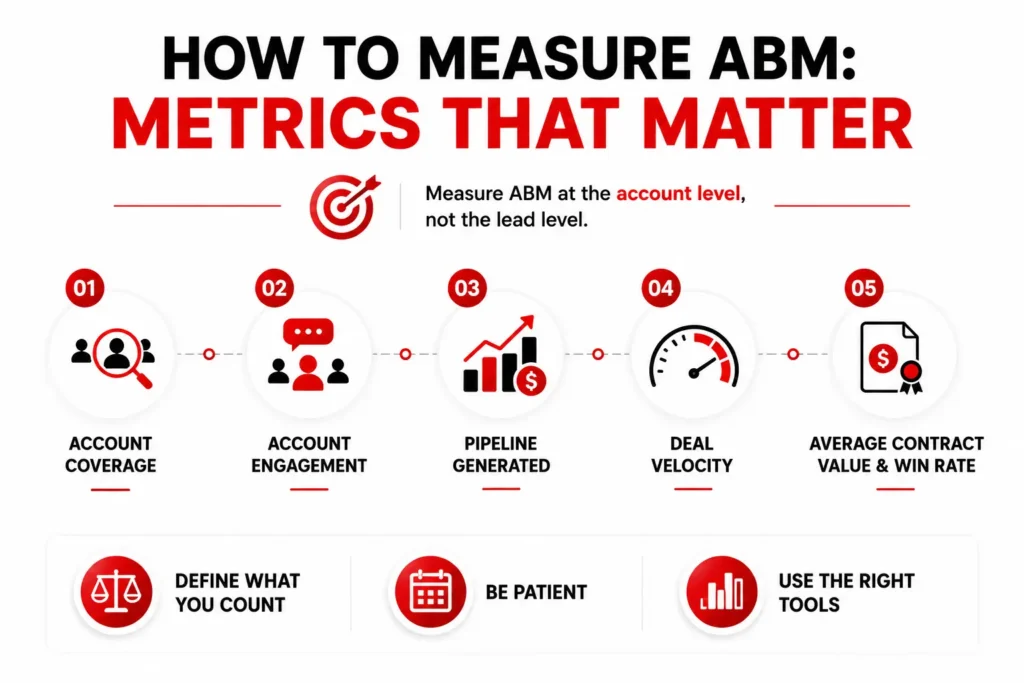
Measure ABM at the account level or don’t bother. Individual lead metrics will tell you the program is failing while it quietly builds your biggest deals.
The metric that replaces the MQL is the marketing qualified account. An MQA is an account where multiple stakeholders show buying signals in the same window: three people from one company hitting your pricing page and attending a webinar within a week says more than 300 unrelated form fills.
Track these five ABM metrics from day one:
- Account coverage. How many contacts you’ve identified per target account versus the full buying committee.
- Account engagement. Meaningful interactions from target accounts, weighted by seniority.
- Pipeline generated. Opportunities created within the target list, in dollars.
- Deal velocity. Days from first engagement to closed-won, compared against non-ABM deals.
- Average contract value and win rate. The proof that focus beats volume.
One decision to make before the first report: whether you count sourced pipeline, deals that started inside the target list, or influenced pipeline, deals the program touched along the way. Both are valid. Picking one and sticking to it is what keeps the CFO conversation honest.
Give the program two full quarters before judging it. Account-level buying takes time, and the first quarter mostly builds coverage and awareness inside accounts that have never heard of you.
Tracking all of this in a spreadsheet works for a pilot. Past a certain list size, tooling takes over.
ABM Software: What You Need (and What You Don’t)
You don’t need an ABM platform to start. You need five capabilities, and how you assemble them depends on list size and budget:
- Account data and enrichment to build the list and keep firmographics current.
- Intent signals to know which accounts are in-market this month.
- Ad orchestration to reach buying committees at named companies.
- Website personalization to adapt your pages to the visiting account.
- Account-level analytics to report on the five metrics above.
Small teams can cover the first two with a single sales intelligence tool and run the rest manually. Larger programs consolidate onto one of the best ABM software platforms once manual work becomes the bottleneck.
Buy tools after the strategy works in miniature, not before. Software scales a working process and multiplies a broken one.
There’s one more shift to know about, because it’s where account-based work is heading.
From ABM to ABX: Where Account-Based Is Heading
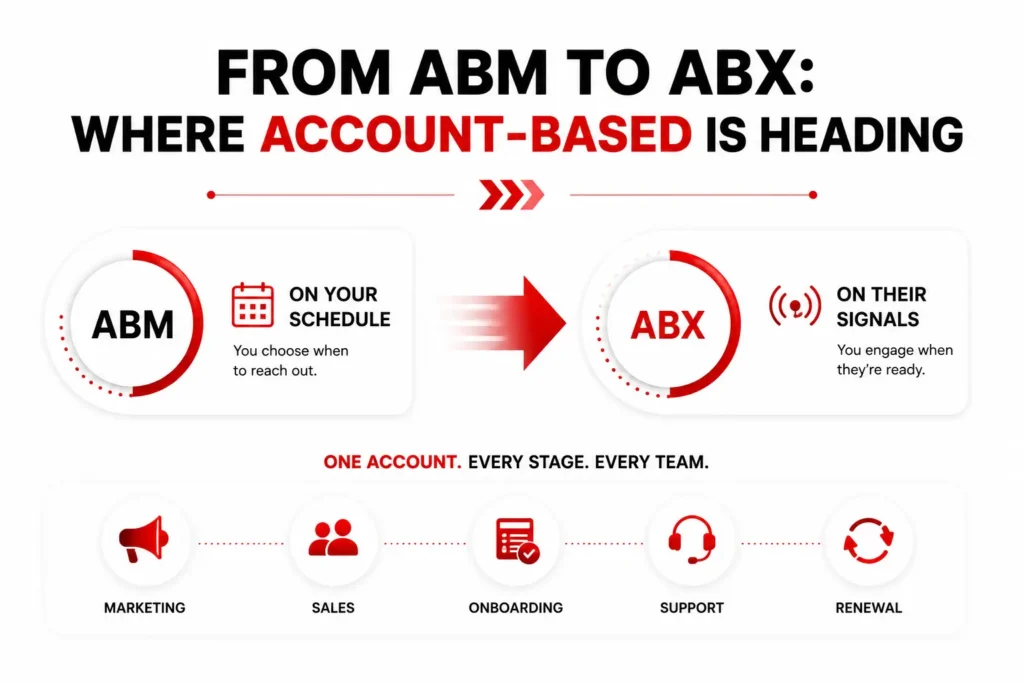
The frontier of ABM has a name: account-based experience, or ABX. It extends account-based thinking past marketing into the full customer lifecycle, from first ad to renewal.
The logic is simple. If marketing personalizes by account but sales, onboarding, and support treat everyone the same, the experience breaks the moment the contract is signed. ABX makes the account the organizing unit for every team that touches revenue.
It also changes when you engage. ABM’s old habit was reaching out on your schedule. ABX waits for signals that the account is ready, then responds with relevance instead of pressure.
That’s the heart of the ABM vs ABX question: ABX doesn’t replace ABM. It’s what a mature ABM program grows into.
Before wrapping up, the questions that come up every time this topic does.
The Bottom Line
Account-based marketing wins by refusing to spend money on companies that will never buy. Define the ICP from real win data, tier the list, map the buying committee, and run sales and marketing as one unit against it.
Start with a Segment program of 20 to 50 accounts, measure at the account level, and give it two quarters before you judge it.
The cluster linked throughout this guide covers every piece in depth, from strategy to metrics to tooling. Pick the stage you’re stuck on and go deeper there.
FAQ
What is account-based marketing in simple terms?
Account-based marketing means choosing the specific companies you want as customers, then marketing directly to the people inside them. Instead of attracting a high volume of leads and filtering later, you filter first and spend your entire budget on companies that fit. Sales and marketing work the same account list together.
What is the difference between ABM and lead generation?
Lead generation optimizes for volume: attract many contacts, qualify them, and pass the best to sales. ABM optimizes for fit: qualify companies before any campaign runs, then generate demand inside them. Lead gen measures success in leads and MQLs. ABM measures success in account engagement, pipeline, and closed revenue from the target list.
How many accounts should an ABM program target?
It depends on the type. Strategic ABM runs a handful of top accounts per marketer. Segment ABM covers clusters of five to 15 similar accounts. Programmatic ABM scales to hundreds using automation. First-time programs do best starting with 20 to 50 accounts in a Segment model, then scaling after the first wins.
Is ABM only for enterprise companies?
No. Programmatic ABM tools brought the cost down far enough that a two-person marketing team can run account-based plays. The real qualifier is deal size, not company size. If your average contract value is below roughly $10K, the economics of personalization stop working regardless of how big your company is.
How long does it take for ABM to show results?
Expect two to three quarters before pipeline results are readable. The first quarter builds account coverage and awareness. Engagement signals appear in the second, and opportunities follow. Leading indicators like account engagement and buying committee coverage move within weeks, so track those early instead of judging the program on closed revenue.
What is a marketing qualified account (MQA)?
A marketing qualified account is an account, not a person, that has shown enough collective buying signal to warrant sales attention. An account typically hits MQA status when several stakeholders engage in a short window, such as multiple people from one company visiting pricing, attending a webinar, or downloading a comparison in the same week.