What Is an ABM Funnel? Stages, Metrics, and How to Build One
An ABM (account-based marketing) funnel is what you get when you take a target account list and build a real, trackable path for moving those accounts toward a deal, instead of hoping engagement adds up to something eventually.
Picture the normal funnel. Wide at the top, narrow at the bottom. Thousands of strangers pour in, a trickle of customers comes out. An ABM funnel throws that shape away. You already know who you want. Fifty accounts, a hundred, whatever fits your team. The funnel’s job isn’t finding people. It’s proving that the accounts you picked are actually moving closer to buying.
That sounds simple. Teams still get it wrong constantly, and not for the reason you’d guess.
What Is an ABM Funnel?
An ABM funnel maps how a target account moves from “on the list” to “closed deal,” tracking the whole buying committee instead of one contact.
In a normal funnel, a lead is a lead until the moment they buy, then they graduate to customer. Clean, linear, one person’s journey. An account doesn’t work that way. A single account might have a CFO reading a pricing page, a VP of Engineering downloading a technical doc, and a procurement lead requesting a security review, all in the same week, all different people, none of whom have talked to your sales rep yet. Under a normal funnel, none of that counts as anything. Under an ABM funnel, that’s the account moving.
That’s the real shift. You stop asking “did this person convert” and start asking “did this account get warmer.” The unit changes. Everything else follows from that.
The funnel isn’t your ABM strategy, it’s the tracking structure that sits underneath one. Get the strategy wrong, target the wrong accounts, skip the sales-marketing alignment, and no amount of clean stage definitions will save you.
ABM Funnel vs Traditional Sales Funnel
A traditional sales funnel starts broad and narrows. Awareness, consideration, evaluation, decision, with a big pool of strangers at the top and a small number of buyers surviving to the bottom.
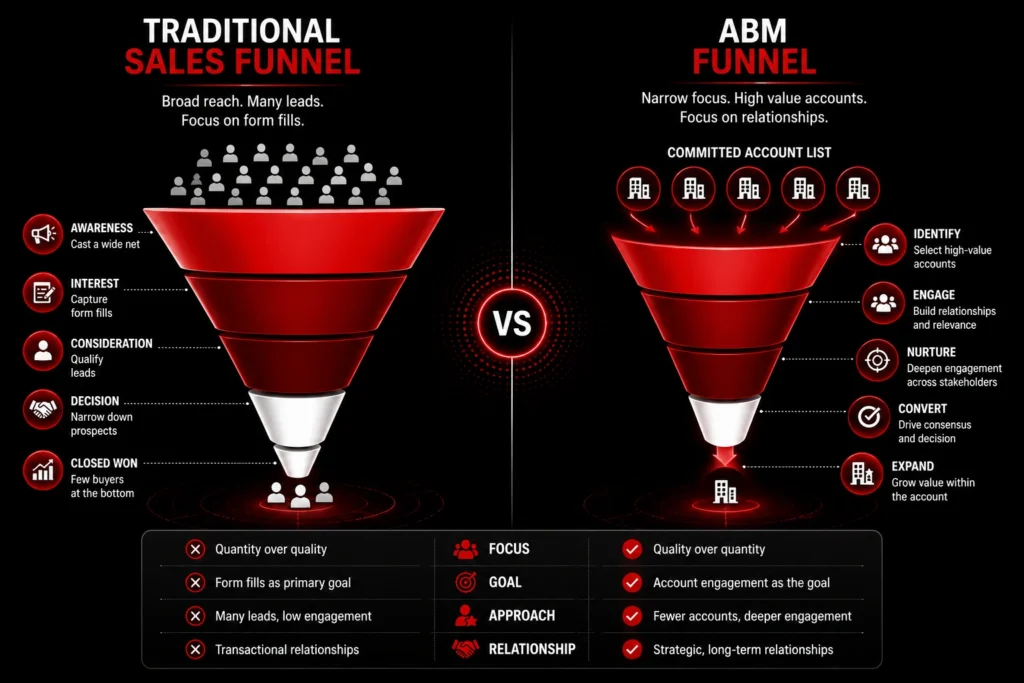
An ABM funnel starts narrow and stays narrow. You’re not trying to survive attrition. You’re trying to deepen a relationship with a list you already committed to. The differences that actually matter:
- Who’s tracked. Traditional funnels track individual leads. ABM funnels track accounts, and an account is really a small group of people acting somewhat together.
- What counts as progress. A traditional funnel counts form fills and demo requests. An ABM funnel counts those too, but also ad impressions, multiple stakeholders engaging, and signals that never touch a form at all.
- Who owns it. A traditional funnel is mostly marketing’s job until a lead gets handed to sales. An ABM funnel is a shared asset from day one, because sales needs to see account movement in real time, not after a lead score crosses a threshold.
- When it ends. A traditional funnel ends at the sale. A real ABM funnel keeps going into expansion, because growing an account you already have is cheaper than winning a new one.
Neither shape is wrong. They’re built for different problems. Wide markets with cheap products want the traditional funnel. Complex deals with a handful of accounts that actually move the needle want the ABM version.
The 5 Stages of an ABM Funnel
Five stages carry the weight. Each one needs four things attached to it: a rule for what gets an account in, the content that stage runs on, what sales does at that point, and the number that proves an account actually moved. Skip any of those four and the stage is just a name on a slide.
| Stage | Entry Rule | Content | Sales Action | Metric |
|---|---|---|---|---|
| Identify | Account matches ICP and fit criteria | None yet, this is research | None yet | Number of accounts on the list |
| Map | Account is confirmed on the target list | Org chart research, role notes | Reps confirm contacts, add missing roles | Contacts mapped per account |
| Engage | 2 or more contacts mapped and confirmed | Role-specific ads, email, LinkedIn touches | SDR outreach begins | Account engagement score |
| Convert | 20%+ of the mapped committee engaged, or a meeting is booked | Case studies, ROI content, demos | AE runs the deal | Opportunity created, deal stage |
| Expand | Deal closed | Onboarding content, usage-based nudges | CS takes over the relationship | Expansion revenue, renewal rate |
Identify
You start with a target list built from your ideal customer profile, not a wishlist of dream logos someone pulled from a trade show badge scan. How big that list should be depends on which type of ABM you’re running, tight and custom for a handful of accounts, or wider and lighter-touch across more of them. This stage produces nothing but a list. No content, no outreach, just the discipline of saying these companies and not those ones.
Map
Now you find the people. Every account on your list has a buying committee hiding inside it, and this stage is about naming names. Who holds budget. Who evaluates technically. Who can quietly kill the deal from procurement. An account can sit in Map for weeks with zero contacts found, that’s normal. What it can’t do is move to Engage until at least two of those people have names attached.
Engage
This is where the actual campaign runs, and where most of the mistakes happen too. Ads, personalized email, LinkedIn touches, content built for specific roles, all aimed at the committee you just mapped. Good sales intelligence is what tells you which signals actually mean something here, since not every click is worth the same. A CFO opening a pricing page matters more than a random click from someone whose role you don’t even know yet.
Convert
Enough of the committee has engaged that sales takes the lead. This stage runs on coordination. Marketing keeps the air cover going with ads and content while sales runs its own sales process to close, and the two need to know what the other is doing so the account doesn’t get two contradictory messages in the same week.
Expand
The deal closes and the funnel doesn’t stop, it changes owners. Customer success picks up the relationship, and this is really where ABM turns into account-based experience: the same personalized thinking applied to onboarding, adoption, and the eventual upsell conversation. Growing an account you already won is far cheaper than finding a new one, which is exactly why this stage belongs in the funnel and not in some separate customer success dashboard nobody in marketing ever looks at.
Also read: ABM vs ABX: what’s the difference
Why a Funnel Stage Needs More Than a Name
A team draws five boxes, labels them Identify, Map, Engage, Convert, Expand, and calls it done. No entry rule. No number. Just vibes. That’s the mistake that quietly wrecks more ABM funnels than bad targeting ever does.
Without a number attached to each stage, the funnel isn’t a funnel. It’s an opinion with a nice diagram. Someone on the team feels like an account is “warming up,” someone else disagrees, and there’s no way to settle it because nothing was ever defined. Write the entry rule down. Twenty percent of the buying committee engaged in the last two weeks, or it doesn’t count. A meeting booked with a real title on the calendar, or the account stays in Engage. Numbers end arguments that feelings can’t.
The same goes for syncing stages into whatever system sales actually lives in. If a rep can’t see that an account just moved into Convert without asking marketing, the stage might as well not exist, because the person who needs to act on it doesn’t know it happened.
The Metrics That Actually Prove an Account Moved
Every stage table above has a metric column for a reason. Metrics are what separate a real ABM funnel from a good-looking chart.
- Account coverage. What share of your target list has any engagement at all. If this is low, nothing else matters yet.
- Buying committee reach. How many mapped contacts per account are actually engaging, not just how many you found.
- Account engagement score. A weighted read of ad clicks, content views, and email opens across the whole committee, not one person’s activity.
- Stage conversion rate. What percentage of accounts move from one stage to the next, and where they get stuck.
- Velocity. How long an account sits in each stage before it moves. A slow Engage stage tells you your content or targeting is off.
- Expansion rate. Revenue growth inside accounts that already closed, the number that proves the Expand stage is real and not decorative.
Get these six right and you’ll know whether an account moved before pipeline ever shows up to confirm it. The ABM metrics breakdown covers how to separate a real signal from a vanity number in more depth.
Where ABM Funnels Break in Practice
A handful of mistakes show up again and again, and most of them trace back to treating an account funnel like a lead funnel with a new coat of paint.
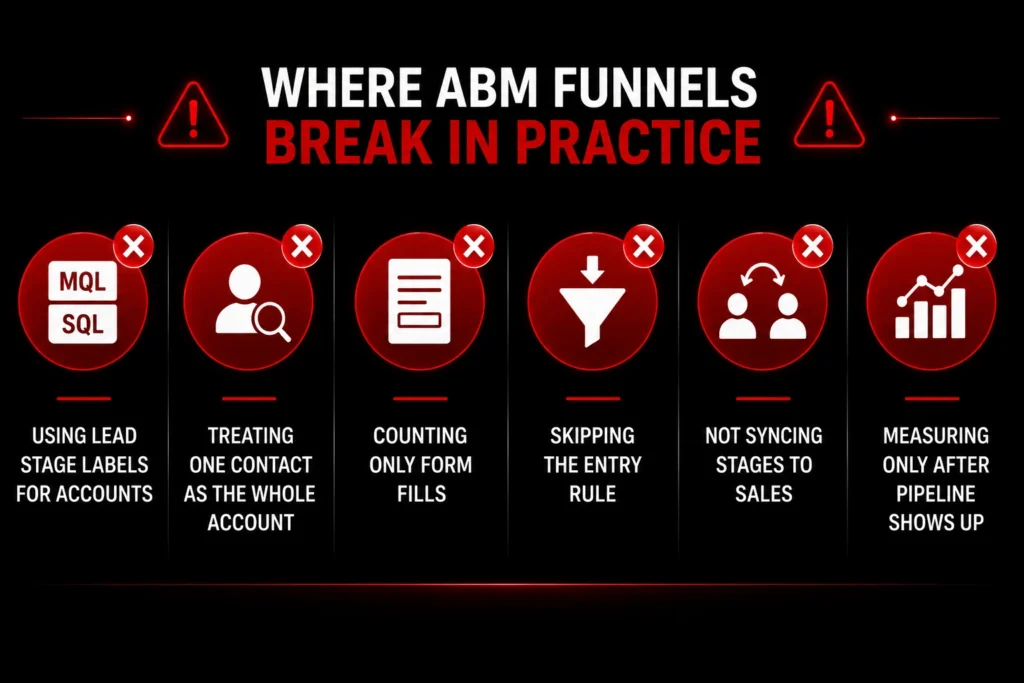
- Using lead-stage labels for accounts. MQL and SQL describe a person crossing a score threshold. They don’t describe a buying committee. Borrowing those labels for an account funnel is where the confusion usually starts. If you need the contrast, the difference between an MQL and SQL is entirely about individual leads, a different unit than what an ABM funnel tracks.
- Treating one contact as the whole account. A single reply from one person isn’t account engagement. It’s one person replying. Don’t let a stage move on the strength of one relationship.
- Counting only form fills. Most of what happens in an ABM funnel never touches a form. Ad impressions and content views are the earliest signals you’ll get, and ignoring them means you’re blind until an account is already halfway convinced.
- Skipping the entry rule. Covered above, and worth repeating because it’s the single most common failure. No threshold means no funnel.
- Not syncing stages to whatever sales uses day to day. A stage marketing can see and sales can’t is a stage that doesn’t function.
- Measuring the funnel only after pipeline shows up. By the time pipeline appears, the early mistakes already happened and there’s nothing left to fix. Watch the leading stages, not just the outcome.
Is “Funnel” Even the Right Word?
Buying committees don’t move through five neat stages in order. A CFO can be deep into evaluation while a procurement lead has barely heard of you. The account isn’t in one stage. Parts of it are in three stages at once.
So “funnel” is a simplification, and every team using one knows it. The honest answer is that the stages aren’t a physical path an account walks. They’re a shared language your team uses to agree on where an account stands right now, so marketing, sales, and customer success are arguing about the same thing instead of three different things. The map isn’t the territory, but a bad map is worse than no map, and a funnel with clear rules beats no framework at all.
The Bottom Line
An ABM funnel isn’t a fancier diagram. It’s a discipline: pick your accounts first, then build a path with real rules for what counts as movement at every stage.
Five stages carry the structure, Identify, Map, Engage, Convert, Expand, but the structure only works if each one has an entry rule, content, a sales action, and a metric attached. Skip that and you’ve drawn a nice picture that tells you nothing.
Write the rules down. Sync the stages to wherever sales actually works. Watch the leading numbers, not just the pipeline that shows up at the end. That’s what separates a funnel from a guess with good branding.
Frequently Asked Questions
What is an ABM funnel?
An ABM funnel is a framework for tracking how target accounts move from a selected list toward a closed deal and beyond, based on the collective behavior of a buying committee rather than a single lead’s journey. It flips the traditional wide-to-narrow funnel shape because the account list is already narrow at the start.
What are the stages of an ABM funnel?
The core stages are Identify, Map, Engage, Convert, and Expand. Identify builds the target account list. Map finds the buying committee inside each account. Engage runs personalized multi-channel outreach. Convert is where sales leads a coordinated close. Expand covers onboarding, retention, and growth after the deal.
How is an ABM funnel different from a traditional sales funnel?
A traditional funnel starts with a broad audience and narrows through awareness, consideration, and decision. An ABM funnel starts with a small, pre-selected list of accounts and tracks how deeply that list engages, using account-level signals from a whole buying committee instead of individual lead scores.
What metrics matter most in an ABM funnel?
Account coverage, buying committee reach, account engagement score, stage conversion rate, velocity between stages, and expansion revenue after close. Raw lead counts and form fills alone miss most of what actually happens in an account-based funnel.
Why do ABM funnels fail?
Most failures come from copying lead-funnel habits onto an account-based motion: using MQL and SQL labels that describe individuals, letting one contact’s activity stand in for the whole account, counting only form fills, and skipping the entry rules that would otherwise give each stage a clear, defensible threshold.
Do I need special software to build an ABM funnel?
No, though the right ABM platform helps once you scale past a handful of accounts. What actually matters is agreeing on entry rules, content, sales actions, and metrics for each stage, and making sure sales can see stage changes in whatever system they already use. The framework matters more than the tool running it.